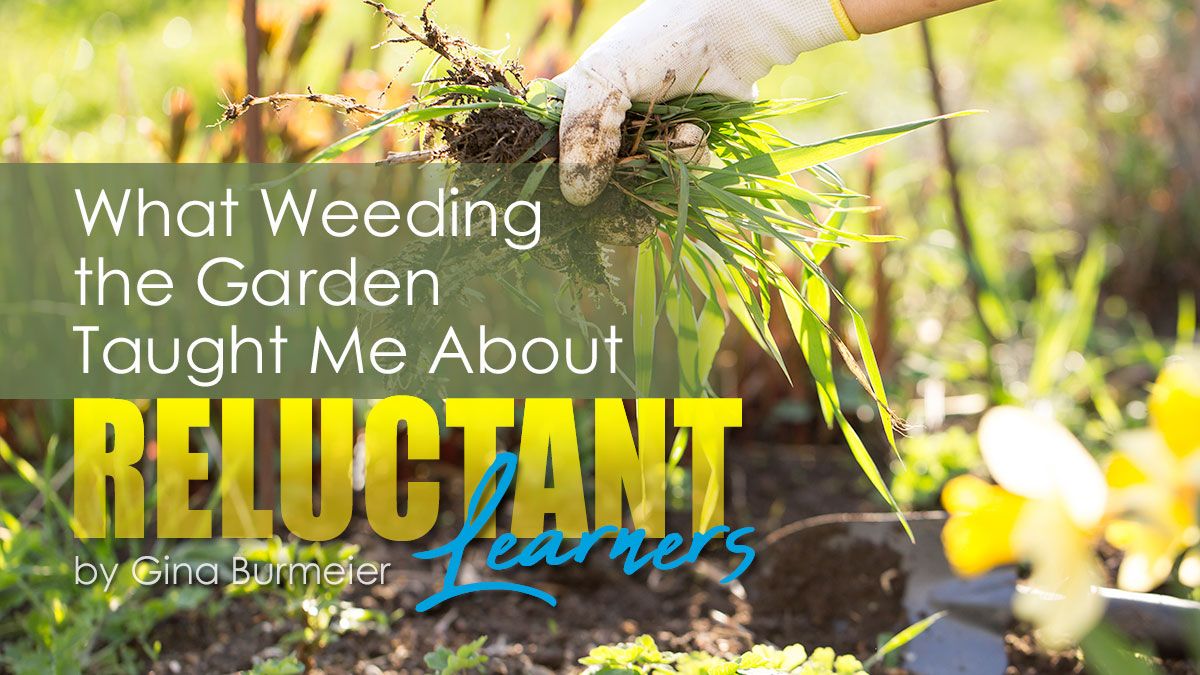
Pulling weeds isn’t the most exciting part of gardening, but it always brings me satisfaction. Some weeds come right out while others are stubborn and need a little extra pulling, often with a garden tool. When it has been hot and dry, I might even spray a little water first to make it easier. After weeding, I love admiring my beautiful flowers or hearty vegetable garden. As I relate this to learning, homeschooling has taught me that reluctant learners are like those beautiful flowers and garden plants. Oftentimes they just need the weeds pulled away to blossom and grow.
Well, finding those weeds isn’t always obvious. It could just be your child is easily distracted and needs more time to mature. Other times it might be more difficult to identify—like a vision, hearing, or processing issue. Some weeds are emotional: fear of failure, perfectionism, anxiety, or comparing themselves to siblings. And there are also environmental weeds: overscheduled days, constant interruptions, not the ideal learning space, or a curriculum that doesn’t fit your child’s learning style. Sometimes they’ve fallen behind in a foundational skill, making every lesson feel frustrating.
The beautiful thing about gardening is that we don’t pull the plant when it struggles—we pull the weeds. What is making learning harder than it needs to be? What frustration keeps showing up? Is there a gap you need to revisit? Does your child need a different learning environment? Do you need to supplement a curriculum or perhaps start at a different level?
From my personal experience, sometimes it took me a while to identify the weeds. When we got off schedule, I realized I needed to get the consistency back. When my daughter was taking hours to finish her math, I realized she just needed to be in a room with another person. When my son was having trouble with letters and sounds, I finally understood he needed more hands-on activities. When my child couldn’t pay attention, we built in activity breaks. When we struggled with fractions, we practiced baking. We made up songs for math facts. We took outdoor breaks. And sometimes I just needed to wait a little longer to introduce a skill or take things a little slower.
Removing weeds is rarely a one-time task. Gardens require regular attention because weeds have a way of returning. The same is true in homeschooling. As children grow, new challenges may appear. A strategy that worked at age seven may not fit at age twelve. Don’t fret; this isn’t a sign that you’re failing. It’s simply part of tending a growing garden.
One of the greatest gifts we can give our children is the freedom to grow without constant comparison. Every garden has plants that bloom at different times. Some burst into color early in the season, while others quietly develop deep roots before producing fruit. Both are growing, even when the progress looks different.
Reluctant learners often surprise us. Once the weeds are cleared away, they take more ownership in their learning and become more confident. Their natural curiosity begins to emerge again. They begin to ask questions and make connections. Growth was always there—it just needed room.
As homeschool parents, our role isn’t to force the flowers to bloom. It’s to faithfully tend the garden, patiently finding what helps our children flourish. The harvest comes in its own season.