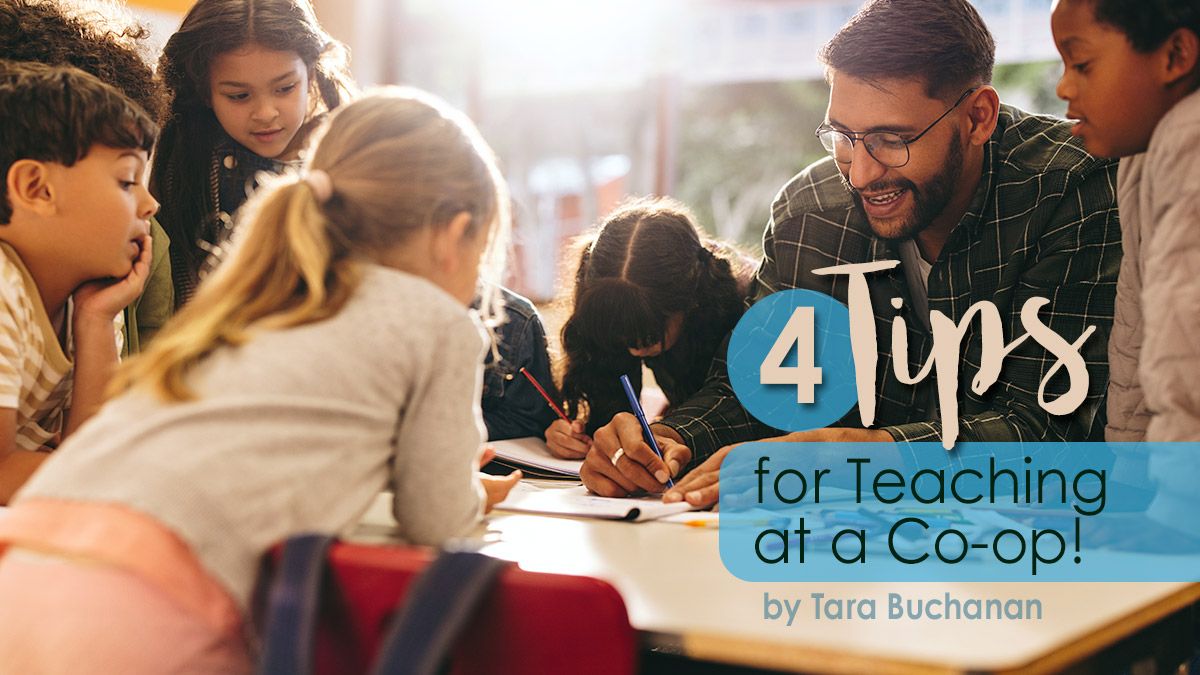
Besides being home educators, many parents also join homeschool co-ops and have to teach in a classroom. And if you haven’t had much experience as a teacher, it can be overwhelming to suddenly be in charge of a roomful of students! So how do you begin when you’ve been assigned to teach a co-op class and you feel unprepared for the task? Every co-op has their own personality and variables to consider as you prepare!
1. Become familiar with the subject and curriculum
There’s no substitute for doing your homework! As you work through what you’re asking your students to do, you will better understand your students’ experience. Hopefully, you’ve been given adequate time to prepare! If your co-op has chosen to use a specific curriculum, get your hands on those materials as soon as possible. Look through the table of contents, read through as much as you can, and get the general flow of the curriculum.
Realistically, you may not be able to master the whole year’s materials before the year begins, especially if you’re teaching older students! Spending time outside of class to stay ahead of your students will be a worthwhile investment. As you read, study, and prepare, you will better understand your students’ experience with the curriculum. Practice activities ahead of time. Do some of the homework you’re asking your students to do. Chances are, if something confuses you, it will confuse your students!
In many co-ops, teachers can choose the curriculum that will be used. Maybe you’re teaching a class of hands-on science activities, or one where you’re doing various art projects. Give one of our consultants a call and we’d love to help you find materials that will work best for your specific situation.
2. Plan out the big picture
How much of the text do you need to work through? Ideally, your co-op director should be able to clarify for you the amount of content and homework that you need to cover. Co-ops typically can’t complete a traditional 36-week curriculum since they meet less often. Look at what you’re expected to do and decide how to space it out over the year.
Sometimes it’s as easy as scheduling a chapter each week, but many times there are other factors to consider. Lessons that need to be done outdoors or how the lesson topic aligns with the calendar can be considered. Or there may be lessons you need to skip altogether. Once you decide what topics/chapters will be covered which weeks, then it’s a matter of deciding how exactly to teach those topics!
3. Decide how you will spend class time
Often the first thing to decide is whether class time will be used to teach a lesson or review a lesson. Will you first present information and have students do the assignments at home? Or will the students read the lesson content at home, while class time is used for reviewing concepts? Or maybe your class will be self-contained and students will not have any related work at home.
No one co-op is the same, so almost all curricula will have to be adapted in some way to fit your specific situation! This might be the tricky part—but it’s also the fun part! How do I keep a group of kids engaged and learning for fifty minutes? What part of this program is best suited for a group situation?
You will likely split your class time between different types of activities: teacher-led (traditional instruction or presentation), independent student activity (completing a worksheet, project, or quiz), and group activities (students doing activities or games together). A good class usually has a nice balance of the three, depending on the subject area and age of the students.
Teacher-Led/Presentation
Some programs will give you a lot of support in this area in their teacher materials. Either way, have notes or an outline that you can refer to. If you have a blackboard or whiteboard available, use it! It doesn’t just help your students to learn better, but also helps you as teacher to stay on track.
Part of the teacher instruction is also facilitating a Class Discussion. Having a variety of questions and discussion topics prepared will help increase understanding. In every classroom are those students who raise their hand at every question and those students that may never raise their hand all year. Asking different levels of questions will give every student a chance to answer. Discussions will get better as the year goes on, as you get to know your students’ personalities better.
Even better than the teacher presenting is allowing your students to share what they have learned or done. Give students a chance to stand up in front of class and practice their public speaking. That can be a great incentive to prepare, knowing a classroom of eyes will be on you. Some kids will certainly be more comfortable with this than others, but all students will improve with more practice.
Group Activities
Many times your curriculum will determine the group activities because the book has already laid it out for you. But you also might need to think of your own! It may take time to develop activities and games that you enjoy doing in your classroom.
Many teachers like to incorporate games like Trashketball, Around the World, and Pictionary. Or you can even design your own Jeopardy Game! (If you have a screen in your class, this online version is super easy to use!) And if you are teaching teens who have devices, a digital game like Kahoot is a fun way to review concepts!
4. Prepare for classroom management
Learning to manage a classroom and keep kids engaged is a skill that takes time to learn. Give yourself some grace! As any teacher can tell you, classroom management is always half the battle. And we all learned a key lesson in the classic book Miss Nelson is Missing! It’s best to start your year out with more structure and high expectations and gradually add in more “fun” than the reverse scenario. Students will rise to the occasion when clear expectations and encouragement are provided.
Just like homeschooling, you will learn through trial and error. And never be afraid to ask for help. Talk to other seasoned teachers about how they keep kids on task or how to deal with a disruptive student. And definitely follow any disciplinary policies your co-op has already set for you.
Incentives can help encourage good behavior, too! Offering stickers, points, or prizes can help motivate students to put in their best effort. Often those small rewards can go a long way. But be sure to make your system easy to implement so it doesn’t take all your energy!
The most important characteristic of a good teacher is caring deeply about your students and subject area
When students know you care, and that you are putting effort into your class, they are more likely to put in the effort as well. Use your co-op’s communication channels to communicate clearly and often about classroom expectations. And of course, all students need encouragement. When they succeed, offer praise! When they are not understanding, be willing to explain again without looking disappointed or frustrated.
Your enthusiasm and knowledge about the topic you are teaching are also essential. Good teachers are known to make a subject “come alive”! Your ability to communicate that this topic is interesting and relevant can make up for your shortcomings in other areas. Your positive attitude will be contagious! And at the end of the year, you may be surprised at how much you learned along the way!
Do you need more one-on-one help in preparing to teach at co-op? Call one of our consultants and we’d love to chat with you!