
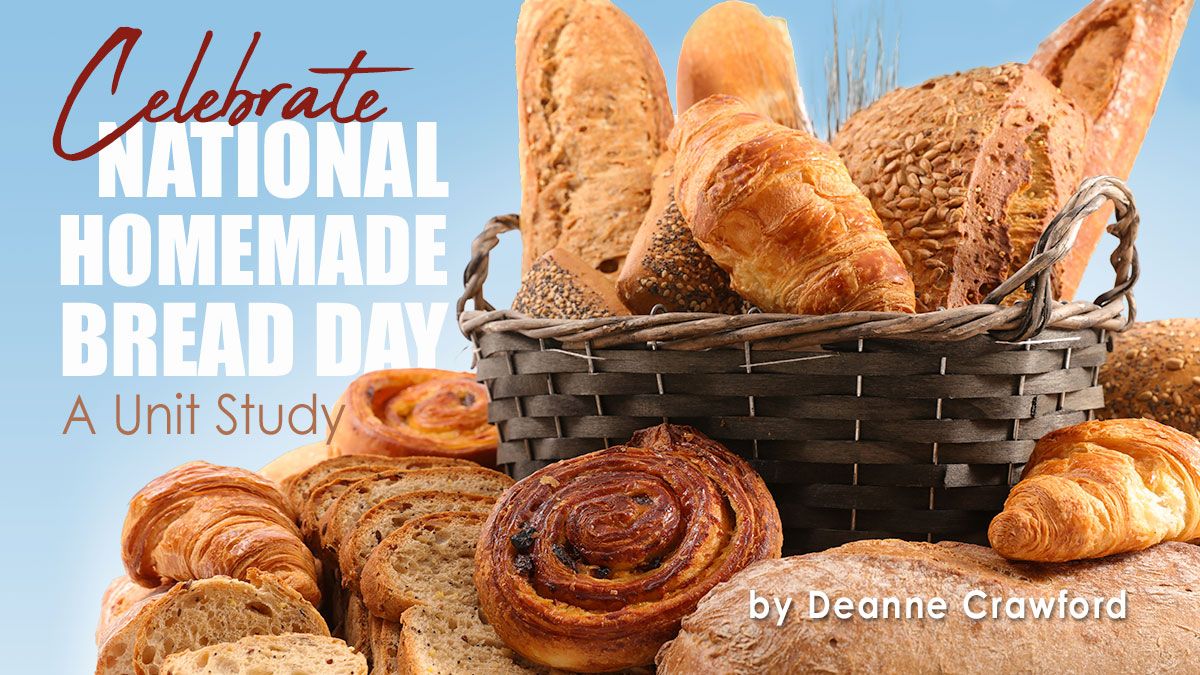
Imagine for a moment the scent of bread baking in the oven. As it wafts through the air, your stomach rumbles a little, and in your mind’s eye, little sticks of butter dance freely.
I hope that this simple exercise sends you eagerly seeking a tried-and-true recipe to fix for your family. That is, unless, your only experience with “fresh” baked bread is the aroma of commercially baked bread! Regardless of which experience describes you, I invite you and your children to celebrate National Homemade Bread Day as we look at the history and science of bread. Along the way, we will look at bread idioms and take the time to bake bread! Throughout this study, you will see hyperlinks to various websites to learn more about the topic. At the time of this writing, the links have been verified as informative and family friendly. If any issues are noted with a link, please contact me at dcrawford@rainbowresource.com.
Bread has been a staple in humanity’s diet for centuries, in fact, many historians feel that the history of bread is closely connected to the history of the world. Ask children what they think this means. Older children may be able to share instances where bread is referenced in their history lessons. If your children are younger, use this opportunity to talk about how bread has changed over the passage of time. For example, if you are studying American history, survival bread (also known as hardtack) was commonly used during the American Revolution and the American Civil War. Interestingly, no one knows when survival bread (hardtack) was first eaten, but it is known to have been a “marching ration” in Ancient Rome. Watch this overview of From Pharaohs to Foodies. Discuss with children the following: Who discovered fermentation. How did bread change through the Ancient Greek and Ancient Roman cultures? The video talks about bread becoming a sign of political power and religious belief. Talk about what this means. You can also read more about the Biblical significance of bread and The Significance of Bread in the Bible, which succinctly connects Old Testament and New Testament bread. This is also a great time to introduce the story of Pompeii and the discovery of 2,000-year-old bread. The British Museum has also recreated the Pompeii Bread Recipe, which makes a great hands-on activity!
Let’s bring our study of bread history back stateside. Folklore says that Christopher Columbus brought sourdough to the New World in the late 1400’s, while many records indicate that the first wheat was planted in Massachusetts in 1602 by Bartholomew Gosnold. Before colonization, native peoples made different types of flatbreads which depended on what ingredients were available. Maize (commonly called Corn) was the primary ingredient for making breads. Women would finely grind the maize and mix it with water to make dough. It was then baked or cooked on hot flat stones or griddles. If maize was unavailable, acorns or different seeds would be ground into a fine flour, then mixed with water to be cooked or baked. Try this easy, delicious American Cornbread Recipe from Compass Classroom. You may also have heard of Fry Bread. The history of Fry Bread tragically dates to the 1860s when the government relocated Indigenous people onto reservations. Watch this overview from Discover America. There is a lot more to this story than we have space to include. If this is a topic that you would like to explore with your children, be sure to check out DK Super History Trail of Tears, Encyclopedia of American Indian History and Culture, or the Native Americans Make History series. The Industrial Revolution also changed America in countless other ways and even had an impact on bread. As the workforce grew, many families no longer had the time available to make bread. Not only that, but machines were also invented that could turn the wheat into flour in large batches. Learn more about the history of flour milling from the Great British Chefs Baking through the Ages (older students) or How Flour is Made. As flour became more readily available, buying bread rather than baking it became the norm, which led to a fun invention–the bread slicer!
Have you heard the saying “The best thing since sliced bread”? While often used to compare new ideas and inventions, at the heart of this saying is Otto Frederick Rohwedder, the inventor of the bread slicing machine. Ask children: Why the invention of the bread slicing machine was important? As a follow up, ask them if they feel it is still important today, why or why not? The Chillicothe Bread Making Company was the first firm to make and sell sliced bread. Learn more from History Pod. Have children find Chillicothe, Missouri on a map. Sliced bread became common place (and much appreciated) in households across the U.S., that is until 1943 when pre-sliced bread was banned by the government! Learn more about this ban from Today I Learned.
Interestingly, over the years, machine ground wheat and machine bread baking fell out of favor and many families have now returned to baking bread at home. Some even have found joy in grinding their own wheat berries. For those unable to make bread at home, small local bakeries have stepped in to help by selling bread loaves that have been made by hand in small batches. There is so much more to learn about the fascinating history of bread! For families who like to go deeper, be sure to check out Food Theory’s History of the Entire World According to Bread.
There is a lot of science we can learn from baking bread. Take a moment and watch the History and Chemistry of Bread. Read The Chemistry of Bread Baking together. Print the helpful infographic for your children. Using the article and infographic, ask children the following: What four ingredients are used to bake bread? What is the most important part of flour that is needed for baking bread? Kneading helps prepare the flours in protein for rising. What is needed to support the process of rising?
Take a few minutes to learn more about yeast.
Now, let’s have fun with yeast! Choose one of the following experiments to do with your children: Blow Up A Balloon with Yeast or Scholastic’s Yeast Experiment. Red Star Yeast is also a great resource for experiments. If you prefer the taste of sourdough, be sure to check out the Science of Sourdough lesson plans!
These are fairly common experiments, if you have already done them with your children, take a few minutes to introduce the science of bread mold and do a bread mold experiment or check out the EPA’s version where students learn more about the health effects of mold. There is even a time lapse bagel and mold video if you are a bit more squeamish.
Bread has been an integral part of culture since the very beginning of humankind. We have previously learned a lot concerning bread’s importance throughout history. But bread has truly been immortalized through stories like The Little Red Hen (check out lessons for K-2 from the National Agriculture in the Classroom here). If your family is like mine and watches It’s A Wonderful Life every Christmas, do you remember Mary’s housewarming gifts to Mrs. Martini? Handing a loaf of bread to Mrs. Martini, she says, “Bread, that this house may never know hunger.” This is closely related to the many idioms that use the word bread, like “This job is my bread and butter.” or that “He is the breadwinner in their family.” Ask children to explain what these idioms mean. Can they think of other “bread” idioms or expressions? World English Academy’s list can help get you started.
And now the moment you have been waiting for–let’s make some bread. Hundreds of recipes are available online with just a click of your mouse. And that is certainly an option. But this may be the perfect time to pull out grandma’s tattered cookbook and bake a treasured recipe from years gone by. Don’t have grandma’s recipe? Check out the King Arthur Baking Company’s website for the Easiest Loaf of Bread You’ll Ever Bake, Easy Everyday Sourdough, and the Easy Gluten Free Bread recipes. They have hundreds of options available, so feel free to explore one that is a better fit for your family! The Busy Toddler website’s Bread in A Bag is a great option for families with younger children. Quick breads are also a great option for families with younger children or for those just a bit short on time! No matter the recipe selected, take time to break bread together in celebration of National Homemade Bread Day!
I would love for you to share your favorite recipe in the comment section on our blog (needs link to the Unit Study) or by emailing me at dcrawford@rainbowresource.com.