Spanning nearly 2,500 miles through 8 states, America’s iconic Route 66 tells a story of a nation built on dreams, innovation, and hard work. Celebrating the 100th anniversary of Route 66, I invite you and your children to travel along the Main Street of America with me. Parents, please note, the underlined words are embedded links to other websites to learn more. At the time of writing, links were checked for accuracy and appropriateness. However, parents may wish to supervise all online activities, as the websites are not managed by Rainbow Resource Center and may change.
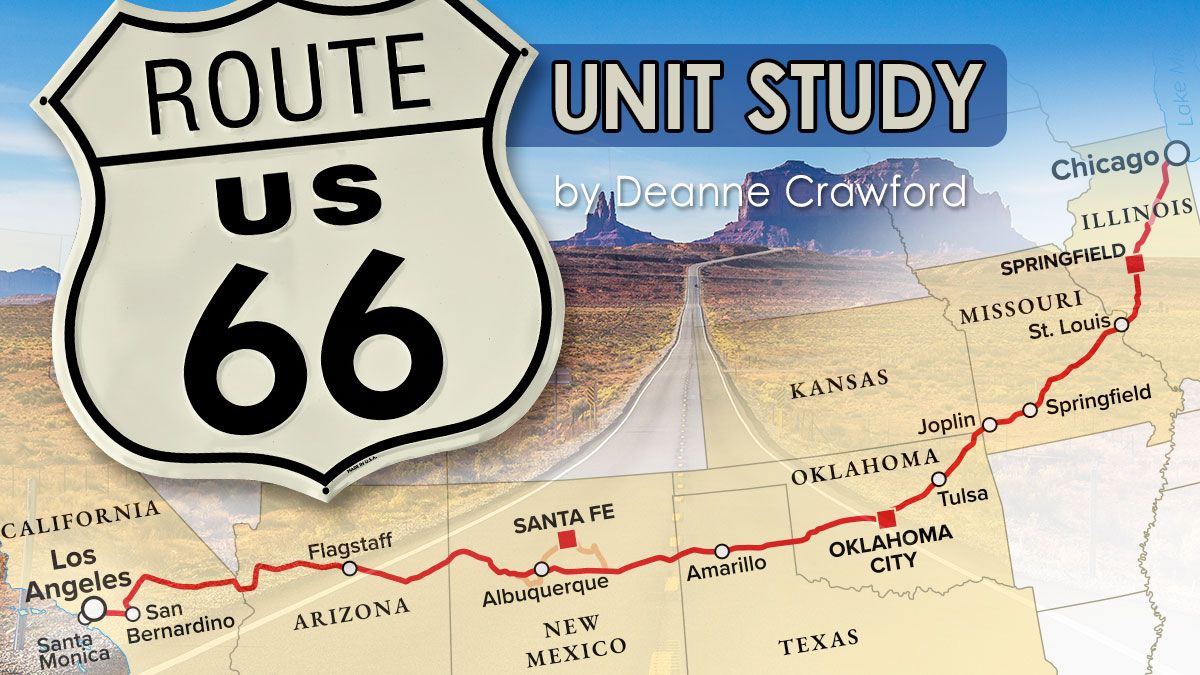
Our story begins with the Model T Ford. Henry Ford’s dream of an affordable vehicle for every American inspired others to dream of ways to make life better in the early 1900s. One man, Cyrus Avery, envisioned an easy-to-travel road system that would connect the agricultural and mining communities to the booming west coast. He was ambitious and came up with the idea of a diagonal route that would go across 8 states: Illinois, Missouri, Kansas, Oklahoma, Texas, New Mexico, Arizona, and California. But it took fortitude to overcome the obstacles to make his vision come true. The plan for Route 66 included using local roads that were already made. But this was a huge challenge! When Route 66 was first imagined, less than 800 miles of the road were paved, and the rest was a mix of dirt (or mud), rock, brick, and even wood planks. And not only was the planned road a weird mix of materials, each state, and even different towns, had built roadways in different widths.
Take a few minutes and go outdoors and build a pathway (road) across your yard. Lay some brick or large stones (if available) or cardboard. Use whatever “building materials” you have lying around. As you lay a path, leave a few areas with just dirt and don’t make it straight—add curves. Now try to ride your bike (or walk) on the “road”. How hard is it? If you don’t have an outside area, try recreating a road using racetrack toys or “build” it with pillows and blankets. Parents, the idea is for children to understand how roads were different a century ago compared to the interstates and paved highways we travel today.
Finishing the road took 12 years of heavy manual labor that relied on thousands of workers, construction crews, and welders. Shovels, wheelbarrows, hand-mixed concrete, and young, strong men became the machinery of the time. Thankfully, by the time the road was finished in 1938, early 20th-century machinery had been invented and was used, like horse-drawn graders, steam shovels, and steam rollers. For a fascinating look at the challenges faced by Route 66 in Oklahoma, watch PBS Learning’s Back in Time Route 66. You may also be interested in watching a fascinating AI recreation of Route 66, that while filled with interesting tidbits does have some telltale signs of AI-generated content. Encourage children to point out things that don’t seem real. This is also a great opportunity to teach children how to spot AI-generated content!
But our history of route 66 is just getting started. Ask children if they can think of any significant events that occurred during the creation of Route 66 (1926–1938). They may mention the Roaring Twenties, the Great Depression, and the Dust Bowl. The Great Depression and the Dust Bowl were terrible times for Americans. But this hardship had a silver lining for Route 66. As part of the government’s push to create jobs in every state, more men worked on the construction, and the road was continuously paved in 1938. The road’s completion spurred westward travel, first for families escaping the Dust Bowl and second as a travel route for World War II soldiers and equipment. Older students may be interested in reading more about Route 66 and World War II at the National Historic Route 66 Federation. Once the war ended, travel had become more commonplace, and men were eager to share the open road with their families. Route 66 experienced immense growth during the 1950s-1960s. It was during this time that the iconic diners, hotels, and gas stations were built and used by traveling families. Check out the real-life Route 66 locations that inspired the Pixar Cars movie! If your children aren’t familiar with this classic 2006 movie, be sure to add it to your movie night list. Older children may also be interested in this AI virtual road trip on Route 66! Be sure to use the time dial to go back in time to see how the towns looked in the past.
See if you can find Route 66 on a map or atlas. Even though Route 66 is no longer an official highway, parts of the highway may still be identified. Look at the National Park Service map of Route 66. If you were to guess what state had the most miles of Route 66, what would be your answer? (New Mexico) What about the fewest miles? (Kansas) Use graph paper to create a bar graph showing the miles of Route 66 in each state: Illinois—301 miles; Missouri—317 miles; Kansas—13 miles; Oklahoma—432 miles; Texas—186 miles; New Mexico—487 miles; Arizona—400 miles; California—315 miles.
Earlier I briefly mentioned the iconic diners, motels, and gas stations. If you watched the video of the real-life Route 66 locations that inspired the movie Cars, many of them were highlighted. A new style of architecture was born during this time. Constructed with a space age theme, Googie Architecture, as it was called, had sharp angles, bright neon colors, and lots of windows. Even the first McDonald’s fast-food restaurant was built in this style—from the glowing golden arches to the abundant windows that highlighted their Speedee service. Watch this fun clip from the Founder that shows how the Speedee Service System worked! Explore other Googie Google images. What stands out to you? If you are interested in learning more about this style of architecture, visit Architecture 101 (older children and parents) or see the introduction to Googie at the Houston Children’s Museum Educator Moment that encourages recreating Googie architecture with LEGO® building blocks. Sadly, many of the original Googie-style buildings have been demolished.
One could almost say Route 66 was too successful. Travel became popular for families, and more companies used 18-wheel trucks to transport goods on the route. Sections were narrow and at times allowed only one vehicle to pass. Sections of the road also began to fall apart. People, and even our government, began to push for divided highways or 4-lane highways. It was during this time that President Eisenhower passed the Federal Aid Highway Act of 1956. Inspired by the German Autobahn, President Eisenhower pushed for a nationwide road system that could be used for safer, faster travel. Thanks to his vision, today we have nearly 49,000 miles of roadways across the United States. While this was a major accomplishment, it also meant that Route 66 was no longer needed. However, most of the states that Route 66 crossed created historic Route 66 associations to preserve its historical value. On June 27th, 1985, Route 66 was officially decertified, which means it is no longer a public roadway. The National Museum of American History has a fascinating look at the interstate development and impact.
As we celebrate 100 years of Route 66, it is important to remember that this road is so much more than empty diners and restored gas stations. In fact, it is my hope that learning a bit of her history has inspired your family to find a few hours to explore a stretch of the road. If you live in a state that Route 66 crosses through, I encourage you to check with your state for a free Route 66 Passport book that is filled with historic places to visit and get your passport stamped.
In the spirit of family adventure, I put together a list of my top exciting family-friendly places to visit. I would love for you to share your family’s favorite place(s) in the comment section!
- Illinois: Abraham Lincoln Museum and Funks Grove Maple Sirup (check out their process here). Atlanta is a little town filled with fun things to see, and my husband’s favorite was Route 66 Arcade Museum! You can also visit Cahokia Mounds (parents, click the Educate tab for teaching resources).
- Missouri: Gateway Arch (or the free museum under the arch), Meramac Caverns, and the Springfield Museum on the Square. Check out my previous unit study on the Hubble Telescope that was written after visiting a replica in Marshfield.
- Kansas: Cars on the Route, Galena Mining Museum, and the Baxter Springs Heritage Center.
- Oklahoma: the Blue Whale of Catoosa, the Oklahoma City National Memorial Museum (middle school and older), and the Stafford Air and Space Museum.
- Texas: Devil’s Rope Museum, Tower Station and U-Drop Inn, Cadillac Ranch, and Palo Duro Canyon State Park.
- New Mexico: Mesalands Community College Dinosaur Museum, Old Town Albuquerque, and Rio Grande Nature Center (a short drive off Route 66).
- Arizona: Bearizona, Meteor Crater, Grand Canyon Railway, and Oatman Wild Burros.
- California: Amboy Crater, Wigwam Motel (makes for an unforgettable overnight stay!) and Santa Monica Pier (end of Route).
Friends, I hope you enjoyed this journey through history! Experiencing Route 66 is an adventure for all ages. Best of all, it reminds us to slow down our pace, to enjoy time together as a family, and to create shared memories as we explore new places.
Happy Traveling!