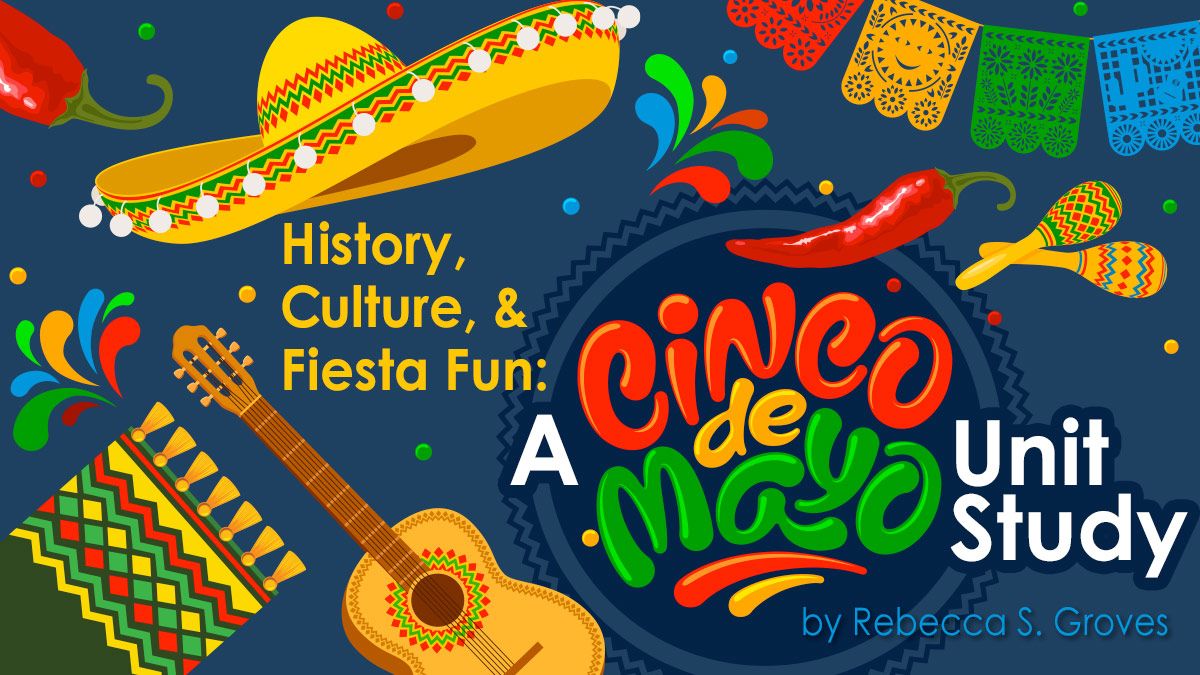
The beginning of May brings many bright colors, new life springing forth, birds chirping merrily, and exuberant Mariachi music! Wait, what!? On the fifth of every May, many Mexicans celebrate the commemoration of the Battle of Puebla. This holiday is conveniently called Cinco de Mayo (5th of May). This unit study explores the culture, history, traditions, language, and more surrounding this festive holiday! Make sure you have plenty of tortillas, a few sombreros, and a good internet connection. As we dive into the historic holiday together, enjoy the many links provided that will take you to videos, activities, and further information. (Please note: The links have been reviewed for family-friendly content, but parents should always supervise children’s online activity. Also, links are subject to change as RRC does not manage these external sites.)
This festive holiday is often confused with Mexico’s Independence Day; however, that occurred on September 16th, 1810, ending the 300 years of Spanish rule. Cinco de Mayo celebrates an against-the-odds battle fought against the French in 1862. While Mexico was independent from foreign rule at the time, the decision of President Benito Pablo Juárez García to default on debt payments to many European governments caused an unwelcome visit. In response to the president’s decision, France, Britain, and Spain sent naval ships to the Bay of Veracruz. Print off this geopolitical map and locate the Bay of Veracruz and draw three naval ships to symbolize France, Britain, and Spain. Maybe even use the countries’ flag colors to distinguish each ship. Now locate Puebla de Zaragoza and place a star there. Is Puebla along the coast or is it located inland? This area will become very important for our study.
Through peaceful negotiations, Britain and Spain withdrew their forces and returned home. Draw arrows from the British and Spain ships away from Veracruz. France, however, chose to use this opportunity to their advantage and take territory in Mexico through force. Draw an arrow from the French naval ship in the Bay of Veracruz inland to Puebla. Commanded ultimately by Emperor Napoleon III, forces struck Veracruz, pushing Juárez’s forces inland. Utilizing some of the biographical links provided, older students can write a brief report on either Napoleon III or on Benito Juárez. High school students can work on their speech and debate skills as they justify or condemn the actions of these individuals. For younger students, get cozy on the couch and read together an adapted history lesson from The Mystery of History on Cinco de Mayo and watch this brief ClickView history video.
The battle that ensued is a classic David and Goliath tale. The French army numbered over 6,000 troops and Juárez’s ragtag group numbered far fewer, around 2,000 men. Take some time in your day to jump into Scripture and read 1 Samuel 17, the story of David and Goliath. As a family, discuss how feeling like the little guy can change your confidence in the situation and pray together that you always remember the goodness of God in ALL situations to overcome, even when we feel so small. Depending on your children’s ages, engage with dedicated Bible resources about this Bible story. For preschool and elementary students, the VeggieTales Dave and Giant Pickle is a fun episode to explore, and go deeper into the story with an elementary lesson from Ministry Spark. For older elementary and junior high students, explore a dramatic retelling of 1 Samuel 17 and encourage kids to act out the story as they hear it. High school students (7th-12th grade) are ready to dig deeper into a lesson that highlights God’s salvation plan and David’s trust in God, and engages them in biblical exploration and hands-on learning. Eager high school students who are wanting to dig deeper into their studies can benefit from a 1 Samuel overview and a devotional reading on trusting God even in intense moments of life.
When the French desired to claim territory in Mexico, Puebla became a centralized point to obtain a holding in Central America. Puebla is home to two fortified citadels, Fort Loreto and Fort Guadalupe. These links will take you to the Local Museum website where you can see photos, read more information, and take a photograph tour of the sites. Draw two mountain peaks in Puebla on your map to signify the fortification of this city and state in Mexico. Not only is Puebla de Los Angeles the beautiful capital city of Puebla, Mexico, but, because of these fortified citadels, it was also a strategic military target. Making this area the ideal location for the French to attempt to claim not once, but twice. The second Battle of Puebla was not the success for Mexico that the 1862 battle was, which is why the symbolism of Cinco de Mayo was so important to the Mexican people early on. The 5th of May was a day of pride, freedom, and accomplishment. Cinco de Mayo is a day of remembering. The Battle of Puebla symbolized so much for the Mexican people, a well-fought battle to remember their heritage, and remember their culture as an independent country. Enjoy a modern-day video tour of Puebla!
The heritage, people, and culture are really what is celebrated each 5th of May. Not just in Mexico, but by Mexican people all around the world. Cinco-de Mouse-O is a wonderful book to read with our littlest learners with its bright colors, tantalizing food depictions, and folk dancing; enjoy this Cinco de Mayo Read Aloud from Kid Time Story Time. Our older students can explore the deeper thinking found through Picture Studies. By right-clicking on each image you can open the image in a new tab for undistracted viewing. (Parental Note: These are paintings of the Battle of Puebla scenes.)
Some great questions to ask while viewing these images are:
- Does this picture remind you of anything you have read or seen before?
- What is the story the artist is telling you?
- What is your favorite part and why?
- How does this picture make you feel?
- What emotions do the colors make you feel?
Cinco de Mayo celebrations have been highly advertised and documented since the first declaration of the national holiday on May 9, 1862, as the “Battle of Puebla Day” or the “Battle of Cinco de Mayo.” While the commemoration of the battle is no longer observed as a national holiday in Mexico, there are parades, dances, food, and celebrations all around the world happening on the 5th of May. High school students may find a picture study fun on the symbolism included in Cinco de Mayo posters from the Library of Congress collection. This may spark further research and discussion over color choices, what the bird and the snake represent, a note of locations of these celebrations, and more.
The best way to celebrate Cinco de Mayo is through appreciation and understanding of the rich Mexican culture the people fought for at the Battle of Puebla in 1862. Joining in song and dance is a way you can experience this festive celebration. Whistlefritz Carnaval is a fun repetitive song that is easy to learn and fun to sing. Lyrics are provided in both Spanish and English in the description. For more language study to catchy, rhythmic melodies, Rock ‘N Learn offers fun and easy simple words and phrases. Learn some common sayings and try working them into everyday conversations with your family throughout the day. Language is a great way to connect individuals with a new culture. Older students could take short passages from their favorite novel and translate them into Spanish, working to identify vocabulary words, parts of speech, and grammar usage. Maybe even try to memorize a short passage or poem! A close reading of the poem Cinco de Mayo by Luis J. Rodriguez for high school students can draw a reader into an experience through the power of words. Reflect on how the tone of the poem elicits emotion and how the author paints a narrative both historical and present. Read it aloud and see how the meaning and understanding may change with your own intonation.
Benito Juárez has a famous quote that is worth spending time sitting with: “Entre los individuos, como entre las Naciones, El respeto al derecho ajeno es la paz.” Translated: “Among individuals, as among nations, respect for the rights of others is peace.” This quote offers students a time to reflect on the message Juárez is communicating. Identify the parts of speech in both English and its translation; what Spanish words can you identify? Have students write this quote and their reflection in their journals.
A big part of the Cinco de Mayo celebration is found around the table enjoying food with family and friends. Tables can be simply set or brightly decorated with Papel Picado and Paper Flowers. Some supplies you will need for both crafts are scissors and lots of brightly colored tissue paper. The dazzling display of Papel Picado originated in Puebla, the center of our study. Here are some simple Papel Picado templates you can follow to create your own festive banners. A piñata can make a festive and useful centerpiece to your table and then become a fun after-lunch activity. Martha from Raise Curious Kids offers an EASY piñata tutorial that does not require any messy paper mache. Our table may be set and looking festive, but what is a party without any food!?
Try your hand at A Big Guac Problem! Elementary students do Part I, middle school students do Part I & Part II, and high school students do Part I, Part II, and Part III.
Part I: You are throwing a neighborhood block party to celebrate Cinco de Mayo in your community. Your mom has put you in charge of making the guacamole for the party. When you make guac for your family of 5, you use 3 avocados, 1 Roma tomato, and ½ a white onion. The RSVP list shows that 15 neighbors are coming! How many avocados, tomatoes, and onions do you need to get from the store?
Part II: Your mom has given you $20 to run to the store and get everything for your guacamole, including 1 lime. Don’t forget to round up (you can’t buy just half a vegetable). You are at the store—add up your cart and apply the 9% sales tax before you get to the checkout:
- Each avocado: $1.21
- Each tomato: $1.13
- Each onion: $1.07
- 1 Lime: $0.45
Do you have enough money to purchase your ingredients? Show your work.
Part III: As you are waiting in line to check out, your phone buzzes. Mom needs you to pick up another bag of candy for the piñata. You dash out of line and run to the candy aisle. The cheapest bag of candy you can find is $2.50. Do you have enough money for groceries and candy?
How did you do? Did you have enough guac for everyone at the block party? Was your piñata full or empty? (Parents, if you need assistance navigating this math problem, a few of our consultants have worked out the parts and can offer you a solutions guide for consultant Rebecca’s A Big Guac Problem. Just reach out via email and we will get this sent to you!)
Speaking of food for our Cinco de Mayo celebration, let’s return to Puebla, Mexico in the 17th century. The archbishop was visiting, so the nuns hurriedly combined Mexican pantry staples, and legend has it this is where the complex, bittersweet Mole originated from. Mole Poblano is a culinary and culturally iconic dish of Mexico. It can be as simple or as complex as you have time for, whether making your own chicken broth or using a store-bought box broth. One thing that is authentically Mexican (and gluten-free) is thickening this sauce with corn tortillas. Lazy Acres Natural Market offers a Kids Cooking Class: Homemade Tortillas. While your kids are guided step-by-step in making corn tortillas, parents, you can prepare the Puebla-originating Mole Poblano for dinner.
Maybe for your Cinco de Mayo Block Party you oversee bringing the guacamole you have already accounted for, chips, cheese quesadillas, and simple tacos. Tacos and quesadillas utilize tortillas as their vessel. Tortillas, especially corn tortillas, go through an awesome science process called nixtamalization. There is a fine membrane, or skin, that coats every corn kernel, and for a corn kernel to be ground into masa flour, that coating can’t be there. Nixtamalization is a chemical process where corn kernels are soaked in an alkaline solution to remove the outside layer. Science Meets Food offers an article on this ancient Science of Tortillas, or you can watch this video from the Science History Institute on The Ancient Chemistry Inside Your Taco. Learning about food sure does make me hungry, and I need a quick, easy, and relatively mess-free way to make tortillas for our block party. Not everyone is a lover of corn tortillas, and with a little flour and leavening agent, Tortilla in a Bag comes to the rescue!
In celebrating the culture and heritage that Cinco de Mayo is all about, we have covered the decorations and food. Another BIG part of Cinco de Mayo celebrations is the music! While you are sitting down enjoying your meal, play some traditional Mexican Mariachi Music in the background. Originating in the Jalisco region of Mexico, let’s locate and draw a musical note on our map for Jalisco. This style of music was played to mark special occasions and to accompany dancing! Mariachi bands were originally composed of primarily stringed instruments, but as European influence prevailed, trumpets were introduced to the ensembles, and the rhythm of the songs took on the familiar “mmm bop bop, mmm bop bop, mmm bop bop” of a polka or waltz.
Where there is music there will be dancing! The country of Mexico has many traditional dances that are all celebrated during Cinco de Mayo. Sometimes people celebrate and tell the story of Cinco de Mayo through dance itself. The Calpulli Mexican Dance Company produced an entire show that tells the story and showcases many traditional folk dances and costumes of Mexico. Mariachi music is a lively and energetic genre of music that encourages individuals to get up and dance. Join Kodomo Kids in learning some basic dance steps to some of Mexico’s traditional folk dances. Get up and grooving! Maybe even put on a performance of your newly acquired dance steps.
We have learned so much about Cinco de Mayo, Puebla, and Mexican heritage and culture! We may have explored a new language and even set up for a big fiesta with our family and friends. We have also learned so many new words that can be used for spelling or vocabulary: nixtamalization, Mariachi, victory, tortilla, battle, commemoration, Mexico, France, Spain, Britain, Napoleon, Puebla, territory, symbolic, parade, tradition, heritage. What other new words have you learned? Add them to your journal with the rest. Maybe even get creative and write a short story with your new knowledge—creative or factual, you choose!
I have had so much fun exploring the Latin American culture and specifically Mexican heritage with you! Cinco de Mayo is so much more than just the 5th of May. My hope is that in learning about Cinco de Mayo, you have a deeper appreciation for the people, culture, and heritage of Mexico and what this victory over France signified for the Mexican people all those years ago! This is such a small bite of the rich history Mexico has to offer. Was there a specific topic that got your student(s) excited and wanting to learn more? What rabbit trails did you explore? Did you host your own Cinco de Mayo fiesta!? In the comments, share with us your findings and explorations on Cinco de Mayo!
Bendiciones, y Adiós!