
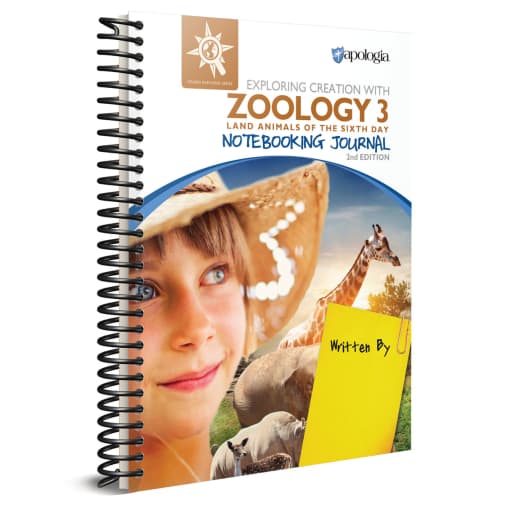
Spiral-bound and consumable, the Notebooking Journal is a wonderful resource to document your learning journey through the Exploring Creation with Zoology 3, 2nd edition Textbook. Included in this colorful resource is a two-day-per-week lesson schedule, parent guide, coloring and drawing pages, pages to record the Textbook activities and answer the What Do You Remember questions, personal reflection questions, vocabulary activity pages, “cut out” animals to create the Animal Atlas throughout the course, minibooks to cut and assemble, simple games to cut and play, and solutions to the notebooking activities. You will need numerous household items for the activities. Sold separately or in the Exploring Creation with Zoology 3 Advantage Set with the Textbook.
Exploring Creation with Zoology 3: Land Animals of the Sixth Day Notebooking Journal (2nd Edition)
Product Overview
- Companion notebook for the Exploring Creation with Zoology 3 2nd edition Textbook
- Optional, helpful resource that includes a suggested weekly schedule, parent guide, coloring and drawing pages, pages to record activities, and more
- Colorful consumable pages. Each student will need their own copy
Description
The Exploring Creation with Zoology 3: Land Animals of the Sixth Day Notebooking Journal pairs strategically with the textbook (sold separately). This notebooking journal will serve as your student’s individual notebook and the place for them to complete all of their assignments.
Keeping a scientific notebook has always been a standard scientific
practice. They will draw and record fascinating facts and information
learned during each lesson, complete the notebooking assignments on
specially designed templates, record experiments, activities, and
projects, complete vocabulary crossword puzzles, put together
beautifully designed miniature books, and more!
What’s Inside?
- A Suggested Schedule with a breakdown of exactly what students need to complete each week
- Templates for your student to record what he or she learned in each lesson, using both words and illustrations
- Note-taking pages with prompts to help teach the student how to identify and record important information from the text
- Creative templates for completing the notebooking assignments
- Project Pages and other sheets for your student to use to keep records of experiments, projects, and activities completed throughout the course
- Beautiful, full-color Miniature Books for your student to create, encouraging him or her to record facts and information learned in each lesson
- Helpful and engaging graphics to help your student visualize and understand concepts
- Scripture copywork in both cursive and print
Exploring Creation with Zoology 3 from Apologia is an elementary science course that takes students on a global journey to study land animals from a biblical worldview. Following the Genesis 1:30, it separates land animals into three categories—wild animals, livestock, and crawling creatures—while exploring their incredible diversity and God’s design.
The course combines clear explanations, vibrant illustrations, and hands-on activities to make zoology memorable and meaningful.
Key Curriculum Features:
- 14 lessons covering wild animals, livestock, crawling creatures, and their habitats
- Biblical worldview emphasizing God’s creative design and care for animals
- Hands-on activities using household or easy-to-find items
- “What Do You Remember?” comprehension questions for review
- Flexible pacing with lessons typically taking about 2 weeks each
Program Components:
- Student Textbook: Full-color hardcover text with lessons, explanations, activities, and supply lists
- Notebooking Journal (optional): Consumable journal for recording observations, drawings, and reflections (regular or Junior version available)
- Lab Kit (optional): Convenient package from Nature’s Workshop with most supplies needed for activities
Important Notes:
· 1st and 2nd editions are not compatible.
- No formal tests; learning is reinforced through activities and notebooking.
- Labs primarily use household or easy-to-find items; students will need a notebook or the Notebooking Journal to record their work.
Exploring Creation with Zoology 3 stands out for its beautiful presentation, hands-on approach, and clear biblical worldview that nurtures curiosity about God’s land creatures. It is an excellent choice for homeschool families seeking an engaging elementary zoology course that combines science and faith.
Browse all Exploring Creation with Zoology 3 resources and sets below!
| Product Format: | Paperback |
|---|---|
| Grades: | K-6 |
| Brand: | Apologia |
| Author: | Jeannie Fulbright |
| ISBN: | 9781960929211 |
| Length in Inches: | 10.8125 |
| Width in Inches: | 9.25 |
| Height in Inches: | 1.125 |
| Weight in Pounds: | 1.9 |