
Memoria Algebra II Set
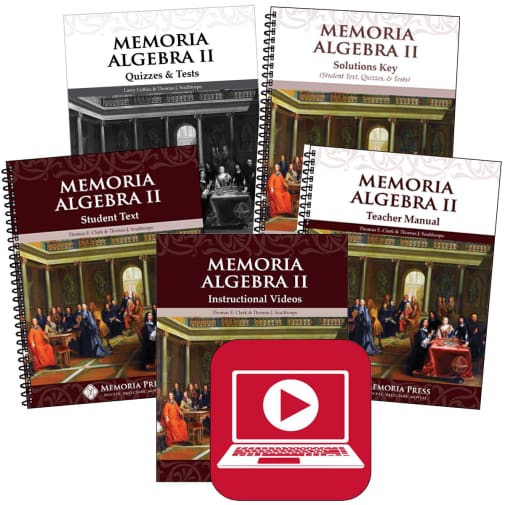
Product Overview
- Students should have completed Memoria Algebra I before attempting this course
- The first six weeks include review and evaluation to ensure students are ready for Algebra II
- Lesson notes in the teacher guide help parents teach new concepts and the instructional videos can be used as a helpful supplement
- Daily recitation exercises help students master definitions, theorems, and equations
Important
This package contains a non-returnable digital item.Description
- Exponents, Polynomials, Solving Equations, and the Cartesian Coordinate System
- Higher-Degree Relations – Quadratic Functions & Transformations
- Higher-Degree Relations—Quadratic Relations
- Higher Degree Relations – Polynomial Functions
- Variable-Degree Relations
The Memoria Algebra II Student Text and optional Instructional Videos guide students step-by-step through each lesson and provide abundant exercises for mastery. The Teacher Manual and Solutions Key also make the content accessible for those without advanced backgrounds in mathematics. The Quizzes & Tests include two versions of each assessment for practice and repeated attempts.
The transition from arithmetic to algebra is a challenging one, so determining student readiness is key. Your student should have mastered arithmetic facts—including operations with fractions, decimals, and percentages—in order to be ready to succeed in this course. Algebra represents a move away from mere fact retention and toward logical reasoning. Different students will be ready for that transition at different times. Your goal should be to ensure student readiness in the interest of all involved.
Memoria Algebra II is the third book in the Memoria Algebra series. This course builds on the conceptual and practical application in Memoria Pre-Algebra and the more complex problem-solving skills learned in Memoria Algebra I. Although problem solving is an important part of this course, the focus changes to graphing complex, higher-degree solution sets in the coordinate system. Following the classical methodology, responses to the recitation questions should be mastered to help solidify understanding of foundational concepts. The publisher recommends completing the Memoria Algebra sequence before geometry because algebra itself is cumulative and this series provides an easy transition to a geometry course.
There is no placement test for this course. Instead, the first six weeks serve as a Probatio Unit (a combination of review and evaluation). Students should aim to score an eighty percent or above on the test at the end of the Probatio Unit. Problem areas should be addressed before moving to Unit I. The four units in the course include: High-Degree Relations – Quadratic Functions and Transformations; Higher-Degree Relations – Quadratic Relations; Higher-Degree Relations – Polynomial Functions; and Variable-Degree Relations. Each day should follow a consistent routine: start with recitation exercises, go over any questions, teach the lesson, and do independent work. Some days do not have a new lesson, and students should work on recitation, do additional exercises from the previous lesson, or review. Components include Teacher Manual, Student Text, Solutions Key, Quizzes & Tests, Instructional Videos, and Lesson Plans. Course components can be purchased individually, or as a Set.
The spiral-bound Teacher Manual aligns with the material in the videos and is the primary instructional resource for the course. The teacher manual has reduced copies of the student text with instruction in the sidebars. Although not scripted, instructions are easy to follow. An answer key for the lesson exercises is also included within each lesson.
The non-consumable Student Text includes an objective for each lesson, review of important terms, example problems with solutions, and exercise problems. Sometimes a lesson is spread out over two days. The appendix includes the recitation schedule and an answer key to the odd problems.
Quizzes & Tests assess the student’s progress. Quizzes are given almost weekly and focus on material from each section of a unit. Tests are cumulative and given after each unit. A final exam is reserved for the end of the program. Each quiz and test has an “A” and “B” version so students can retake the “B” version if necessary or use for review. Pages are perforated for easy removal.
Complete detailed solutions to the student text exercises and quizzes & tests are included in the spiral-bound Solutions Key.
Instructional videos are a supplement to the course. Co-author, Thomas Sculthorpe presents the instruction in the streaming videos. They were recorded when he was teaching a class that met once a week at a classical school. Use these videos as needed to reinforce lesson content.
The Lesson Plans are very helpful in spacing out the 59 lessons in a logical format while incorporating review and scheduling in quizzes and tests. Lesson Plans include 34 weeks of instruction, five days a week. ~ Gina
| Product Format: | Product Bundle |
|---|---|
| Grades: | 9-10 |
| Brand: | Rainbow Resource Center |