I love hearing excited parents say, “My child is reading now!” Yes, celebrate! You’ve both worked hard to get to this point and now your child is reading silently (or “in secret” as my mother used to say). Thus far, you’ve been right beside your child, asking them questions, guiding them through the process and learning how to process the content. Now they’re “flying solo.” How do we know that they’re grasping what’s written? As the subject matter and the reading levels get more challenging, how do we verify that they’re understanding and retaining key content?
There are traditional ways to ensure your student is really understanding what they’re reading: purchase a literature guide, use reading and comprehension supplements. All good. But let’s talk about a technique you can use quickly, that accommodates multiple levels of learners and can be used with a variety of reading selections, genres, and interests. Perhaps you’ve heard of Charlotte Mason, a 19th century educator who had interesting approaches to learning. One method she developed, the Narration Technique, has multiple benefits for reading comprehension. This method can be applied no matter what curriculum you’re using. If you are reading to your children or they (yes, even your high school students) are reading to you, you’ve got a simple and effective way to help students engage in their reading and improve their reading comprehension.
What is Narration?
Narration helps your student process what they’ve been listening to or reading. When children are young, we use this kind of technique when reading picture books to our preschoolers. “Tell me what’s happening.” “What do you think will happen next?” “Why was the girl surprised?” “What is the bear doing?” “Which character would you like to be friends with?” You are asking questions that pull out the content you student has read. These questions draw out your child’s understanding, analysis, sequencing and predicting skills, and so much more. These questions lead to Narrations.
Narration is a way to tell what the reader understood. Simultaneously, it helps students practice reasoning skills, extrapolating from that understanding (like conclusions, inferences). Narrations model how to be inquisitive about what we are reading. Reading is fun! That fun is because we enjoy it but also because we’re learning things or we’ve gained something from that experience. Narrations help students verbalize what they’ve experienced in the story or whatever they’ve read. Narrations can also teach your child to be inquisitive about what others are reading. You’ve modeled asking good questions about reading; now they can too! They will start asking themselves and others the questions that you’ve been asking them.
Benefits of Oral Narration:
- Builds a child’s verbal fluency (and eventually, writing fluency) and vocabulary use
- Helps kids see positive consequences of reading (I read books and I know things)
- Applies logic skills like inferencing, summarizing, making conclusions, and more
- Preps kids for composition skills
Once a child is ready to write (upper elementary and higher), per your choice and direction, have your student handwrite answers. Initially, there’s no need to grade—just get the ideas down. What you’re looking for is whether your child understood what they’ve been reading.
Benefits of Written Narration:
- Develops a child’s writing fluency
- Practices summarizing
- Practices retelling events in correct order and using transition words (sequencing)
- Checks reading comprehension in a non-stressful way
- Promotes social/emotional learning
- Conversationally tests reading comprehension
Getting Started with Narration
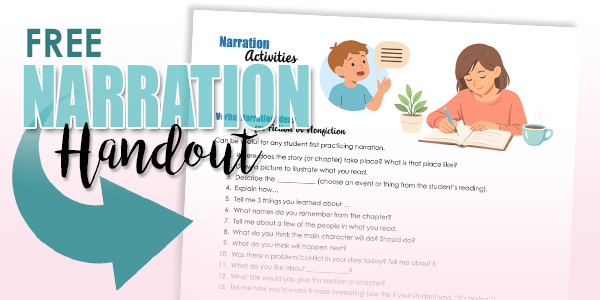
Start with oral narration: shorter questions first. As your student becomes more familiar with the process, work up to more detail-oriented or analytical questions that naturally require longer answers. Start with short, manageable book sections (a few paragraphs or a double page spread, etc.). Check out our printable handout for an easy list of “let’s do a narration” activities. Add your own. With a little prep, you can have narration questions ready at a moment’s notice. Try writing questions and label them One through Six. Students can roll a dice to see what question they’ll answer. Use these six questions repeatedly to help students gain confidence and then you can add more questions. You could write out several narration questions on index cards (one per card); create a stack. After reading, your child can pick one to talk about. Again, this is a short task.
You can use narration techniques no matter what your reading program or book genre. If you read a book together as a family, try using some of these suggested narration questions as conversation starters. If you’re reading a book on your own, take the opportunity to model narrations to your children. After your student has practiced some oral narrations, you can write down what they say. Eventually, students can transition to writing down their own narrations (from about 4th grade on). This task sneaks in composition skills! Read (or have your students read) aloud what’s been written. If they desire, after reading aloud, they can make changes. Older students may start editing their written narrations, adding to the content, etc. Collect these written narrations; grading is not necessary. Later on, as a child’s ability strengthens, narrations can be used anytime you want to practice editing skills, improve punctuation, or document what they’ve read, etc. Continue to engage and celebrate one of life’s most valuable and enjoyable learning skills!