Welcome Matey! Join us to celebrate the beautifully diverse land of Australia in this unit study! Down under, January 26th is a national holiday celebrating the colonization of New South Wales, or Australia, as it’s called today. We have much to learn. Be sure to follow the links for child friendly videos and websites.
Inhabited for thousands of years, Australia was claimed by Britain in the 1770s and designated a penal colony or settlement designed to separate prisoners from the general population. Most convicts were transported for petty crimes like stealing bread and clothing for survival. As the colony grew, rebellion against the King and serious offenders, like murderers, were also taken to the colony. Many prisoners completed their sentences and chose to stay in Australia to join the free settlers. Learn more about Australia’s fascinating history at the Museums of History New South Wales and through the interactive game found at the Australian Broadcasting Company Education.
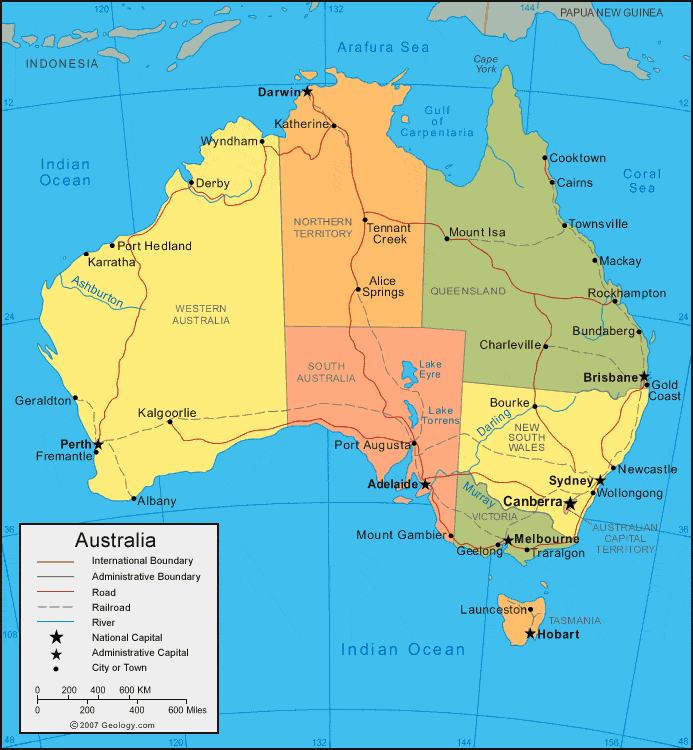
Located in the Southern hemisphere, Australia is an island continent surrounded by the Indian and Pacific Oceans. The country is divided into six states and two self-governing territories. Each state has its own state constitution, dividing the state’s government into the same legislature, executive, and judiciary branches as the federal government. Explore more about Australia on YouTube through National Geographic Kid’s Destination World and Jeography’s Australia Song. Ask your children to research and plan a pretend trip to Australia. Choose places to visit, plan an itinerary and set a budget. Australia.com provides ample resources to get started. If you have students near driving age, introduce the driving rules in Australia as compared to your state. Go deeper and map the trip using the Australia Travel Safely Road Map.
Unlike the republican government in the United States, Australia is a federation, a constitutional monarchy, and a parliamentary democracy. Let’s look at these terms separately. Australia is a federation. The constitution that was enacted in 1901 created a federal system of government. Under this system, powers are divided between a central government and individual states. The term Constitutional Monarchy may sound unusual. By this definition, Australia is ruled by the British monarch but operates within the limits of a constitution. The Queen is formally represented by a Governor General with no role in the day-to-day duties. The term parliamentary democracy describes the joining together of an elected body and Queen to lead a country. The Australian constitution defines the Parliament as the Queen, the Senate and the House of Representatives. Both the Senate and House are responsible for national laws, and legislation has to be approved by both houses before being enacted. Ask older children to contrast and compare the U.S. Government and the Australian system of government. This is also a perfect time to learn more about the U.S. government. Ben’s Guide to the U.S. Government is a helpful resource for all ages.
Let’s take a brief look at the Australian flag and national anthem. Adopted in 1901, the flag has a blue background with the Union Jack (United Kingdom flag) in the upper left corner, and a large white commonwealth star with 7 points below the Union Jack. These 7 points represent the 6 states (one point each) and one point for the two territories. The right side has five stars that represent the Southern Cross Constellation, also an Australian national symbol. Watch an excellent introduction to the Southern Cross on the Sixty Symbols YouTube channel. Color the Australian flag or visit YouTube for lessons to draw the flag.
Until 1984, the national anthem of Australia was God Save the Queen. Have your children listen here. Does the tune may sound familiar? Listen to My Country ‘Tis of Thee. Share observations. Learn more about the lyrical history here. Today, Advance Australia Fair is the national anthem of Australia. Although written in the late 1800s, it was not until the mid 1970s, that the people rallied to change the anthem. Visit the Royal Australian Historical Society for a quick look at the story behind the anthem.
Our study is not complete without a look at the uniquely beautiful animals of Australia. Egg laying mammals, koalas, and kangaroos are just a few of the unusual wildlife that fascinate children and adults. Are you scratching your head at the idea of an egg laying mammal? Science tells us that mammals give birth to their young, and not lay eggs like birds or fish. Egg laying mammals (monotreme) like the platypus and echidna are primarily found in Australia. Learn more about the platypus at National Geographic Kids. As adorable, and teddy-bear like as the koala is, it is not part of the bear family. Rather, it is a marsupial, the same classification as the kangaroo! The San Diego Zoo offers a delightful Koala Cam to observe koalas in their Australian Outback habitat recreation. Test your knowledge with this fun, interactive marsupial quiz! Learn more about diverse Australian animals at the Kid’s World Travel Guide.
As we conclude our study, let’s take a brief look at the bush fires that have impacted Australia. Bush fires are considered uncontrolled and may damage wildlife and property. While bush fires can be catastrophic, they are a natural phenomenon essential to Australian’s environment. They are common during Australian summer months (November to February) due to high temperatures and dry weather. The 2019-2020 season was especially hot and dry, due to a climate phenomenon similar to El Niño called the Indian Ocean Dipole or the Indian Niño. While many fires have a natural cause (lightning), they may also be caused by careless behavior. Ask your children to identify behaviors that could cause a fire (Unattended campfires, cigarettes thrown on the ground, etc.). Learn more about the history of Australian Bush fires here. Students can also gain a deeper understanding about the impact wildfires have on Australia at Kid Cyber and the Australian Academy of Science websites.
Exploring Australia is a fabulous journey for children and parents alike. While it may not be possible to visit this country that covers an entire continent, there are several family friend websites to learn more. Some favorites include Nat Geo Kids, Kids world Travel Guide, and the Land Down Under Virtual Field Trip on YouTube.
It is my hope that this journey to Australia has been fun and educational. I would love to hear from you and what your children discovered! Drop me an email at dcrawford@rainbowresource.com or leave a comment on this post below!