The term “classical education” is one you hear frequently in home school circles. There are some well-known publishers who specialize in products following a classical education model. These products have a lot of appeal because they are structured, academically rigorous, and often, user-friendly. On the other hand, the whole approach can seem a bit intimidating and overwhelming with all that is offered and the different directions that are taken in some subjects (such as the progymnasmata approach to writing skills). One is left wondering if you can do “a little bit” of classical education rather than embrace the whole kit-and-caboodle – the philosophy, the various courses, the publishers.
The short answer is: You can! Actually, if you are helping your 3rd grader memorize the multiplication facts or the list of prepositions from Easy Grammar, introducing some fun logic puzzles like Mind-Benders to your 6th grader, or assigning a persuasive essay to your 10th grader, you are incorporating “a little bit” of classical education into your school year. However, I doubt that is what is meant by the question.
The question that is really being asked is “Can I use some of the classical education materials in my (Charlotte Mason, traditional, or even unschooling) homeschool?” Again, the answer is “Yes!”
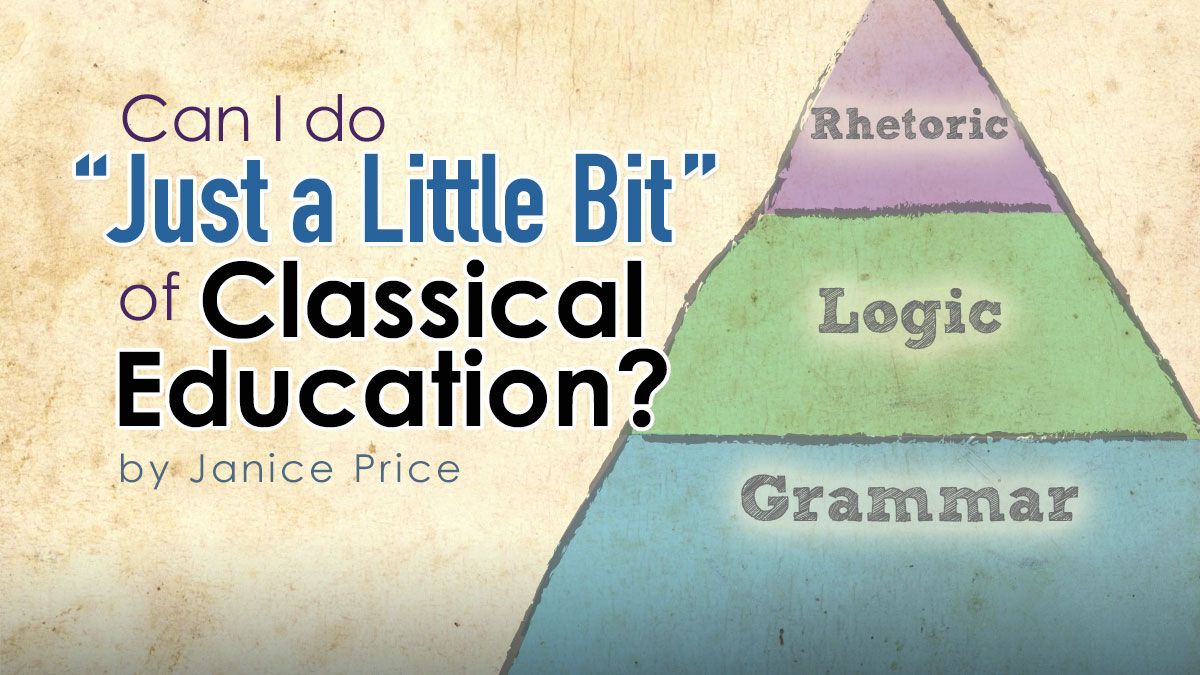
Classical education is based on the Trivium, which outlines the educational emphasis of three age groups or stages:
- Grammar (lower to mid elementary) where students are little fact sponges and can memorize large quantities of facts often by utilizing rhymes and songs.
- Logic (middle school) where students are organizing and sorting through all that factual information and learning to analyze.
- Rhetoric (high school) where students are synthesizing facts, drawing conclusions, and learning effective, efficient ways to communicate those conclusions (either orally or in writing).
Courses and materials from classical education publishers are written with these stages in mind. You can incorporate any of the courses/materials from our classical publishers into your homeschool – whenever and wherever they meet your needs – just keep in mind the general focus of the intended age group.
So, for instance, you might find that Memoria Press’ Literature and Composition (largely classical with some Charlotte Mason elements) – are exactly what you want even though your approach to history and science may be more laid back. With classical language arts, you can expect to learn grammar from a structure of language perspective, to incorporate diagramming, and to master the writing process and different forms of writing. We often hear that parents appreciate the classic, challenging literature used in Memoria Press as well as the continual practice of analytical reading skills. Some families also love using Memoria Press curriculum in the lower grades specifically because of the traditional, good literature that you would also find in a Charlotte Mason approach. Traditional Spelling is another good classical option that can be used independently from a purely classical curriculum. It reviews phonics skills, utilizes dictation, and incorporates word study and learning games.
Likewise, if you want to cover history chronologically (a typically classical perspective) rather than starting with American history, you can do it. Consider Story of the World or BiblioPlan to see if they will blend with the rest of your courses. Both cover world history in four general time periods spread out over four years.
Or, perhaps you want to add Latin (to augment vocabulary) or logic (thinking skills). Memoria Press, Classical Academic Press and Greek ‘N Stuff each offer programs in Latin that cover a wide span of grades. Latin is a great elective that paves the way for other foreign language studies or laying the foundation for debate. They might or might not mean you should think about jumping into a wholly classical approach.
Any of these scenarios (and many others) are totally OK – even if you are not following a classical approach to education. In fact, it’s been done before. The traditional approach has borrowed heavily from classical education as it has developed over the years. Even the Charlotte Mason approach, which seems very different on the surface, shares some common roots. A always, the important consideration is ALWAYS what is best for your student and your family.
The Rainbow Resource Center consultant team is available to answer your questions about either products or approaches.