
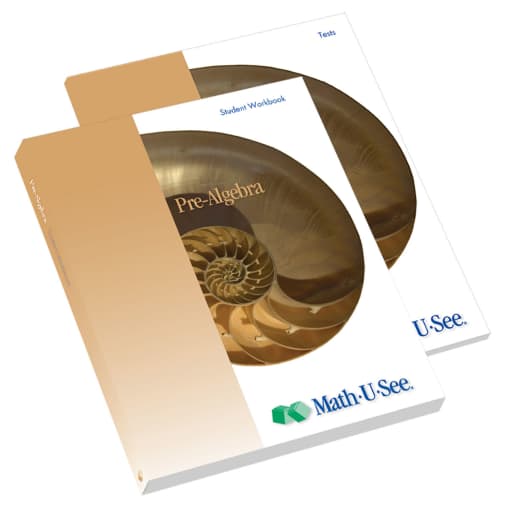

The Math-U-See Pre-Algebra Student Workbook and Tests include the consumable student resources that are necessary for the program. The Student Workbook contains a mix of practice problems and word problems. Space is provided to work out the problems, but some students may prefer having access to scratch paper. The Test Booklet provides an opportunity to evaluate concept mastery. Parents are encouraged to reteach previous lessons if the student has not mastered a concept. Both books are consumable and not reproducible; each student will need their own copy of the Workbook and Test Booklet. Not a standalone product; you will also need the Math-U-See Pre-Algebra Instructional Videos (Online or DVD), Pre-Algebra Instruction Manual, Integer Block Kit, and the Algebra Decimal Insert Kit. Components are sold separately or in convenient sets.
Math-U-See Pre-Algebra Student Workbook and Tests
Product Overview
- Consumable student workbook and test booklet for the Math-U-See Pre-Algebra course
- Student Workbook includes lesson practice, systematic review, and application and enrichment worksheets
- Tests measure mastery of previous concepts before students advance to the next concept
Important
Teacher materials are necessary to use the student materials and these are sold in Universal or Level Up sets only.Description
The Pre-Algebra Student Pack contains the Student Workbook with lesson-by-lesson worksheets, review pages, and honors pages. It also includes the Pre-Algebra Tests. The Pre-Algebra level covers negative numbers, order or operations, solving for the unkown, and other topics. (As we reprint our books in each level of Pre-Algebra through Calculus, we are changing the title of the "Honors" pages to "Application and Enrichment" to mirror our lower-level books. This change is intended to clarify that this content extends lesson concepts but does not include academic "Honors"-level coursework and the designation "Honors" cannot be added to student transcripts even if all pages are completed. The content and solutions are unchanged, but for a short transitional period, books within a level may be inconsistent in the name of these pages.)
Basic pre-algebra concepts including negative numbers, exponents, factoring, and ratios. Includes rules of solving equations using the associative, commutative, and other properties; simple operations with polynomials. Also covers geometry concepts of surface area, volume and Pythagorean theorem.
Lessons follow a similar format – watch the
DVD lesson, work through lesson examples in the instruction manual together,
and complete worksheets. Lessons conclude with a test. Cumulative unit tests
are scheduled regularly to assure students retain previous teaching. A final test
over all concepts taught concludes the course.
| Product Format: | Other |
|---|---|
| Grades: | 7-8 |
| Brand: | Math-U-See |
| Length in Inches: | 11 |
| Width in Inches: | 8.5 |
| Height in Inches: | 1.375 |
| Weight in Pounds: | 3.3 |