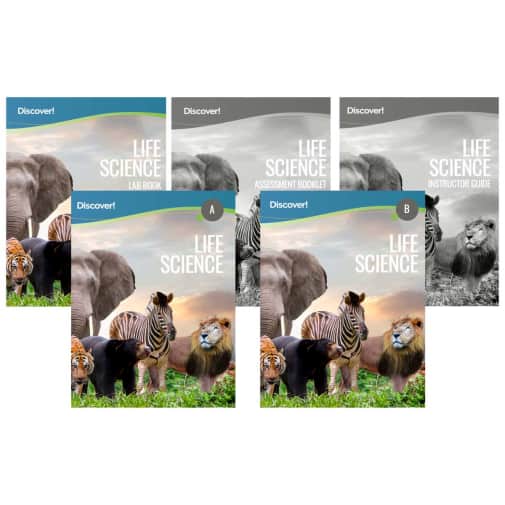

Discover! Life Science is a self-directed middle school curriculum that is flexible for different learning styles and abilities. Required for the course are Student Worktexts A and B, the Instructor Guide, the Lab Manual, and the Assessment Book. Currently, these are only sold in a set—they are not available individually. The consumable and colorfully illustrated Student Worktexts are organized into eight topical units, with each unit containing 7-10 chapters. Each chapter begins with objectives, vocabulary words and definitions, and materials for the Worktext activities. Chapters introduce a real-world story and informational text. Following the readings, students answer related questions and complete application activities and chapter reviews called “show what you know.” Scattered throughout the chapters are extension activities, which may include focus readings or activities, mini labs, online research projects, and creative projects. Chapters will take about 2 days to complete. Each unit also includes one or two formal lab experiments, which are found in the Lab Manual. These are not scheduled; rather, the experiment(s) should be completed at your convenience prior to a chapter review and assessment. The Lab Manual contains the student instructions, material lists, safety notes, and space to document the lab experience. It also includes observation sheets for the mini labs to help students become proficient with lab documentation. Complete teaching notes for experiments are found in the back of the Instructor Guide. The Assessment Booklet includes the consumable assessments for each chapter. There are two types of assessments available: traditional tests with fill-in-the-blank, matching, or short-answer (or drawing) questions, and project-based performance assessments with project requirements and grading rubrics. The Discover! Life Science Instructor Guide is used with the Student Worktexts and Lab Manual. Along with chapter objectives, each chapter provides parents with suggestions to support learning and teach to and challenge three learning styles (auditory, visual, and kinesthetic), extension/enrichment activities, co-op activities for families using the curriculum with a large group, and all the answers. It also includes the assessments and answers. Not reproducible.
Discover! Life Science Set (2nd Edition)
Product Overview
- Flexible curriculum to meet the needs of different learning styles and abilities
- Covers scientific method and theories, classification, microbes, botany, photosynthesis, DNA, human anatomy, and health topics
- Kit includes the Instructor Guide, Student Worktext A, Student Worktext B, Lab Manual, and the Assessment Book
- Additional household or easily found items required for lab activities; optional microscope and slide activities included
Description
Discover! Life Science, 2nd Edition, immerses students to the incredible diversity of living things and the systems that sustain life. The course begins with classifying organisms, from microscopic microbes to complex plants and animals. Students explore vascular and non-vascular plants, seeded and non-seeded plants, and the natural life cycles that support ecosystems. Key biological processes such as photosynthesis and the Calvin Cycle are examined to show how energy flows through living systems. Learners investigate genetics, DNA structure, and modern biotechnological advances that are transforming science and medicine. The course also focuses on the human body, exploring major body systems, how they work together, and what happens when systems fail. Topics in human health, disease prevention, and medical innovation help students connect biology to everyday life. A Career Spotlight highlights exciting pathways including Genetic Engineer, Biomedical Engineer, Epidemiologist, Agricultural Engineer, and Software Engineer, inspiring students to see how life science drives innovation and improves human health.
Discover! Life Science includes:
- Student Worktext A
- Learn about systemic building blocks of life science, microbes, plants, and botanical life. The text concludes with the natural life cycles, and the balance and disruption in plant ecosystems. Each unit features a related career, such as a mycological engineer, agricultural engineer, and plant morphologist.
- Student Worktext B
- Continue with genetics and DNA structure, human anatomy and reproductive systems, and human body systems. The text concludes with human health optimization and the impact of medicine. Each unit features a related career such as working as a mechanical engineer, genetic engineer, biomedical engineer, software engineer, and epidemiologist.
- Instructor Guide
- Take the guesswork out of lesson planning, offering helpful teaching tips, pacing suggestions, and complete answer keys for all activities and assessments.
- Lab Book
- Includes at least one lab for each lesson. Labs provide a clear connection between the unit and the lab. Students make predictions, search for answers, and synthesize data collection to make inferences and/or suggest further research.
- Assessment Booklet
- Each unit includes a traditional assessment modeled after standardized tests and a performance assessment that challenges students to apply their understanding in creative, meaningful ways. Rubrics are included to support consistent and clear evaluation.
Discover! Science at the middle school level offers families two different paths to choose from: General Science I and General Science II, or the one-year immersive courses in Earth & Space Science, Life Science, and Physical Science. Whether choosing General Science or the Disciplinary immersive pathway, students will practice scientific inquiry, data analysis, and engineering design; explore real-world applications and careers; develop problem-solving skills; and develop strong scientific literacy.
| Product Format: | Other |
|---|---|
| Grades: | 6-8 |
| Brand: | Discover! |