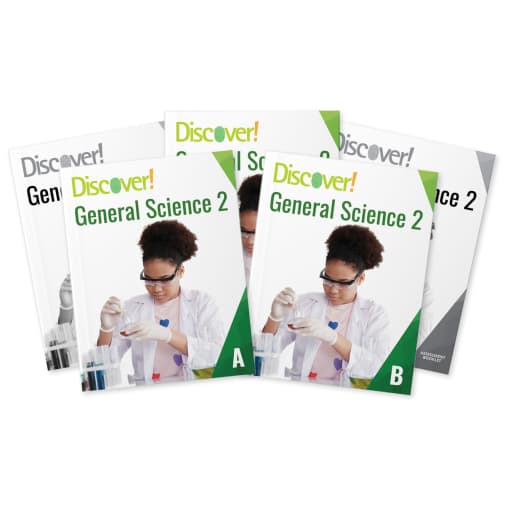

Discover! General Science II is a self-directed curriculum that is flexible for different learning styles and abilities. Required for the course are Student Worktexts A and B, the Instructor Guide, the Lab Manual, and the Assessment Book. Currently, these are only sold in a set—they are not available individually. The consumable and colorfully illustrated Student Worktexts are organized into ten topical units, with each unit containing 6-8 chapters. Each chapter begins with objectives, vocabulary words and definitions, and materials for the Worktext activities. Chapters introduce a real-world story and informational text. Following the readings, students answer related questions and complete application activities and chapter reviews called “show what you know.” Scattered throughout the chapters are extension activities, which may include focus readings or activities, mini labs, online research projects, and creative projects (songs, drawings, etc.). Chapters will take about 2 days to complete. Each unit also includes one or two formal lab experiments, which are found in the Lab Manual. These are not scheduled; rather, the experiment(s) should be completed at your convenience prior to a chapter review and assessment. The Lab Manual contains the student instructions, material lists, safety notes, and space to document the lab experience. It also includes observation sheets for the mini labs to help students become proficient with lab documentation. Complete teaching notes for experiments are found in the back of the Instructor Guide. The Assessment Booklet includes the consumable assessments for each chapter. There are two types of assessments available: traditional tests with fill-in-the-blank, matching, or short-answer (or drawing) questions, and project-based performance assessments with project requirements and grading rubrics. The Discover! General Science II Instructor Guide is used with the Student Worktexts and Lab Manual. Along with chapter objectives, each chapter provides parents with suggestions to support learning and teach to and challenge three learning styles (auditory, visual, and kinesthetic), extension/enrichment activities, co-op activities for families using the curriculum with a large group, and all the answers. It also includes the assessments and answers. Not reproducible.
Discover! General Science 2 Kit
SKU
008636
Grade 8
These icons are designed to help you quickly understand and learn important information about our products.
Teaching Method
Traditional
Teacher-centered curriculum commonly used in classrooms that may include a text, teacher manual, tests, etc.
Charlotte Mason
A methodology based on the work of a 19th century educator who maintained that children learn best from literature (Living Books), not textbooks.
Classical
A methodology based on the Latin Trivium (three stages of learning), including the grammar stage (memorization and facts), logic stage (critical thinking), and rhetoric stage (developing/defending ideas).
Unit Study
A thematic or topical approach centered around one topic that integrates multiple subject areas.
Montessori (Discovery)
A methodology based on the work of a 20th century educator that emphasizes student and sensory-driven discovery learning and real-life applications.
Other
Other methodologies
Religious Content
Secular
Contains content contrary to common Christian beliefs (i.e. evolution).
Neutral
Avoids religious or theoretical topics or presents multiple viewpoints without preference.
Christian/Religious
Faith-based or including instructional religious content.
Learning Modality
Auditory
Learns through listening, talking out loud or reading out loud.
Visual
Learns through seeing, prefers written instructions and visual materials.
Kinesthetic/Tactile (Hands-On)
Learns through moving, doing and touching.
Multi-Sensory
Curriculum that employ a variety of activities/components.
Presentation
Sequential
Curriculum progresses through well-defined learning objectives. Emphasizes mastery before moving to the next topic.
Spiral
Topics and concepts are repeated from level to level, adding more depth at each pass and connecting with review.
Conceptual/Topical
Focus is on the “why,” often with a unifying concept as well as specific skills; coverage may be broader.
Teacher Involvement
Low Teacher Involvement
Student-led materials; parent acts as a facilitator.
Medium Teacher Involvement
A mix of teacher-led time and independent student work.
High Teacher Involvement
Teacher-led lessons; may utilize discussions, hands-on activities and working together.
Additional Materials Required
No other materials needed
Everything you need is included.
Other Materials Required
There are additional required resources that are a separate purchase.
Other Materials Optional
There are additional resources mentioned or recommended but are not absolutely necessary.
Consumable
Consumable
Designed to be written in; not reusable.
Non-Consumable
Not designed to be written in; reusable.
Our Price
$192.50 Product Overview
- Flexible curriculum to meet the needs of different learning styles and abilities
- Covers scientific history and theories; methods and data; plant ecosystems; matter; periodic table; simple machines; and geology
- Kit includes the Instructor Guide, Student Worktext A, Student Worktext B, Lab Manual, and the Assessment Book
- Additional household items and some lab equipment required; microscope and slides optional
Description
Publisher's Description of Discover! General Science 2 Kit
Discover! General Science 2 is designed for 8th grade students and focuses on life and balance in nature, matter, energy, electromagnetism, force and motion, simple machines, and geology.
The instructor guide takes the guesswork out of lesson planning by providing helpful suggestions and answer keys for all activities and assessments.
Student worktexts include activities, instruction, extensions, and mini-labs to appeal to all learning styles. In student worktext A, students will explore lessons on life in nature and matter in all states. In student worktext B, lessons focus on energy, force, and geology.
The lab book includes comprehensive experiment procedures to accompany each unit in the worktext and a section of mini-lab notes.
The assessment book allows students to grow as independent learners. It provides chapter assessments covering 5-10 lessons of material and rubrics that guide students through the assessments.
This package includes Discover! General Science 2 Student Worktext A, Student Worktext B, the Lab Book, the Instructor Guide, and the Assessment Booklet.
The instructor guide takes the guesswork out of lesson planning by providing helpful suggestions and answer keys for all activities and assessments.
Student worktexts include activities, instruction, extensions, and mini-labs to appeal to all learning styles. In student worktext A, students will explore lessons on life in nature and matter in all states. In student worktext B, lessons focus on energy, force, and geology.
The lab book includes comprehensive experiment procedures to accompany each unit in the worktext and a section of mini-lab notes.
The assessment book allows students to grow as independent learners. It provides chapter assessments covering 5-10 lessons of material and rubrics that guide students through the assessments.
This package includes Discover! General Science 2 Student Worktext A, Student Worktext B, the Lab Book, the Instructor Guide, and the Assessment Booklet.
Category Description for Discover! Science - Middle School
Discover! Science at the middle school level offers families two different paths to choose from: General Science I and General Science II, or the one-year immersive courses in Earth & Space Science, Life Science, and Physical Science. Whether choosing General Science or the Disciplinary immersive pathway, students will practice scientific inquiry, data analysis, and engineering design; explore real-world applications and careers; develop problem-solving skills; and develop strong scientific literacy.
Details
| Product Format: | Other |
|---|---|
| Grade: | 8 |
| Brand: | Discover! |
Videos
Reviews