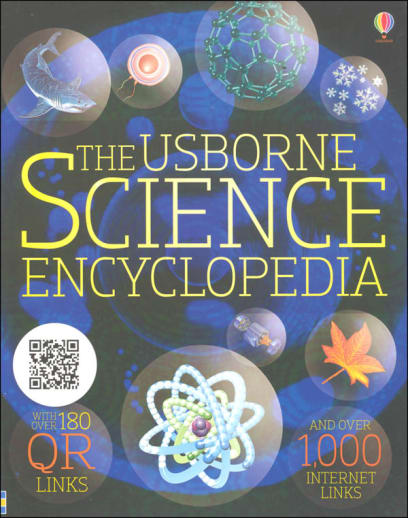
This book is obviously an Usborne book; it's overloaded with interesting information and tons of color pictures. But it also has something else: internet links. A great deal of science is packed in the book, with even more available online at the many quality websites chosen by Usborne. More than 1,000 internet links and 180 QR links are included. Perform more than 120 experiments and activities, and see video clips, diagrams, pictures, and other helpful online highlights. Sites allow you to see video clips of animals, hear animal sounds, build your own roller coaster, dissect a virtual frog, relive the story of landing on the moon complete with sounds, images, and slideshows, and so much more. All of science is covered in this book: physics, chemistry, biology, information technology, earth sciences, astronomy, anatomy, zoology, and Earth conservation. A wonderful resource even for those without online access. This book is available in two sizes (with identical content).The small-format paperback version measures 7 1/2" x 9 1/2". The large-format hardcover version measures 8 3/4" W x 11" H. 448 pgs. ~ Stephanie
Science Encyclopedia Small-format (Usborne 2015 Edition)
Description
You will find the whole field of science from physics, chemistry, biology, information technology, Earth sciences and astronomy to new fields such a genetic engineering, nanotechnology, telecommunications and the preservation of planet Earth including: Clear explanations of over 2,500 scientific terms -- Over 1,500 illustrations and diagrams -- Over 140 experiments, activities and observations to carry out -- A quick reference dictionary defining over 1,500 scientific terms -- Test-yourself revision aids. This combined volume includes: Energy, Forces & Motion, Earth and Space, Human Body, Materials, Mixtures & Compounds, World of Plants, Animal World, and Light, Sound & Electricity.
Elemental Science is designed as a Classical science program and may also appeal to Charlotte Mason educators. Targeting PK-9, each course provides a framework of study, notebooking activities, and memorization. The text and experiments for the series are found in quality resource books including DK, Usborne, Kingfisher and similar publishers. Each level is made up of a Teacher’s Guide and a Student Workbook (or Diary for PK-1), with several additional resources also being required. Written to be religiously neutral, the origins of life and earth are not studied in-depth, although several of the resource books may reference the Big Bang Theory and/or millions of years.
Teacher Guides contain lesson plans, material and book lists, teacher helps and forms. Student Workbooks contain worksheet pages, narration, journal and experiment forms, and more. Courses contain 36 weeks of study with one or more suggested scheduling options. Written for ages 4-6, Intro to Science provides younger learners an introduction to chemistry, biology, geology, meteorology, botany and zoology. Structured similarly to the Grammar Stage courses, this simplified course emphasizes reading excellent books, observation skills, nature studies, hands-on activities, and coloring.
At the Grammar and Logic Stages in the Elemental Science Classical Science Series, students spend one year on each of the branches of Science: Biology, Earth Science, Chemistry, or Physics. Grammar Stage work involves observation, experiments, teacher demonstrations, memorization, notebooking, and reading the selected resource books. At the Logic Stage, assignments include experiments, vocabulary, memory work, sketching, and narration. Also available, the Elemental Science: Physical Science covers traditional middle school topics using a printed guide, a free online textbook and teacher guide (CK-12 Physical Science), and online labs. Please note, according to the publisher, the hands-on experiments used in Physical Science are the same as those found in the Elemental Science Classical Science series. Students completing Biology for the Logic Stage and Chemistry for the Logic Stage are ready for a high school level Biology course.
Also from Elemental Science, Science Chunks, is a survey of science for grades 1-6. Each year (3 are available) provides 36 lessons (one per week) that uses quality, visually appealing science encyclopedias, hands-on activities, and notebook activities. Science Chunks offers a highly flexible way for families to learn science together.
| Product Format: | Softcover Book |
|---|---|
| Grades: | 4-AD |
| Brand: | Usborne |
| ISBN: | 9780794523558 |
| Length in Inches: | 9.4375 |
| Width in Inches: | 7.5 |
| Height in Inches: | 1.1875 |
| Weight in Pounds: | 3.1 |