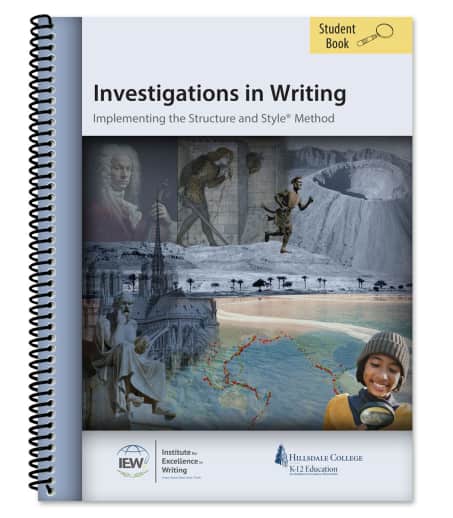
Students will incrementally review and apply the methods taught in Structure and Style® for Students. Add literature studies for a complete language arts credit. This spiral-bound student book includes a scope and sequence, lesson pages (with instructions, source texts, worksheets, and checklists), appendices with suggested literature tie-ins, writing mechanics helps, sample compositions, and vocabulary lists. Each unit begins with the lesson goals. Accompanying PDF downloads (reproducible checklists, vocabulary cards, and exemplars) are available for free with the purchase of these books (download instructions included in each text). Consumable, nonreproducible, 264 pgs, pb. First edition. ~ Ruth
IEW Investigations in Writing Student Book
SKU
009389
ISBN
9781623414191
Grade 6-8
These icons are designed to help you quickly understand and learn important information about our products.
Teaching Method
Traditional
Teacher-centered curriculum commonly used in classrooms that may include a text, teacher manual, tests, etc.
Charlotte Mason
A methodology based on the work of a 19th century educator who maintained that children learn best from literature (Living Books), not textbooks.
Classical
A methodology based on the Latin Trivium (three stages of learning), including the grammar stage (memorization and facts), logic stage (critical thinking), and rhetoric stage (developing/defending ideas).
Unit Study
A thematic or topical approach centered around one topic that integrates multiple subject areas.
Montessori (Discovery)
A methodology based on the work of a 20th century educator that emphasizes student and sensory-driven discovery learning and real-life applications.
Other
Other methodologies
Religious Content
Secular
Contains content contrary to common Christian beliefs (i.e. evolution).
Neutral
Avoids religious or theoretical topics or presents multiple viewpoints without preference.
Christian/Religious
Faith-based or including instructional religious content.
Learning Modality
Auditory
Learns through listening, talking out loud or reading out loud.
Visual
Learns through seeing, prefers written instructions and visual materials.
Kinesthetic/Tactile (Hands-On)
Learns through moving, doing and touching.
Multi-Sensory
Curriculum that employ a variety of activities/components.
Presentation
Sequential
Curriculum progresses through well-defined learning objectives. Emphasizes mastery before moving to the next topic.
Spiral
Topics and concepts are repeated from level to level, adding more depth at each pass and connecting with review.
Conceptual/Topical
Focus is on the “why,” often with a unifying concept as well as specific skills; coverage may be broader.
Teacher Involvement
Low Teacher Involvement
Student-led materials; parent acts as a facilitator.
Medium Teacher Involvement
A mix of teacher-led time and independent student work.
High Teacher Involvement
Teacher-led lessons; may utilize discussions, hands-on activities and working together.
Additional Materials Required
No other materials needed
Everything you need is included.
Other Materials Required
There are additional required resources that are a separate purchase.
Other Materials Optional
There are additional resources mentioned or recommended but are not absolutely necessary.
Consumable
Consumable
Designed to be written in; not reusable.
Non-Consumable
Not designed to be written in; reusable.
Our Price
$35.00 Product Overview
- Course starts with notetaking and ends with inventive and formal essays
- Assignments provide practical application of vocabulary and mechanics
- Applies writing skills taught in IEW’s Structure and Style®
- Grading checklists are adaptable to student needs
Description
Publisher's Description of IEW Investigations in Writing Student Book
In this theme-based writing curriculum, students write about intriguing topics such as Socrates, plate tectonics, and other interesting subjects while they learn to write with the Structure and Style® writing method. Offering a full year of instruction for students in 6th grade, these lessons cover the nine IEW Units. Literature suggestions and access to vocabulary cards and other helpful PDF downloads are included.
Category Description for Investigations in Writing (IEW)
Students will travel the world and the ages with this 30-lesson, theme-based writing curriculum. The course provides engaging content that will spur writing assignments: from geography (the history of maps to the Ring of Fire and the Dead Sea) to mythology (ancient tales like Aesop’s Fables and the Minotaur) to famous cultural contributors (like Vivaldi and Socrates). This curriculum assumes teachers have learned the methodology of and have access to the IEW program, Teaching Writing: Structure and Style, which will be referenced in each unit.
Students start the year by practicing taking notes and outlining, then writing from these notes. Students will retell narratives, summarizing single and multiple references, and write from pictures. By lessons 20 and 21, students will practice inventive writing, focusing on their favorite activity. Rather than use source texts, they’ll develop their own content using the six investigative questions of who, what, when, where, why, and how. In lessons 22 and 23, they’ll continue developing inventive writing by focusing on their favorite season. Then students will move to writing formal essays on the French Revolution, transportation (a two-part lesson), and formal critiques on The Little Match Girl by Hans Christian Anderson (another two-part lesson). The course ends with another formal critique of After Twenty Years by O. Henry. These last two texts are provided within the student material. However, if you’d like to make this a more complete language arts program, additional literature is recommended by Hillsdale College, including selections of Greek Mythology from Realms of Gold; The Children’s Homer; The Scarlet Pimpernel; and The Count of Monte Cristo. The reading level and content of these pieces varies significantly. IEW recommends teachers read and review literature before assigning to their student. Twenty-eight of the course’s lessons highlight vocabulary words (such as catastrophic, infrastructure, and cartographer), which are practiced regularly (with the intent of incorporating these words in their writing assignments) and periodically quizzed.
To teach the course, purchase either the Teacher Student Combo or individual student and teacher pieces. This course is the fourth in a series of multi-theme courses (and the first middle school course) created in conjunction with Hillsdale’s K-12 American Classical Education topics of scope and sequence. © 2025, first edition. ~ Ruth
Details
| Product Format: | Paperback |
|---|---|
| Grades: | 6-8 |
| Brand: | Institute for Excellence in Writing |
| ISBN: | 9781623414191 |
| Length in Inches: | 11 |
| Width in Inches: | 9.25 |
| Height in Inches: | 0.9375 |
| Weight in Pounds: | 1.55 |
Videos
Reviews