
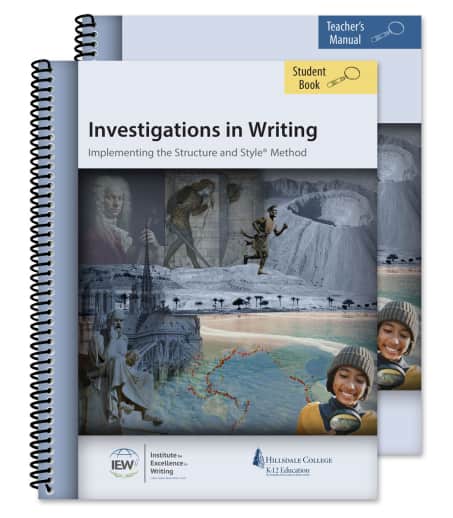
This combo package includes the required components for this course: the reusable spiral-bound teacher text and consumable spiral student text. See individual component descriptions for more details. Accompanying PDF downloads (reproducible checklists, vocabulary cards, and exemplars) are available for free with the purchase of these books (download instructions included in each text). This course is the fourth in a series of multi-theme courses created in conjunction with Hillsdale’s K-12 American Classical Education topics of scope and sequence, which assigns a Grade 6 reading level to this course. However, the suggested literature tie-ins vary in difficulty level: selections of mythology from Realms of Gold; The Children’s Homer; The Scarlet Pimpernel; and The Count of Monte Cristo. IEW recommends teachers read and review literature before assigning to their student. First edition. ~ Ruth
IEW Investigations in Writing (Teacher/Student Combo)
Product Overview
- Students compose using investigative questions
- Aligns with Hillsdale College’s suggested topics
- Applies writing skills taught in IEW’s Units 1-9
- Full year of composition instruction with literature tie-ins with a 4-day per week schedule
Description
Students will travel the world and the ages with this 30-lesson, theme-based writing curriculum. The course provides engaging content that will spur writing assignments: from geography (the history of maps to the Ring of Fire and the Dead Sea) to mythology (ancient tales like Aesop’s Fables and the Minotaur) to famous cultural contributors (like Vivaldi and Socrates). This curriculum assumes teachers have learned the methodology of and have access to the IEW program, Teaching Writing: Structure and Style, which will be referenced in each unit.
Students start the year by practicing taking notes and outlining, then writing from these notes. Students will retell narratives, summarizing single and multiple references, and write from pictures. By lessons 20 and 21, students will practice inventive writing, focusing on their favorite activity. Rather than use source texts, they’ll develop their own content using the six investigative questions of who, what, when, where, why, and how. In lessons 22 and 23, they’ll continue developing inventive writing by focusing on their favorite season. Then students will move to writing formal essays on the French Revolution, transportation (a two-part lesson), and formal critiques on The Little Match Girl by Hans Christian Anderson (another two-part lesson). The course ends with another formal critique of After Twenty Years by O. Henry. These last two texts are provided within the student material. However, if you’d like to make this a more complete language arts program, additional literature is recommended by Hillsdale College, including selections of Greek Mythology from Realms of Gold; The Children’s Homer; The Scarlet Pimpernel; and The Count of Monte Cristo. The reading level and content of these pieces varies significantly. IEW recommends teachers read and review literature before assigning to their student. Twenty-eight of the course’s lessons highlight vocabulary words (such as catastrophic, infrastructure, and cartographer), which are practiced regularly (with the intent of incorporating these words in their writing assignments) and periodically quizzed.
To teach the course, purchase either the Teacher Student Combo or individual student and teacher pieces. This course is the fourth in a series of multi-theme courses (and the first middle school course) created in conjunction with Hillsdale’s K-12 American Classical Education topics of scope and sequence. © 2025, first edition. ~ Ruth
| Product Format: | Other |
|---|---|
| Grades: | 6-8 |
| Brand: | Institute for Excellence in Writing |
| ISBN: | 9781623414177 |
| Length in Inches: | 11 |
| Width in Inches: | 9.75 |
| Height in Inches: | 1.3125 |
| Weight in Pounds: | 3.15 |