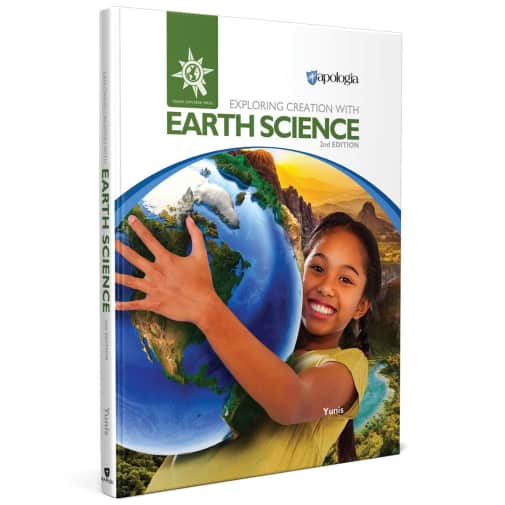
Exploring Creation with Earth Science Textbook (2nd Edition)

SKU
005839
ISBN
9781960929334
Grade K-6
Teaching Method
Traditional
Teacher-centered curriculum commonly used in classrooms that may include a text, teacher manual, tests, etc.
Charlotte Mason
A methodology based on the work of a 19th century educator who maintained that children learn best from literature (Living Books), not textbooks.
Classical
A methodology based on the Latin Trivium (three stages of learning), including the grammar stage (memorization and facts), logic stage (critical thinking), and rhetoric stage (developing/defending ideas).
Unit Study
A thematic or topical approach centered around one topic that integrates multiple subject areas.
Montessori (Discovery)
A methodology based on the work of a 20th century educator that emphasizes student and sensory-driven discovery learning and real-life applications.
Other
Other methodologies
Religious Content
Secular
Contains content contrary to common Christian beliefs (i.e. evolution).
Neutral
Avoids religious or theoretical topics or presents multiple viewpoints without preference.
Christian/Religious
Faith-based or including instructional religious content.
Learning Modality
Auditory
Learns through listening, talking out loud or reading out loud.
Visual
Learns through seeing, prefers written instructions and visual materials.
Kinesthetic/Tactile (Hands-On)
Learns through moving, doing and touching.
Multi-Sensory
Curriculum that employ a variety of activities/components.
Presentation
Sequential
Curriculum progresses through well-defined learning objectives. Emphasizes mastery before moving to the next topic.
Spiral
Topics and concepts are repeated from level to level, adding more depth at each pass and connecting with review.
Conceptual/Topical
Focus is on the “why,” often with a unifying concept as well as specific skills; coverage may be broader.
Teacher Involvement
Low Teacher Involvement
Student-led materials; parent acts as a facilitator.
Medium Teacher Involvement
A mix of teacher-led time and independent student work.
High Teacher Involvement
Teacher-led lessons; may utilize discussions, hands-on activities and working together.
Additional Materials Required
No other materials needed
Everything you need is included.
Other Materials Required
There are additional required resources that are a separate purchase.
Other Materials Optional
There are additional resources mentioned or recommended but are not absolutely necessary.
Consumable
Consumable
Designed to be written in; not reusable.
Non-Consumable
Not designed to be written in; reusable.
Our Price
$55.00 $55.00 $44.00
Rainbow Savings: $11.00

Product Overview

  • Core Text for Apologia’s Exploring Creation with Earth Science (2nd edition)
  • Fourteen lessons (chapters) cover the universe, our earth, the earth’s spheres, climate and weather, weather forecasting, the cycles of life, and God in creation
  • Includes hands-on activities, activity supply list by lesson, pronunciations, answer key, and more
  • Vibrant full-color illustrations

Description

Publisher's Description of Exploring Creation with Earth Science Textbook (2nd Edition)

Within the entire universe, we know of only one planet that is capable of life, and we call it home. Everything that we need to survive and thrive has been given to us by our Creator. Beauty and life surround us on our home planet, Earth, and Apologia’s Exploring Creation with Earth Science, 2nd ed. helps students understand that God is in all things—from the natural order in the foundation of our universe to the unique and methodical processes that preserve our home planet. In this course, students will study the Earth’s geosphere, hydrosphere, atmosphere, and biosphere. They will dig deep and dive in as they complete activities that put the world at their fingertips. They’ll even get to build their own 3D globe, which they can keep for years to come!

Exploring Creation with Earth Science, 2nd ed. begins by taking students on a journey through the entire universe to help them realize that Earth is our home, and it’s a wonderful place to be. Since Earth is the only known planet to support life, it makes sense to try to understand and appreciate the gift God has given us. Students then learn about Earth’s special place in the habitable zone and how God designed Earth to protect us and provide for all of our needs. Next, students study the different spheres of our planet, including the geosphere, hydrosphere, atmosphere, and biosphere. They will understand that the rotation of Earth gives us variety for our days and nights, and the revolutions of Earth around our Sun give us variety in our seasons during the year. Our location on Earth gives us even more diverse locations to enjoy. As students build a functional globe throughout their lessons, they will comprehend latitude, longitude, and time zones. They’ll explore the movements that shape our planet and the different types of rocks that form the Earth’s crust. Studying weather, climates, and atmospheric conditions will help budding meteorologists forecast their weekly weather. Lessons about life on Earth, the cycles of life, unique places on our planet, and seeing God in creation round out the school year.

As students work through this course, they will use common household items to complete activities that expand upon the information taught in each lesson. In addition to building a 3D globe complete with mountain ranges, students will create expanding universe putty and a galaxy mobile, build a Goldilocks Zone, bake “edible rocks,” and more. These engaging, hands-on activities bring learning to life and create an atmosphere of fun!  

This 1-year Earth Science course contains 14 lessons. The Notebooking Journal (sold separately) includes a suggested detailed lesson plan and daily schedule to set young explorers up for success.

This course covers the following topics: 

  • Lesson 1: The Observable Universe

  • Lesson 2: Life in the Habitable Zone

  • Lesson 3: Spheres of the Earth

  • Lesson 4: Mapping Your World

  • Lesson 5: The Geosphere

  • Lesson 6: Making and Shaping the Land

  • Lesson 7: The Hydrosphere

  • Lesson 8: The Atmosphere

  • Lesson 9: Climate and Weather

  • Lesson 10: Weather Forecasting

  • Lesson 11: The Biosphere

  • Lesson 12: Cycles of Life

  • Lesson 13: Unique Places on Earth

  • Lesson 14: God in Creation

  • The goal of this curriculum is to help students understand that the Earth is their home, so they should get to know it, understand it, and appreciate its beauty and design. It is written to help students recognize the wonders that surround them every day. 

Category Description for Exploring Creation with Earth Science

Embark on a journey into this wonderful planet that we call home. From the galaxies above to the depths of the seas, children will learn more about the world around them and the awesome God who created it! Filled with hands-on activities, this course offers fourteen modules teaching children about our observable universe, the atmosphere, hydrosphere, climate and weather, life cycle, and so much more. One of the simpler activities that I absolutely love in this course is how children are shown what a frame of reference is, and how it appears that they are always in the center, even if they truly are not. What a life lesson for all of us! Other activities include expanding universe thinking putty and creating a globe to map throughout their study. An excellent addition to the elementary line-up, providing homeschool families more options in their pursuit of a God-centered study of science. Hardcover.

The Exploring Creation with Earth Science Notebooking Journal is a consumable K-6 multi-grade record of learning. Along with black-line coloring pages, full-color illustrations and activity pages, this recommended resource also includes a suggested weekly schedule. Divided into 28 weeks, the schedule encompasses textbook readings, hands-on activities, and Notebooking Journal pages. Students will complete 2 lessons per week to complete the course within one school year. SC. Spiral-bound.

In case you are wondering about the updates to the 2nd edition, the text contains updated graphics, clarification for many of the hands-on activities, and the addition of Creation Confirmation sections that show students the connection between scientific facts and our understanding of Creation and our Creator. Otherwise, the table of contents and topics are essentially the same. As far as the activities are concerned, there are additional activities that are built upon the previous activities; other activities are similar or slightly modified. The 1st Edition Exploring Creation with Earth Science Lab Kit from Nature’s Workshop Plus is compatible with the 2nd Edition. New activity videos are available at the Apologia website for an additional fee. The publisher states the 1st edition and 2nd edition courses are not compatible. 

Details
More Information
Product Format:Hardcover Book
Grades:K-6
Brand:Apologia
ISBN:9781960929334
Videos
This product doesn't have a video
Reviews
Product Q&A