
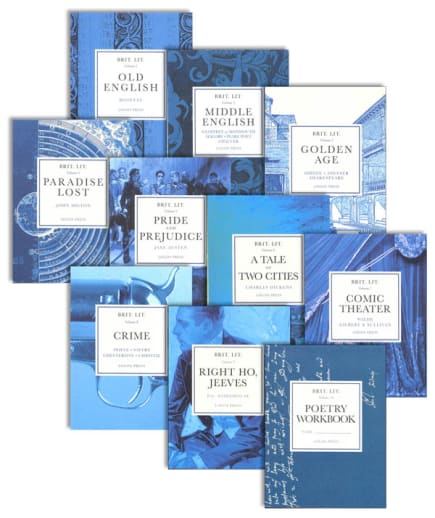
This British Literature series covering classic English authors from Beowulf to P. G. Wodehouse is unique: Each volume of Logos Press's Brit Lit gives you both the unabridged primary sources and the complete reference tools that teachers and students would need during a year-long British Literature class.
No more flipping back and forth between reference books and dog-eared thrift editions: For the first time, the classroom helps and the classics themselves are interwoven for classical & Christian schools.
Selected and edited by Rebekah Merkle, a veteran teacher at Logos School in Moscow, ID.
With each of the ten volumes you'll get:
- Daily reading schedules
- Engaging comprehension questions for every day's reading and detailed answers
- Introductory essays highlighting themes and offering Christian perspective
- Page-by-page, on-the-spot marginalia offering explanations, context, and important notes
- Memorization for 200 lines of poetry over the year
- 90 integrative assignments and supplementary poems in the Poetry Workbook
- Comprehensive end-of-volume tests over readings and the Poetry Workbook
One set of ten volumes = all the Brit Lit a student would need in a year:
Vol. I: Old English (218 pgs) Beowulf, paired with complementary readings from ¬the Hobbit (sold separately). Poetry Workbook: Caedmon's Hymn, Th¬e Battle of Maldon, ¬The Wanderer, and how to write Anglo-Saxon poetry.
Vol. II: Middle English (506 pgs) Most of Geoffrey of Monmouth's History of the Kings of Britain, Sir Gawain and the Green Knight, and selections from Le Morte D'Arthur and ¬The Canterbury Tales, paired with complementary readings from Th¬at Hideous Strength (sold separately). Poetry Workbook: How to write iambic pentameter.
Vol. III: Golden Age (698 pgs) Defense of Poesy, Faerie Queene Book 1, Hamlet, and Much Ado about Nothing. Poetry Workbook: Wyatt, Surrey, selections from Spenser's Amoretti and Epithalamion, Shakespeare's sonnets, and how to write sonnets.
Vol. IV: Paradise Lost (386 pgs) Paradise Lost. Poetry Workbook: Addison, Steele, the rise of coffee houses, Jonathan Swift's A Modest Proposal, John Donne, George Herbert, and how to write epigrams, write Horatian and Juvenalian satire, and turn a Scripture passage into poetry a lá Milton.
Vol. V: Pride & Prejudice (474 pgs) Pride and Prejudice. Poetry Workbook: Blake, Wordsworth, Coleridge, Keats, Byron, Shelley, and how to write an ode and Austen-esque character sketches.
Vol. VI: Tale of Two Cities (684 pgs) A Tale of Two Cities. Poetry Workbook: Hopkins and Tennyson, and how to write in Hopkins' Anglo-Saxon style.
Vol. VII: Comic Theater (216 pgs) The Importance of Being Earnest and Gilbert and Sullivan's Pirates of Penzance. Poetry Workbook: Rudyard Kipling, Lewis Carroll, and how to coin words and write a nonsense poem.
Vol. VIII: Crime (548 pgs) Whose Body? by Dorothy Sayers, a Sherlock Holmes story, a Father Brown story, and ¬The Mysterious Affair at Styles by Agatha Christie. Poetry Workbook: More practice writing poems.
Vol. IX: Right Ho, Jeeves (310 pgs) Right Ho, Jeeves. Poetry Workbook: Tracking P. G. Wodehouse's classical education by finding the source for every scriptural, classical, and poetic allusion.
Vol. X: Poetry Workbook (253 pgs) Poetry Workbook:See the previous volumes for some of the ninety exercises that accompany each volume.