These icons are designed to help you quickly understand and learn important information about our products.
Teaching Method
Traditional
Teacher-centered curriculum commonly used in classrooms that may include a text, teacher manual, tests, etc.
Charlotte Mason
A methodology based on the work of a 19th century educator who maintained that children learn best from literature (Living Books), not textbooks.
Classical
A methodology based on the Latin Trivium (three stages of learning), including the grammar stage (memorization and facts), logic stage (critical thinking), and rhetoric stage (developing/defending ideas).
Unit Study
A thematic or topical approach centered around one topic that integrates multiple subject areas.
Montessori (Discovery)
A methodology based on the work of a 20th century educator that emphasizes student and sensory-driven discovery learning and real-life applications.
Other
Other methodologies
Religious Content
Secular
Contains content contrary to common Christian beliefs (i.e. evolution).
Neutral
Avoids religious or theoretical topics or presents multiple viewpoints without preference.
Christian/Religious
Faith-based or including instructional religious content.
Learning Modality
Auditory
Learns through listening, talking out loud or reading out loud.
Visual
Learns through seeing, prefers written instructions and visual materials.
Kinesthetic/Tactile (Hands-On)
Learns through moving, doing and touching.
Multi-Sensory
Curriculum that employ a variety of activities/components.
Presentation
Sequential
Curriculum progresses through well-defined learning objectives. Emphasizes mastery before moving to the next topic.
Spiral
Topics and concepts are repeated from level to level, adding more depth at each pass and connecting with review.
Conceptual/Topical
Focus is on the “why,” often with a unifying concept as well as specific skills; coverage may be broader.
Teacher Involvement
Low Teacher Involvement
Student-led materials; parent acts as a facilitator.
Medium Teacher Involvement
A mix of teacher-led time and independent student work.
High Teacher Involvement
Teacher-led lessons; may utilize discussions, hands-on activities and working together.
Additional Materials Required
No other materials needed
Everything you need is included.
Other Materials Required
There are additional required resources that are a separate purchase.
Other Materials Optional
There are additional resources mentioned or recommended but are not absolutely necessary.
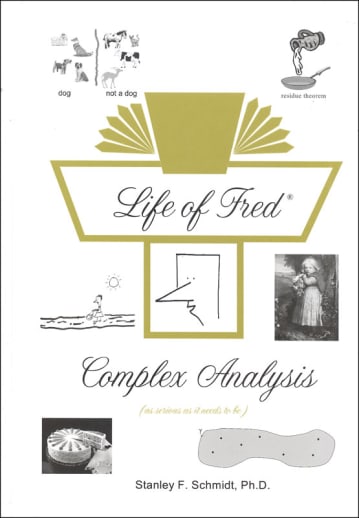
Publisher's Description of Life of Fred: Complex Analysis
Complex Analysis is the
theory of functions of a single complex variable. (That is: Functions that map
from complex numbers to complex numbers.) This is advanced undergraduate
mathematics with applications to even more advanced mathematics, physics, and engineering.
Topics include:
Arithmetic in the complex plane
Conjugates and absolute value
Polar form
Complex functions
Graphing
Limits and derivatives
Cauchy-Riemann equations
Holomorphic functions - Regions, open sets, connected sets
Paths
Analytic functions
Integration along a path
Fundamental Theorem of Complex Integration
Piecewise smooth paths
Paths with corners or cusps
Cauchy’s theorem
Closed paths
Simple paths
Cauchy–Goursat theorem
Trig functions, exponents, and logs in the complex plane
Argument of a polar complex function
Morera’s theorem
Three kinds of isolated singular points
Order of a pole
Proving L’Hospital’s rule in the complex plane
Meromorphic functions
Casorati-Weierstrass theorem
Picard’s great theorem
Cauchy’s formula
Jordan curve theorem
Liouville theorem
Proof of the Fundamental Theorem of Algebra
Taylor series and Laurent series
Residue theorem
Analytic continuation
Riemann Zeta function
Conformal Mappings
Homotopic paths
Harmonic functions
Unlike most other
Complex Analysis programs, this one also has:
• Fred's scheduling issues
• Red Robin Hood
Life of Fred Complex
Analysis is a hardcover textbook containing 176 pages. This book is not
consumable. All answers are written on separate paper or in a notebook.
Number of Lessons: 24
Chapters. It is not broken up into daily lessons.
Life of Fred(LOF) is an unconventional series of math texts that seem accessible and friendly, especially for students who dislike traditional programs. According to Dr. Schmidt, the author, this series is designed to teach you the math you need to know without repetition, redundancy, and a multitude of problems to work. LOF follows the storyline of Fred's life while incorporating solid math concepts and skills. Motivated or independent students will appreciate this series, as well as gifted math students who might need a challenge. Written to the student and intended to be self-teaching, the author prefers that students use these with very little help from you, so they can learn to study and understand on their own. Even the solutions (found in the text) are addressed to the student. In fact, there's a lot of actual instruction in the solutions, which students should read after trying to solve problems on their own. Math in a story context can sometimes make more sense to students than stand-alone math concepts - especially if it's an entertaining story! Students do two books per year up through pre-algebra; beginning with algebra, one book per year.