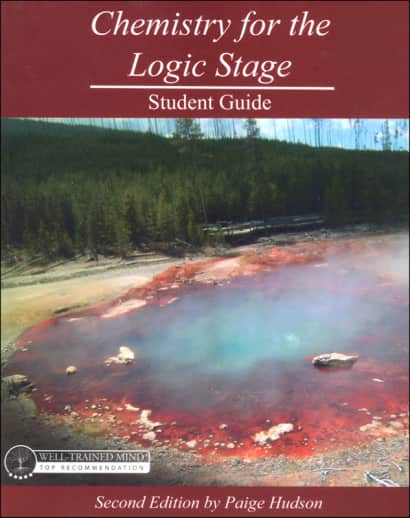
Required for the course, the Chemistry for the Logic Stage Student Guide equips students for independent learning. The Student Guide is not a textbook, rather it is a place for students to read lesson expectations, see assigned pages from the visually engaging encyclopedias, and complete written assignments. The helpful student assignment sheets contain the weekly topic, sketch assignment, experiment directions, report options, dates to enter, and memory work. Please note, some of the experiments require parental supervision. Reproducible for purchasing family only.
Chemistry for the Logic Stage Student Guide (2nd Edition)
SKU
078656
ISBN
9781953490049
Grade 7-8
Classical
Neutral
High Teacher Involvement
Multi-Sensory
Other Materials Required
These icons are designed to help you quickly understand and learn important information about our products.
Teaching Method
Traditional
Teacher-centered curriculum commonly used in classrooms that may include a text, teacher manual, tests, etc.
Charlotte Mason
A methodology based on the work of a 19th century educator who maintained that children learn best from literature (Living Books), not textbooks.
Classical
A methodology based on the Latin Trivium (three stages of learning), including the grammar stage (memorization and facts), logic stage (critical thinking), and rhetoric stage (developing/defending ideas).
Unit Study
A thematic or topical approach centered around one topic that integrates multiple subject areas.
Montessori (Discovery)
A methodology based on the work of a 20th century educator that emphasizes student and sensory-driven discovery learning and real-life applications.
Other
Other methodologies
Religious Content
Secular
Contains content contrary to common Christian beliefs (i.e. evolution).
Neutral
Avoids religious or theoretical topics or presents multiple viewpoints without preference.
Christian/Religious
Faith-based or including instructional religious content.
Learning Modality
Auditory
Learns through listening, talking out loud or reading out loud.
Visual
Learns through seeing, prefers written instructions and visual materials.
Kinesthetic/Tactile (Hands-On)
Learns through moving, doing and touching.
Multi-Sensory
Curriculum that employ a variety of activities/components.
Presentation
Sequential
Curriculum progresses through well-defined learning objectives. Emphasizes mastery before moving to the next topic.
Spiral
Topics and concepts are repeated from level to level, adding more depth at each pass and connecting with review.
Conceptual/Topical
Focus is on the “why,” often with a unifying concept as well as specific skills; coverage may be broader.
Teacher Involvement
Low Teacher Involvement
Student-led materials; parent acts as a facilitator.
Medium Teacher Involvement
A mix of teacher-led time and independent student work.
High Teacher Involvement
Teacher-led lessons; may utilize discussions, hands-on activities and working together.
Additional Materials Required
No other materials needed
Everything you need is included.
Other Materials Required
There are additional required resources that are a separate purchase.
Other Materials Optional
There are additional resources mentioned or recommended but are not absolutely necessary.
Consumable
Consumable
Designed to be written in; not reusable.
Non-Consumable
Not designed to be written in; reusable.
Our Price
$25.99 $25.99 $20.95
Rainbow Savings: $5.04
Product Overview
- Promotes independent learning through the organized student assignments and the ample space to record learning
- Students will complete sketches, guided experiment sheets, and answer discussion questions
- Use alongside Chemistry for the Logic Stage Teacher Guide
Description
Publisher's Description of Chemistry for the Logic Stage Student Guide (2nd Edition)
Category Description for Chemistry for the Logic Stage
Chemistry for the Logic Stage from Elemental Science takes middle school students into a deeper study of the periodic table, matter and molecular properties, solutions, chemical reactions, acids and bases, organic chemistry, and applications in industry. Rather than using a dry, uninspiring textbook, visually appealing and engaging encyclopedias, hands-on activities, and organized notebooking activities provide the learning framework. Independent student learning is the goal, with parents guiding lessons rather than doing any direct teaching. The course is 36 weeks, with the option of either a 2 Day or 5 Day/week schedule laid out in the Teacher Guide. Chemistry for the Logic Stage Teacher Guide also includes the student assignments sheets, helpful tips to lead your student through the program, comprehension questions, unit tests, and answers for the student's work. An optional Science Fair Project is scheduled. The Chemistry for the Logic Stage Student Guide offers all the consumable student pages and assignments. Both are required along with Spine Resources. Please note, the Usborne Illustrated Dictionary of Science is currently out of print. It should be available in the used marketplace or through the library system. Optional resources are included to enrich learning.
Details
| Product Format: | Paperback |
|---|---|
| Grades: | 7-8 |
| Brand: | Elemental Science |
| ISBN: | 9781953490049 |
| Length in Inches: | 10 |
| Width in Inches: | 8 |
| Height in Inches: | 0.75 |
| Weight in Pounds: | 1.35 |
Videos
Reviews