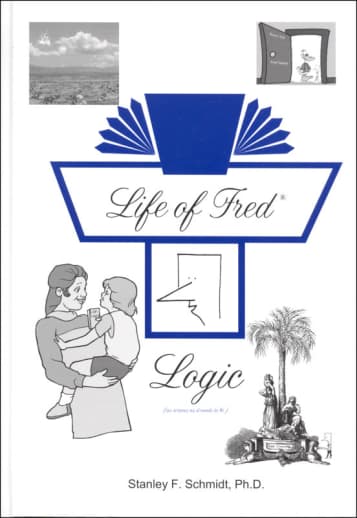
Learn logic in a day! That is, a day in the life of Fred. Here is a complete coverage of logic in a mere 176 pages. No ancillaries required. That's right. No separate teacher book, no test pack, no workbook needed. It's all right here - the whole "Kittens" caboodle. Fred, now six (and still a professor at Kittens U), is preparing to give a logic lecture. Ironically, and somewhat conveniently, Duck (first introduced in Life of Fred: Apples) pays Fred a visit and provides ample fodder for some of the first topics covered in the book. Duck, who always speaks in sentences that are false, helps to illustrate both logic sentence structure and the concept of every sentence being True or False. As always, Dr. Schmidt manages to both entertain and train. Along with the levity and random bits of eclectic knowledge provided in chapter 1, Dr. Schmidt gets right down to introducing us to both pure and applied logic and the language of logic (the use of symbols, modeling, and structures) - all in the first few pages of the book. From there, the course progresses through the topics of truth tables, connectives, the language of logic, inductive vs. deductive reasoning, logic fallacies (covered all in ONE conversation), and predicate logic. These first six chapters provide a complete high school logic course. Once logic as a second language is mastered, working through the remaining ten chapters is the equivalent of completing a college-level logic course. This part of the course is more heavily theoretical. It uses the structures and models learned in the first part of the course, progressing to proofs, introducing more complex structures and lemmas, and giving much thought to Gdel's Incompleteness Theorem. No prerequisites are required to begin this course, though I think it would help if your student had completed Algebra and Geometry before tackling it. While the math skills themselves are not needed, the ability to reason well and think logically (and somewhat mathematically) is. There are no exercises to complete, though there are 99 "puzzles" to solve. In addition to a very alert and thoughtful mind, familiarity with and understanding of symbolic language, proofs, combinations, set theory, and other topics typically covered in higher-level math would aid solutions. As far as teaching time, there is none. The course is totally self-instructional. Instruction is directed to the student/reader and all answers are included in the back of the book. Dr. Schmidt goes to great lengths as the book's narrator to make sure the student does not take the easy road and check the answers before first exercising his/her brain. He also already anticipates questions and objections the student might have, with many "reader" interjections, shown in distinctive font, at these points. One quibble I have with the book (and a caution to parents) is Dr. Schmidt's unnecessary incorporation of drugs (cocaine) and drinking used in one of the early examples in the book. I can guess the reason for this, but I wish he had considered another option". This course will appeal most to those who enjoy math, enjoy Fred, and enjoy a good story along with their study.
Life of Fred: Logic
Description
Do you think Logic is a dry, boring subject? It's not! Not when Fred teaches it. What other math book has a chapter titled "Stinky Logic?" This book doesn't have bothersome "problems" or strenuous "exercises." It has delightful "puzzles," instead. It has serious mathematical Logic, from the basics to advanced topics.
As usual, Fred has adventures. Duck comes back. Fred is pressured to buy life insurance for his wife (Fred isn't married). Fred "beeps" the nose of 128 lions.
Suitable as a high school text (first six chapters) or as a college text (all 16 chapters).
- Sentences in logic
- Connectives
- Inductive reasoning
- Seventeen logic fallacies
- Predicate logic
- Syllogisms
- Quantifiers
- Proofs in predicate logic
- Direct and indirect proofs
- Set theory as a predicate logic structure
- Axiom systems: consistent, complete, meaningful, independent, and recursive
- Arithmetic model
- Gdel numbering of symbols, sentences, and proofs
- Proof of the Diagonal Lemma
- Gdels Completeness theorem
- Gdels two Incompleteness theorems and their proofs
- Many puzzles and their complete solutions
Life of Fred (LOF) is a one-of-a-kind, unconventional homeschool math curriculum that turns learning into an entertaining adventure. Follow the hilarious life of Fred Gauss—a 5-year-old math professor at KITTENS University—as he encounters real-life situations requiring math. Created by Dr. Stanley Schmidt, this series teaches solid concepts without endless repetition, redundancy, or drill-heavy problems.
Perfect for students who dislike traditional math programs, LOF is written directly to the student for self-teaching. Motivated, independent, or gifted learners thrive here, building deep understanding and mathematical thinking. Solutions (in the book) include extra instruction and are addressed to the student—encouraging them to try problems first, then learn from detailed explanations. Math in a captivating story context often "clicks" better than isolated concepts—especially with Fred's quirky humor!
Curriculum Levels and Recommended Grades/Pacing
- Elementary (Apples through Jelly Beans): Start any time after basic addition/subtraction (often grades 1-4; quick pace possible). Our Elementary Packages contain these ordered sets of workbooks.
- Intermediate (Kidneys, Liver, Mineshaft): Bridge to upper levels (grades 4-6). Our Intermediate Package contains these workbooks.
- Before High School (Fractions; Decimals & Percents; Pre-Algebra 0 with Physics, Pre-Algebra 1 with Biology, Pre-Algebra 2 with Economics): Grades 5-8; typically two books per year up through pre-algebra. Our Pre-Algebra Set includes all of these titles.
- High School & Beyond (Beginning/Advanced Algebra, Geometry, Trigonometry, Calculus, Statistics, Linear Algebra, etc.): One book per year; full high school sequence plus college-level. Our two High School Sets include these workbooks.
Books are hardcover, non-consumable, reusable, and comprehensive—covering more math than most homeschool programs.
Pros of the program:
- Engaging narrative makes kids excited for math.
- Minimal problems focus on mastery and application.
- Affordable, complete standalone curriculum.
- Great for reluctant math learners or advanced students.
Important considerations:
- Light on repetitive practice/review (supplement with "Zillions of Practice Problems" books for retention).
- Requires strong reading/independent work (not ideal for very young or struggling readers without parent help).
- Unconventional sequence (concepts integrated uniquely).
Life of Fred is a top choice for families seeking a rigorous yet joyful homeschool math curriculum that fosters love for the subject. Start with Apples for the full experience—Fred's adventures will have your student begging for the next chapter!
| Product Format: | Hardcover |
|---|---|
| Grades: | 9-AD |
| Brand: | Z-twist Books |
| ISBN: | 9781937032555 |
| Length in Inches: | 10.25 |
| Width in Inches: | 7.1875 |
| Height in Inches: | 0.625 |
| Weight in Pounds: | 1.25 |