These icons are designed to help you quickly understand and learn important information about our products.
Teaching Method
Traditional
Teacher-centered curriculum commonly used in classrooms that may include a text, teacher manual, tests, etc.
Charlotte Mason
A methodology based on the work of a 19th century educator who maintained that children learn best from literature (Living Books), not textbooks.
Classical
A methodology based on the Latin Trivium (three stages of learning), including the grammar stage (memorization and facts), logic stage (critical thinking), and rhetoric stage (developing/defending ideas).
Unit Study
A thematic or topical approach centered around one topic that integrates multiple subject areas.
Montessori (Discovery)
A methodology based on the work of a 20th century educator that emphasizes student and sensory-driven discovery learning and real-life applications.
Other
Other methodologies
Religious Content
Secular
Contains content contrary to common Christian beliefs (i.e. evolution).
Neutral
Avoids religious or theoretical topics or presents multiple viewpoints without preference.
Christian/Religious
Faith-based or including instructional religious content.
Learning Modality
Auditory
Learns through listening, talking out loud or reading out loud.
Visual
Learns through seeing, prefers written instructions and visual materials.
Kinesthetic/Tactile (Hands-On)
Learns through moving, doing and touching.
Multi-Sensory
Curriculum that employ a variety of activities/components.
Presentation
Sequential
Curriculum progresses through well-defined learning objectives. Emphasizes mastery before moving to the next topic.
Spiral
Topics and concepts are repeated from level to level, adding more depth at each pass and connecting with review.
Conceptual/Topical
Focus is on the “why,” often with a unifying concept as well as specific skills; coverage may be broader.
Teacher Involvement
Low Teacher Involvement
Student-led materials; parent acts as a facilitator.
Medium Teacher Involvement
A mix of teacher-led time and independent student work.
High Teacher Involvement
Teacher-led lessons; may utilize discussions, hands-on activities and working together.
Additional Materials Required
No other materials needed
Everything you need is included.
Other Materials Required
There are additional required resources that are a separate purchase.
Other Materials Optional
There are additional resources mentioned or recommended but are not absolutely necessary.
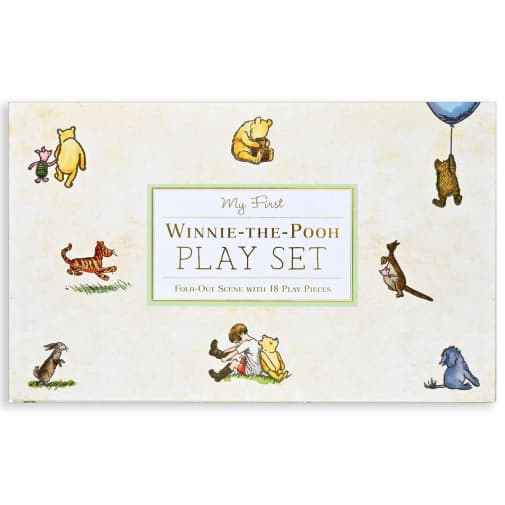
Publisher's Description of My First Play Set - Winnie-The-Pooh
Get ready! Get set! PLAY!
This hands-on play set will spark creativity and imagination in your little one, building a foundation for a lifelong love of learning.
Sensory play is essential for toddlers and preschoolers, helping them develop social and emotional skills while learning how the world works, fostering independent thinking for years to come.
Play set comes with a fold-out Hundred Acre Wood board with printed background and floor.
Comes with 18 adorable Winnie-the-Pooh and friends play pieces.
Play prompts are included to spark learning, imagination, and fun!
Screen-free play for ages 4 and up.
Hardcover fold-out play set with perforated card stock play pieces.
Features original Winnie-the-Pooh art by E. H. Shepard.
Play set measures 13" wide x 8" high folded and 22" wide x 8" high unfolded.
Delighting families for 100 years, A. A. Milne’s Winnie-the-Pooh is a collection of charming stories about a lovable stuffed bear, a young boy, and their many friends! As children, and then again as parents introducing our own children, we went with Winnie to the “Hundred Acre Wood,” and we would be remiss to not take a unit study “Expotition” celebrating this classic children’s story—no matter your age. With childhood themes of cherished companions, memorable conversations, adventures, and melodic “hums” (or ditties), Milne provided endearing stories for the generations. Throughout this study, hyperlinks will lead you to family-friendly websites for enhanced learning.