These icons are designed to help you quickly understand and learn important information about our products.
Teaching Method
Traditional
Teacher-centered curriculum commonly used in classrooms that may include a text, teacher manual, tests, etc.
Charlotte Mason
A methodology based on the work of a 19th century educator who maintained that children learn best from literature (Living Books), not textbooks.
Classical
A methodology based on the Latin Trivium (three stages of learning), including the grammar stage (memorization and facts), logic stage (critical thinking), and rhetoric stage (developing/defending ideas).
Unit Study
A thematic or topical approach centered around one topic that integrates multiple subject areas.
Montessori (Discovery)
A methodology based on the work of a 20th century educator that emphasizes student and sensory-driven discovery learning and real-life applications.
Other
Other methodologies
Religious Content
Secular
Contains content contrary to common Christian beliefs (i.e. evolution).
Neutral
Avoids religious or theoretical topics or presents multiple viewpoints without preference.
Christian/Religious
Faith-based or including instructional religious content.
Learning Modality
Auditory
Learns through listening, talking out loud or reading out loud.
Visual
Learns through seeing, prefers written instructions and visual materials.
Kinesthetic/Tactile (Hands-On)
Learns through moving, doing and touching.
Multi-Sensory
Curriculum that employ a variety of activities/components.
Presentation
Sequential
Curriculum progresses through well-defined learning objectives. Emphasizes mastery before moving to the next topic.
Spiral
Topics and concepts are repeated from level to level, adding more depth at each pass and connecting with review.
Conceptual/Topical
Focus is on the “why,” often with a unifying concept as well as specific skills; coverage may be broader.
Teacher Involvement
Low Teacher Involvement
Student-led materials; parent acts as a facilitator.
Medium Teacher Involvement
A mix of teacher-led time and independent student work.
High Teacher Involvement
Teacher-led lessons; may utilize discussions, hands-on activities and working together.
Additional Materials Required
No other materials needed
Everything you need is included.
Other Materials Required
There are additional required resources that are a separate purchase.
Other Materials Optional
There are additional resources mentioned or recommended but are not absolutely necessary.
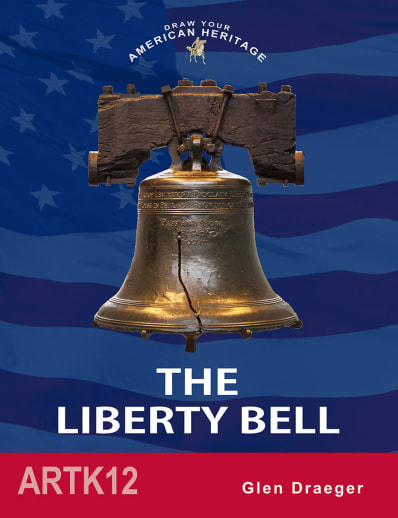
ArtK12 Draw Your American Heritage – the Liberty Bell begins
with fun and lively text providing background context for the art lesson to
follow. Short paragraphs appeal to a range of reading abilities, and all users
enjoy the old photos and graphics. As you begin the drawing lesson, you are
asked to fold a piece of printer paper into 12 sections. The book then walks
you through adding parts of the drawing into each box. It’s an approach that
most students will be comfortable with using on their own. I enjoyed the
commentary as you progress! Funny little tidbits and interesting trivia move
the book along.
The format makes this a natural to add to your unit study of
American history, American monuments, patriotic landmarks, etc. You could also
add this to your art lessons as an example of the grid method.
The book is not consumable. Free templates are available on
the publisher’s website to get you started if you are hesitant to dive right
in. ~Sara
Publisher's Description of ArtK12 Draw Your American Heritage - Liberty Bell
Like the Statue of Liberty, the Liberty Bell is an iconic symbol of freedom and liberty in the
U.S. and the world, but unlike Lady Liberty, the Pennsylvania State
House Bell (its original name) started off as a simple bell to call
leaders in the colonies to meetings in the building that would later be
named Independence Hall where the Declaration of Independence was
signed. This is the 2nd book in our Draw Your American Heritage series.
Students will not only learn the story of how The Liberty Bell became
the icon it is today, but will also draw the bell with easy
step-by-step instructions.
ArtK12 Draw Your American Heritage Series
offers a student activity-based learning with easy-to-read text kids find fun
and fascinating. Loads of photos interject with short paragraphs providing
historical context about what they are to draw. The combination of drawing with
history makes these ArtK12 mini lessons a natural addition to a unit
study. Drawing lessons use the grid method and require only a piece of printer
paper and a pencil to begin. Step-by-step instructions lead you to fold your
paper and use the lines created to replicate the bit of history in a very
manageable way. This method is often
used to scale a photo into a larger format like a poster or even a mural!
The books themselves are not consumable, so the entire
family can use one copy. Use the free downloadable templates to get started if
you are a less confident artist. ~Sara