
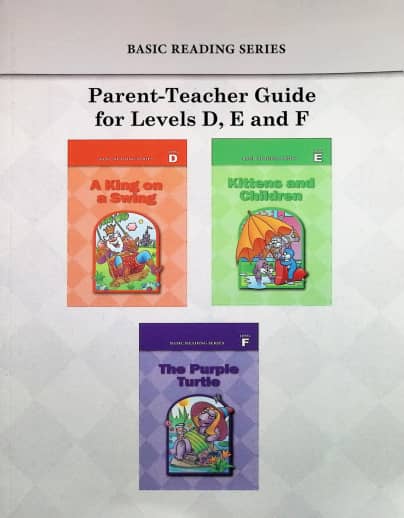
Basic Reading Series: Parent-Teacher Guide for Levels D, E and F
Product Overview
- Explains the methodology and how to use the components of the Basic Reading Series
- Includes step-by-step instructions for each section of the reader
- A placement test for all the levels is included in the back of the guide
Description
The Basic Reading series is a time-tested, linguistics-based reading program originally developed in the 1960s that continues to help thousands of children become confident readers. Using an inductive whole-word phonics approach, it teaches reading by starting with words and word families children already know orally, then gradually introducing new patterns and irregular words in a logical, controlled sequence.
Instead of sounding out individual letters or relying
heavily on sight words, students learn letter-sound relationships in the
context of whole words (for example, m-a-n says man). This method helps
children quickly recognize patterns, build reading confidence, and progress at
their own pace.
Program Highlights:
- Six progressive levels (A through F) not strictly tied to grade levels
- Starts with simple, predictable words and slowly introduces more complex patterns
- Excellent for a wide range of learners, including gifted, on-target, and struggling readers
- Minimal handwriting required; focus stays on reading development
Program Components:
- Colorful Readers: Carefully controlled vocabulary with patterned word lists and engaging stories
- Workbooks: Practice with words, phrases, sentences, and reading comprehension (increasing in complexity by level)
- Parent-Teacher Guides: One for Levels A–C and one for D–F. Each features clear instructions, placement tests, teaching guidance, and program background
The Basic Reading series is a good choice for families looking for a gentle, logical, whole-word phonics approach that builds strong reading foundations without frustration. It works particularly well for children who struggle with traditional intensive phonics programs or need extra time to gain confidence.
Once students complete the full series, they typically have the skills to read practically any age-appropriate English material with fluency and understanding.
| Product Format: | Paperback Book |
|---|---|
| Grades: | K-3 |
| Brand: | Peter Rasmussen |
| ISBN: | 9781937547196 |
| Length in Inches: | 10.875 |
| Width in Inches: | 8.5 |
| Height in Inches: | 0.375 |
| Weight in Pounds: | 0.85 |