Basic Reading Series: Parent-Teacher Guide for Levels A, B and C

SKU
052920
ISBN
9781937547189
Grade K-3
Teaching Method
Traditional
Teacher-centered curriculum commonly used in classrooms that may include a text, teacher manual, tests, etc.
Charlotte Mason
A methodology based on the work of a 19th century educator who maintained that children learn best from literature (Living Books), not textbooks.
Classical
A methodology based on the Latin Trivium (three stages of learning), including the grammar stage (memorization and facts), logic stage (critical thinking), and rhetoric stage (developing/defending ideas).
Unit Study
A thematic or topical approach centered around one topic that integrates multiple subject areas.
Montessori (Discovery)
A methodology based on the work of a 20th century educator that emphasizes student and sensory-driven discovery learning and real-life applications.
Other
Other methodologies
Religious Content
Secular
Contains content contrary to common Christian beliefs (i.e. evolution).
Neutral
Avoids religious or theoretical topics or presents multiple viewpoints without preference.
Christian/Religious
Faith-based or including instructional religious content.
Learning Modality
Auditory
Learns through listening, talking out loud or reading out loud.
Visual
Learns through seeing, prefers written instructions and visual materials.
Kinesthetic/Tactile (Hands-On)
Learns through moving, doing and touching.
Multi-Sensory
Curriculum that employ a variety of activities/components.
Presentation
Sequential
Curriculum progresses through well-defined learning objectives. Emphasizes mastery before moving to the next topic.
Spiral
Topics and concepts are repeated from level to level, adding more depth at each pass and connecting with review.
Conceptual/Topical
Focus is on the “why,” often with a unifying concept as well as specific skills; coverage may be broader.
Teacher Involvement
Low Teacher Involvement
Student-led materials; parent acts as a facilitator.
Medium Teacher Involvement
A mix of teacher-led time and independent student work.
High Teacher Involvement
Teacher-led lessons; may utilize discussions, hands-on activities and working together.
Additional Materials Required
No other materials needed
Everything you need is included.
Other Materials Required
There are additional required resources that are a separate purchase.
Other Materials Optional
There are additional resources mentioned or recommended but are not absolutely necessary.
Consumable
Consumable
Designed to be written in; not reusable.
Non-Consumable
Not designed to be written in; reusable.
Our Price
$11.95

Product Overview

  • Explains the methodology and how to use the components of the Basic Reading Series
  • Includes step-by-step instructions for each section of the reader
  • A placement test for all the levels is included in the back of the guide

Description

Basic Reading Series Parent-Teacher Guide serves as an extremely helpful guide for parents and teachers using the Basic Reading Series A-C. The two-page introduction in front of the book gives an overview of the program, the methodology behind it, and the components for each level. Then each level includes a few pages of advice on how to best implement the program. Next, each level is broken down into sections with scripted lessons. “Worth repeating” tips are placed throughout the guide as helpful hints and reminders so the program will be taught in the most effective way. Instructions are also included on when to begin each section of the workbooks. A note about the authors and a placement test for all the levels are in the back of the guide. With this guide, parents and teachers feel equipped and confident teaching the Basic Reading Series! ~ Gina
Publisher's Description of Basic Reading Series: Parent-Teacher Guide for Levels A, B and C
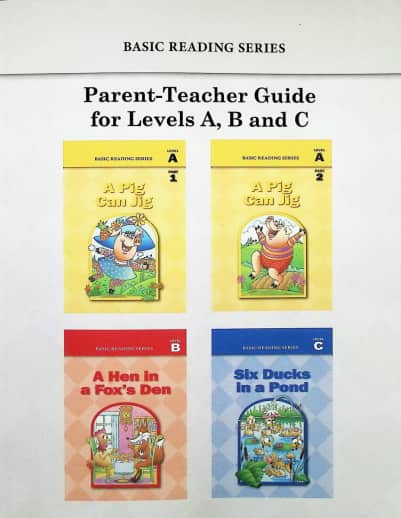
The Basic Reading Series is a successful and proven whole-word phonics program for beginning readers. The series consists of readers and workbooks in six levels: A through F. This Guide -- covering Levels A, B and C -- provides parents and teachers with the resources needed to help them implement the program with a single child or a group of children.
Category Description for Basic Reading Series

Developed in the 1960s, Basic Reading Series is a tried-and-true reading program that has been used in many schools with much success. Taking a different approach to traditional phonics, this program is not a sight word program, but rather “inductive whole-word phonics with a strong research linguistics base.” What exactly does this mean? It teaches language that is already known to children at the oral level and starts with these predictable words and word families before adding irregular words. Children learn the letter-sound relationship in the context of words (the letters m-a-n say man) instead of sounding out each individual letter. Children begin to learn the patterns of words and quickly learn other words (f-a-n says fan, p-a-n says pan, etc.). Then irregular or confusing words are introduced later in small, teachable steps. Building on natural discovery, all learners benefit from this method. Gifted children can take off at a quicker pace, average readers progress nicely, and struggling readers are not overwhelmed because of the controlled order and gradual buildup of word families. The only requirements to start the program are letter recognition and the ability to communicate orally.

This series includes six levels (A-F) and each level has a reader and a workbook (level A has 2 readers). These levels are not designated grades, so children should go through the levels at a pace they can handle. Some children will finish in second grade, while others might continue into third. And some children might develop a solid reading foundation and move on to another reading program or other readers before they finish the series. Once students complete the entire series, they will be able to read practically any English-language material of interest. Because of the controlled vocabulary in the series, supplemental reading material is not recommended while children are just beginning to read. However, reading rich literature aloud to your child is strongly encouraged.

Two Parent-Teacher Guides are available (one for Levels A, B, and C and one for Levels D, E, and F). The guide gives the history of the program, straightforward teaching instructions on how to use the readers and the workbooks, and a placement test. The colorful readers have several sections that begin with a controlled word list that follows a pattern. Students should be familiar with the meaning of the words before beginning the sections. Each workbook has a page detailing how to best use the workbooks. In the Level A workbook, students practice reading words, phrases, and short sentences and matching them with the correct pictures. By Level F, students are reading several paragraphs and practicing lots of varied reading comprehension skills. Purposely, no handwriting is required so children can keep their reading progress separate from their handwriting. I can see this being a good fit for struggling learners who get frustrated when workbooks require written responses.

If your child doesn’t respond well to traditional phonics or you just want to try something different, you might look at this well-done whole-word phonics program that has been used for decades with much success and provides an opportunity to develop confidence in reading at your child’s pace! ~ Gina

Details
More Information
Product Format:Paperback Book
Grades:K-3
Brand:Peter Rasmussen
ISBN:9781937547189
Length in Inches:10.875
Width in Inches:8.5
Height in Inches:0.375
Weight in Pounds:0.9
Videos
This product doesn't have a video
Reviews
Product Q&A