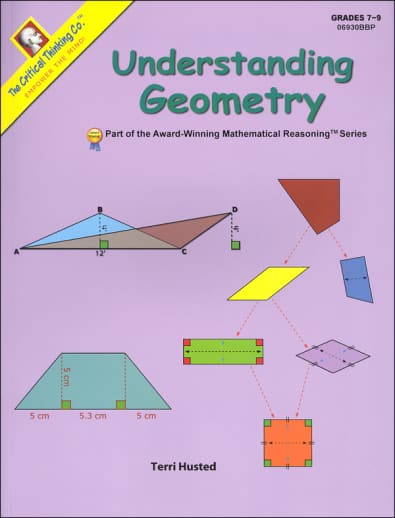
Geometry isn't treated with the intensity in middle school, in many cases, for high school success in the subject. This book follows the National Math Standards and presents an introduction to the basics of geometry. Students won't just learn the properties of geometry, but will learn the reasoning behind the properties and learn the basics of geometric proofs and coordinate geometry. A glossary is included in this 256-page book that can be used as a text in junior high and it is reproducible for family or classroom use. COMPLETE SOLUTIONS ARE AVAILABLE FREE ON THE PUBLISHER WEBSITE.
Understanding Geometry (Mathematical Reasoning)
SKU
052042
ISBN
9781601444530
Grade 7-9
Neutral
Low Teacher Involvement
Visual
Spiral
These icons are designed to help you quickly understand and learn important information about our products.
Teaching Method
Traditional
Teacher-centered curriculum commonly used in classrooms that may include a text, teacher manual, tests, etc.
Charlotte Mason
A methodology based on the work of a 19th century educator who maintained that children learn best from literature (Living Books), not textbooks.
Classical
A methodology based on the Latin Trivium (three stages of learning), including the grammar stage (memorization and facts), logic stage (critical thinking), and rhetoric stage (developing/defending ideas).
Unit Study
A thematic or topical approach centered around one topic that integrates multiple subject areas.
Montessori (Discovery)
A methodology based on the work of a 20th century educator that emphasizes student and sensory-driven discovery learning and real-life applications.
Other
Other methodologies
Religious Content
Secular
Contains content contrary to common Christian beliefs (i.e. evolution).
Neutral
Avoids religious or theoretical topics or presents multiple viewpoints without preference.
Christian/Religious
Faith-based or including instructional religious content.
Learning Modality
Auditory
Learns through listening, talking out loud or reading out loud.
Visual
Learns through seeing, prefers written instructions and visual materials.
Kinesthetic/Tactile (Hands-On)
Learns through moving, doing and touching.
Multi-Sensory
Curriculum that employ a variety of activities/components.
Presentation
Sequential
Curriculum progresses through well-defined learning objectives. Emphasizes mastery before moving to the next topic.
Spiral
Topics and concepts are repeated from level to level, adding more depth at each pass and connecting with review.
Conceptual/Topical
Focus is on the “why,” often with a unifying concept as well as specific skills; coverage may be broader.
Teacher Involvement
Low Teacher Involvement
Student-led materials; parent acts as a facilitator.
Medium Teacher Involvement
A mix of teacher-led time and independent student work.
High Teacher Involvement
Teacher-led lessons; may utilize discussions, hands-on activities and working together.
Additional Materials Required
No other materials needed
Everything you need is included.
Other Materials Required
There are additional required resources that are a separate purchase.
Other Materials Optional
There are additional resources mentioned or recommended but are not absolutely necessary.
Consumable
Consumable
Designed to be written in; not reusable.
Non-Consumable
Not designed to be written in; reusable.
Our Price
$39.99 Description
Publisher's Description of Understanding Geometry (Mathematical Reasoning)
The successful completion of this colorful 272-page book will prepare middle schoolers for high school geometry. It covers more than 50% of the concepts taught in high school geometry using a step-by-step approach and teaches the reasoning behind the properties taught in geometry–instead of merely asking them to memorize them. Students are also taught the basics of geometric proofs and coordinate geometry in a way middle school students can understand. Students who struggle with high school geometry usually have lower standardized test scores because it is a fundamental subject in high school standardized testing.
A glossary of terms that every student should master is included. This book can be used as a classroom textbook in Grades 7, 8, or 9 (usually over a two-year period) or as a reference for high school students. This book covers more than the National Math Standards for middle school mathematics.
This book contains the answers. A free, downloadable Detailed Solutions (PDF) is also available.
Contents
- Geometry Notation
- Lines
- Planes
- Angles—Types and Properties
- Pythagorean Theorem
- Polygons
- Quadrilateral Properties
- Parallelogram Properties
- Perimeter
- Circumference
- Pi
- Trapezoids
- Geometric Constructions
- 3D Shapes—Prism, Cylinders, Pyramids, and Cones
- Symmetry
- Transformations—Reflection, Translations, Rotations, and Dilations
- Tessellations
- Proofs
- Congruency
- Slopes
NOTE: It is our recommendation that students complete Understanding Pre-Algebra before attempting Understanding Geometry
Category Description for Mathematical Reasoning (Gr. PK-9)
Mathematical Reasoning by The Critical Thinking Company is a colorful, engaging, full-color activity book series that builds strong mathematical reasoning and problem-solving skills from early childhood through middle school. Rather than rote memorization, students actively explore concepts through a wide variety of fun, thought-provoking activities.
The program follows a spiral approach with a Concrete → Semi-Concrete → Semi-Abstract → Abstract progression, helping students develop deep understanding and critical thinking.
Key Curriculum Features:
- Covers number concepts, patterns, geometry, measurement, data analysis, fractions, probability, and problem-solving
- NCTM standards aligned with strong emphasis on reasoning and real-world application
- Engaging, full-color worksheets with eye-catching illustrations and hands-on activities
- Spiral review that reinforces concepts over time
- Suitable as a core curriculum or supplement for critical thinking and skill reinforcement
- Begins with simple readiness skills for ages 3–4 and progresses to advanced topics through Grade 6, plus the Geometry level
Program Components:
- Student Books: Full-color, consumable activity books (Levels Beginning 1 & 2 for ages 3–4; Levels A–G for Grades K–6; Geometry also available)
- Answers provided in the back of books starting in Level B
- Reproducible for family use
Mathematical Reasoning curriculum stands out for its fun, non-intimidating format that develops both mathematical skills and critical thinking. It is an excellent choice for homeschool families seeking an engaging, long-term math reasoning program that works well as a core or supplement.
Browse all Mathematical Reasoning levels and resources below!
Details
| Product Format: | Paperback Book |
|---|---|
| Grades: | 7-9 |
| Brand: | Critical Thinking Company |
| Length in Inches: | 11 |
| Width in Inches: | 8.5 |
| Height in Inches: | 0.8125 |
| Weight in Pounds: | 2 |
Videos
Reviews