
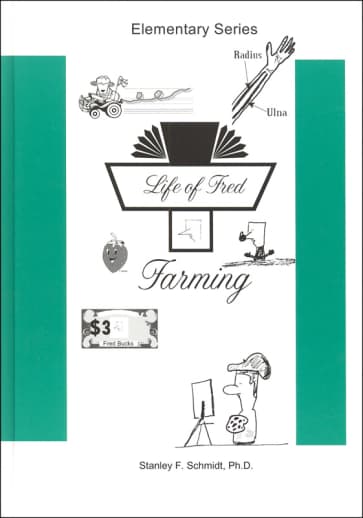

Sixth in
the elementary series of Life of Fred, in Farming, this book introduces
readers to Kingie, Fred’s oil painting doll who joins in the adventures. Kingie’s
pictures are visible throughout the book and Fred’s drawing of Kingie is on the
front cover.
The
recommended schedule for Farming (as with others in the elementary
series) is a chapter a day (6 pages). At the end of each chapter, there’s a
“Your Turn to Play” (ranging from 3-6 questions). With 19 chapters, you’d
finish the book in about 4 weeks. The author recommends students write out
their answers in a separate notebook. Then, they will check their work using
the answers provided on the next page. Periodically, you’ll find additional
problems to answer orally in A Row of Practice.
Math
topics reviewed include double- and triple-digit addition; community;
measurement (gallon, diameter, circumference, time); functions, cardinal
numbers; tips for adding faster; consecutive even, natural, and odd numbers; pi,
radius, diameter; commutative law of addition, multiplication, and property of
set union, and more. By the end of this book, your student should be a “Wizard
of Addition.”
The
adventures of Fred will include atypical concepts for an elementary math text,
including poetry by Joyce Kilmer, oenology (wine making), obligate carnivores,
a caesura (i.e., a pause), paleobotanists, and more.
Note on
content: the Ten
Commandments are mentioned—only because of the number itself. In chapter
sixteen, Fred and friends mathematically discuss Moses and the plagues. In
chapter 9, two characters are arrested for fraud and in chapter ten, a
cigar-smoking unscrupulous character escapes the police in chapter 10. Purchase
this book individually or in a set of Level E-J, or as part of the Elementary Package. Copyright 2017. 127 pages,
nonconsumable, hardcover. ~ Ruth
Life of Fred: Farming
SKU
050462
ISBN
9780979107290
Grade 2-5
Neutral
Low Teacher Involvement
Visual
No other materials needed
Sequential
These icons are designed to help you quickly understand and learn important information about our products.
Teaching Method
Traditional
Teacher-centered curriculum commonly used in classrooms that may include a text, teacher manual, tests, etc.
Charlotte Mason
A methodology based on the work of a 19th century educator who maintained that children learn best from literature (Living Books), not textbooks.
Classical
A methodology based on the Latin Trivium (three stages of learning), including the grammar stage (memorization and facts), logic stage (critical thinking), and rhetoric stage (developing/defending ideas).
Unit Study
A thematic or topical approach centered around one topic that integrates multiple subject areas.
Montessori (Discovery)
A methodology based on the work of a 20th century educator that emphasizes student and sensory-driven discovery learning and real-life applications.
Other
Other methodologies
Religious Content
Secular
Contains content contrary to common Christian beliefs (i.e. evolution).
Neutral
Avoids religious or theoretical topics or presents multiple viewpoints without preference.
Christian/Religious
Faith-based or including instructional religious content.
Learning Modality
Auditory
Learns through listening, talking out loud or reading out loud.
Visual
Learns through seeing, prefers written instructions and visual materials.
Kinesthetic/Tactile (Hands-On)
Learns through moving, doing and touching.
Multi-Sensory
Curriculum that employ a variety of activities/components.
Presentation
Sequential
Curriculum progresses through well-defined learning objectives. Emphasizes mastery before moving to the next topic.
Spiral
Topics and concepts are repeated from level to level, adding more depth at each pass and connecting with review.
Conceptual/Topical
Focus is on the “why,” often with a unifying concept as well as specific skills; coverage may be broader.
Teacher Involvement
Low Teacher Involvement
Student-led materials; parent acts as a facilitator.
Medium Teacher Involvement
A mix of teacher-led time and independent student work.
High Teacher Involvement
Teacher-led lessons; may utilize discussions, hands-on activities and working together.
Additional Materials Required
No other materials needed
Everything you need is included.
Other Materials Required
There are additional required resources that are a separate purchase.
Other Materials Optional
There are additional resources mentioned or recommended but are not absolutely necessary.
Consumable
Consumable
Designed to be written in; not reusable.
Non-Consumable
Not designed to be written in; reusable.
Our Price
$19.00 Product Overview
- “Your turn to play” section follows each of 19 chapters
- Engaging way to supplement or review math concepts
Description
Publisher's Description of Life of Fred: Farming
This book covers beginning mathematics including . . .
- Adding to 14
- Googol
- Percents
- Adding to 16
- Rows of a Matrix
- Median Average
- Union of Sets
- All of Mathematics Generated by the Empty Set
- Proof that the Set of Everything (the Universal Set) Cannot Exist
- Cardinality of a Set
- Collinear Points
- Numbers vs. Numerals
- Borrowing One in Subtraction
- Definition of Function
- Domain and Codomain
- Radius and Ulna
- Dollars in Different Denominations
- and much more . . .
Unlike all other math
programs, this one also teaches about:
• Why Many Dolls Have a Vacant Stare
• Litotes
• Three Things in Order to be Great
• Oxymorons
• Collective Nouns
• Cock-a-doodle-doo in Four Languages
• Circumference of the World, What Iniquitous Means
• The Second Sound Recording Ever Made
• The Proof that Every Number is Interesting
• Flour Fights Are Fun
• Rhetorical Questions
• The Game of Questions
• Caesura
• Humerus vs. Humorous
The answers are included in the textbook.
Life of Fred Farming is a hardcover textbook containing 128 pages. This book is not consumable. All answers are written on separate paper or in a notebook. It is designed to be read with the student.
Life of Fred Farming contains 19 lessons and is designed to take approximately one month to complete.
Category Description for Life of Fred Elementary Series
This nontraditional
Life of Fred Elementary curriculum is as simple as ABC: these books progress
in alphabetical order by title. Designed to help students understand why they
are learning math, students can start this series if they know addition and
subtraction facts up to 10. The entire elementary series (Apples
through Jelly Beans) can be completed in just 12-18 months. Apples
through Dogs overviews grades 1-4 concepts (also available as a package).
Edgewood through Jelly Beans is designed for grades 2-4 concepts (available
as a package). All elementary books can also be
purchased as a complete package.
However, no matter your student’s elementary level, the program recommends
beginning with Apples.
Each book
follows the adventures of five-year-old Fred, a professor at Kittens University.
These ten elementary series books tell stories that happen in one week of Fred’s
life. Fred, of course, behaves like the child he is, but also exhibits positive
behaviors and character qualities (responsibility, cleanliness, making wise
choices, valuing truth and honesty, etc.). Chapters will also include content
from other subjects, such as time; the Earth’s composition; Archimedes;
seasons; how to not be rude; or the difference between fish and whales. Books
include Fred’s drawings and funny photographs. The writing also includes a
quirky sense of humor. The text will sometimes vary in font size—just for the
fun of it. As a narrative series, the math terms and concepts covered in each
book are found in its Index. To ensure what is reviewed and taught, consult the
index as the best resource. See each
individual book descriptions for specific content or parental alerts.
The math
concepts begin with simple addition. The books progress using a spiral
approach, each one going deeper into math concepts and other engaging facts and
knowledge. The math principles and concepts are taught with:
- An engaging story that continues one chapter at a time
- Direct application of concepts taught
- Interesting facts, characters, and tidbits (some non-math related)
- A chapter-ending exercise called, "Your Turn to Play," where students solve a handful of problems. Solutions are found on the next page.
Details
| Product Format: | Hardcover Book |
|---|---|
| Grades: | 2-5 |
| Brand: | Z-twist Books |
| ISBN: | 9780979107290 |
| Length in Inches: | 10.375 |
| Width in Inches: | 7.25 |
| Height in Inches: | 0.5 |
| Weight in Pounds: | 0.95 |
Videos
Reviews