It is hard to not fall in love with a course that begins,
"A physician writing physics? How does he know anything about
physics?" Continuing, the author explains that we are specializing
ourselves out of the ability to appreciate and understand any subject, he
reinforces the fact that we can learn anything if we are purposeful and devoted
to learning the subject. While this may seem like a laborious introduction, for
many of us, learning physics seems overly complicated, and I greatly appreciate
the efforts Dr. Hardin has taken to write a comprehensive, engaging, and
understandable physics course!
Written from a biblical worldview, Science
Shepherd Fundamentals of Physics introduces students to the
general study of physics as well as to specific topics such as the scientific
method, standardized measurement and data collection, matter (solids, liquids,
gases), kinetic energy and potential energy, forces, mechanical equilibrium,
Newton's laws of motion, gravity, waves, sound, light, color, and radioactive
physics. The course concludes with a brief history of science and scientists
through a biblical worldview and provides readers with applications of physics
that support God's creation of the universe. Labs are not included in the
Textbook; rather, they are found in the optional (recommended) Fundamentals of Physics Lab
Manual, which covers the key principles taught in the course.
There are three required components for this rigorous middle
school course. The Fundamentals of Physics Student Textbook, the
Fundamentals of Physics Answer Key and Parent
Companion, and the consumable Fundamentals of Physics Test
Booklet. These components are available individually or in a
convenient Fundamentals
of Physics Set.
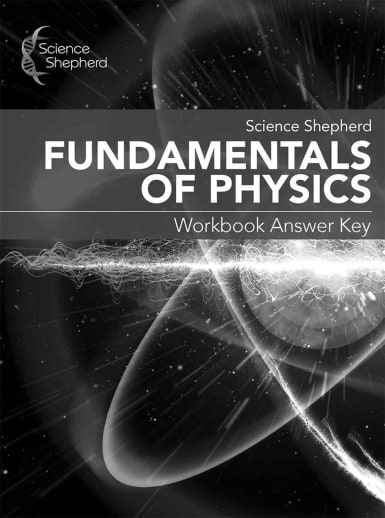
Optional resources include the Fundamentals of Physics
Workbook and the Workbook Answer Key,
which are companions to the Fundamentals of Physics Digital Course available
from Science
Shepherd. This is a rigorous course that homeschool families will
appreciate for its clear explanations, ease of use, and excellent preparation
for high school science study. It may also function as an excellent
introductory physics course for 9th-10th grade.
~Deanne