
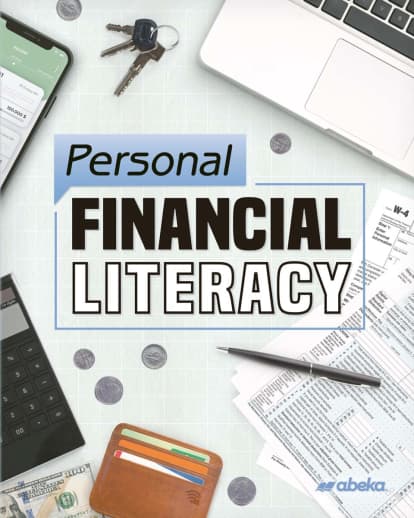
Personal Financial Literacy (432113)

SKU
044261
ISBN
9781632232168
Grade 11-12
Teaching Method
Traditional
Teacher-centered curriculum commonly used in classrooms that may include a text, teacher manual, tests, etc.
Charlotte Mason
A methodology based on the work of a 19th century educator who maintained that children learn best from literature (Living Books), not textbooks.
Classical
A methodology based on the Latin Trivium (three stages of learning), including the grammar stage (memorization and facts), logic stage (critical thinking), and rhetoric stage (developing/defending ideas).
Unit Study
A thematic or topical approach centered around one topic that integrates multiple subject areas.
Montessori (Discovery)
A methodology based on the work of a 20th century educator that emphasizes student and sensory-driven discovery learning and real-life applications.
Other
Other methodologies
Religious Content
Secular
Contains content contrary to common Christian beliefs (i.e. evolution).
Neutral
Avoids religious or theoretical topics or presents multiple viewpoints without preference.
Christian/Religious
Faith-based or including instructional religious content.
Learning Modality
Auditory
Learns through listening, talking out loud or reading out loud.
Visual
Learns through seeing, prefers written instructions and visual materials.
Kinesthetic/Tactile (Hands-On)
Learns through moving, doing and touching.
Multi-Sensory
Curriculum that employ a variety of activities/components.
Presentation
Sequential
Curriculum progresses through well-defined learning objectives. Emphasizes mastery before moving to the next topic.
Spiral
Topics and concepts are repeated from level to level, adding more depth at each pass and connecting with review.
Conceptual/Topical
Focus is on the “why,” often with a unifying concept as well as specific skills; coverage may be broader.
Teacher Involvement
Low Teacher Involvement
Student-led materials; parent acts as a facilitator.
Medium Teacher Involvement
A mix of teacher-led time and independent student work.
High Teacher Involvement
Teacher-led lessons; may utilize discussions, hands-on activities and working together.
Additional Materials Required
No other materials needed
Everything you need is included.
Other Materials Required
There are additional required resources that are a separate purchase.
Other Materials Optional
There are additional resources mentioned or recommended but are not absolutely necessary.
Consumable
Consumable
Designed to be written in; not reusable.
Non-Consumable
Not designed to be written in; reusable.
Our Price
$41.55

Product Overview

  • Abeka elective worth ½ credit for high school
  • Blends practical money management with a biblical perspective on stewardship
  • Financial practices extend into 21st century financial technology
  • Real world application projects

Description

The Personal Financial Literacy student textbook has many features to make study interesting and successful. Notes in the margin are color-coded: Yellow tips contain additional facts, Green notes give definitions and other important pieces of information, and Blue thought provokers ask critical thinking questions. Special feature boxes also appear throughout the text. Tech connect boxes highlight financial technology, reality check boxes prompt thinking about real-life applications, and biblical worldview boxes bring to focus what God’s Word says about finances.

There is a total of 9 chapters that cover practical money-management skills through real-world projects on budgeting, banking, college and career planning, debt, insurance, housing, transportation, and investing with a balanced biblical perspective on stewardship. Each chapter has several section reviews and concludes with a final chapter review section. Real Life Application Activity exercises are found in the back of the textbook and the workbook pages needed are found in the Student Quizzes/Tests workbook. A generous glossary concludes the student textbook. Each entry provides the section number of where to locate the term in the textbook. First Edition. Softcover, 296 pages. ~Amber

Publisher's Description of Personal Financial Literacy (432113)

Personal Financial Literacy introduces students to conventional financial practices and cutting-edge technologies that they will navigate as adults. Content is reinforced with dozens of engaging real-world simulation projects and examples that include: creating a high school budget that prioritizes saving, choosing an occupation based on God-given aptitudes, exploring funding options for college or skilled job training, opening and managing bank accounts, practicing a zero-based budget for a young adult income and spending needs, purchasing a vehicle, renting and setting up an apartment, building an excellent financial reputation, learning how to avoid high interest rates and pay off debt, choosing the correct insurance to protect income and assets, and choosing a diversified investment portfolio. While learning about earning income, spending, saving, credit and debt, insurance, and investments, students will be challenged to align the content they are studying with Scripture to develop personal convictions about stewardship. The balanced, biblical perspective combined with the practical preparation for managing personal finances provides a valuable resource for young adults.

Category Description for Abeka Personal Financial Literacy

Personal Financial Literacy equips students with practical money-management skills through real-world projects with a balanced biblical perspective on stewardship. This 1 semester (½ credit) course helps young adults build financial confidence and develop convictions for wise earning, spending, saving, and giving. The following topics are covered:

  • Foundations of personal finance
  • Budgeting
  • Starting a career with or without a college degree
  • Becoming a wise consumer
  • Managing cash flow
  • Establishing credit and avoiding debt
  • Controlling risk
  • Investing in the future

The Student Textbook has many features to make study interesting and successful. Notes in the margin include quotes, tips, notes, biblical worldview, technology, and thought provokers. Life Activities are found in the back of the textbook. Worksheets and Handouts for Life Activity Exercises and Action programs assigned within the Section Review of the student textbook are located in the Student Quizzes/Tests along with all assessments. Answers to assessments are found in the Teacher Quiz/Test Key with solutions. The Life Activity exercises solution key is found in the Teacher Edition.

The Personal Financial Literacy Teacher Edition provides lesson plans, answers, teaching procedures, discussion questions, solutions key for chapter reviews and life activity exercises, and more for this one-semester course with 85 lessons. A calculator of your choice is recommended for students to use. Digital Teaching Slides are referenced and can be purchased through abeka.com. Prerequisite math skills required are arithmetic, percentages, decimals, and ratios.

This is a great option for a student looking for some up-to-date, practical life skills teaching in personal finances! First Edition. ~Amber

Details
More Information
Product Format:Paperback Book
Grades:11-12
Brand:Abeka
ISBN:9781632232168
Length in Inches:10
Width in Inches:8
Height in Inches:0.5
Weight in Pounds:1.35
Videos
This product doesn't have a video
Reviews
Product Q&A