
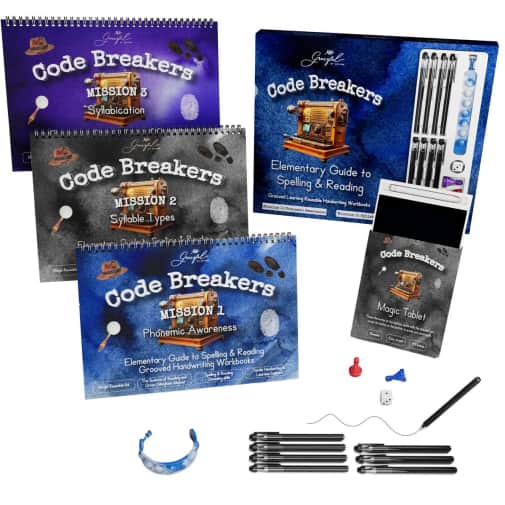
Young children undertake an exciting mission as they become spies to crack open the codes of reading, spelling and handwriting! Code Breakers by Grooved Learning offers a unique learning experience for kids because of the grooved letters kids can touch and feel. This program is super flexible! Use as a standalone program or as a supplement. If using as a standalone, just add decodable readers aligned to the Science of Reading to practice fluency. The Code Breakers Toolkit offers a lot of valuable components! The Toolkit includes a start guide, three reusable grooved handwriting workbooks, eight magic self-erasing pens, game pieces, a reusable magic tablet, and a complimentary digital library with lots of support materials.
The Start Guide is a small booklet that includes simple instructions on how to start your mission and QR codes to access digital resources. A description of all the products in the Toolkit and how they are meant to be used is also included in the guide.
Top-bound spiral Mission Manuals (reusable handwriting workbooks) allow pages to flip from top to bottom. The top portion includes the “code” or phonics/spelling rule and the bottom provides practice. Using all modes of learning, students listen to parents read and teach the code, look at the visual examples, and feel and write in the grooved letters. The grooved letters on the practice pages guide the pen and train the hand muscles. This tactile and sensory feedback ensures correct letter formation and consistent spacing while improving fine motor skills. Students are practicing reading, spelling, and handwriting all at the same time! The Magic Pens erase just after 20 minutes (or can be wiped away instantly) providing kids with endless practice without worksheets! The grooved color-coded dots and blending bars (with a provided key) underneath letters and words help even more with beginning reading skills. Learn letters, sounds, blends, and digraphs in Mission Manual 1. Overcome sneaky spelling rules and learn about six syllable types in Mission 2. Read longer words and learn syllable division in Mission 3.
Game pieces include 2 pop-it bracelets students can pop as they say each sound; a basketball game with small cardstock basketballs for practicing vowel teams; and game pieces for a Chutes and Ladders game to practice blends and digraphs. The games are included in the spiral workbooks. The back of each basketball piece is blank and can be used as a counter to mark the number of sounds in each word or as a marker for Diphthong Bingo.
The reusable Magic Tablet is a mess-free writing board (8 ½ inches) that comes with a writing pen. This gives students practice writing letters and words without the grooves. Just press the button at the bottom of the board to erase and use again!
The Top Secret Digital Library is chock-full of tools offering extremely helpful guidance for the lessons. The library includes a printable scope & sequence and word list, printable workbooks and sound cards, and over 60 teacher support videos! The short videos are not overwhelming and show you exactly how to teach the concepts and use the materials effectively. You can also create a free account to access the AI companion named Groovie. Your friend, Groovie, provides useful information about teaching reading, creates individual lesson plans for you, provides interactive blending practice and games, and gives you access to engaging decodable e-books (that can also be read aloud).
How do the lessons work? Scan the QR code in the Start Guide to open the Top Secret Digital Library. The twenty-page printable scope & sequence is your mission plan. Follow this sequence and check off each skill as it is learned. After you teach the new concept, your student practices it by using the grooved handwriting pages. Your student still interacts with you by saying the sounds or reading the words as he/she practices the handwriting. The color-coded dots and blending bars underneath the letters and words provide helpful clues. Each marking represents a sound and as students glide their finger over the phonemic markings, they can see and feel the distinct sounds in each word. Work your way through the manuals at your student’s pace. The videos guide you through how to teach each concept. Keep lessons short (10-15 minutes) then review with a game, word assessment (included), decodable reader, or a passage (aligned with the Science of Reading) for another 5-10 minutes if desired. Being consistent is the key to seeing success!
Sound Cards (sold separately) are an additional resource that complement the Code Breakers program. Each Sound Card Set comes with sound cards, dividers, 3 magic pens with refills, a start guide, and a mirror so students can see how their mouth moves as they say each sound. On one side of each card there is a letter(s) with a colorful illustration that represents the sound. The other side has the sound or rule, the grooved letters of the word that portray the illustration, grooved color-coded dots and blending bars, and more words using that specific sound. The cards used alongside Code Breakers add an extra element of learning. For example, as students are learning their vowel sounds in the first manual, the sound card for the short “e” and long “e” can be used to help teach these sounds. Students can look at the picture of an elk (short e) and eel (long e) and say the sound from the sound card as they practice writing the letter “e” in the manual.
Younger children might just begin with the sound cards first
to learn the letters. Some children might also use the first page of the
workbook with the sound cards to practice letter sound recognition. Older
children might start reading simple words once they understand the first 10 to
15 letters. Again, the program is extremely flexible!
Code Breakers is aligned to the Science of Reading and uses the Orton Gillingham methodology, teaching to all avenues of learning (seeing, hearing, and touching). Children actually enjoy learning with the short lessons and hands-on approach as they use their code breaking skills to discover the patterns behind reading, spelling, and handwriting! ~ Gina