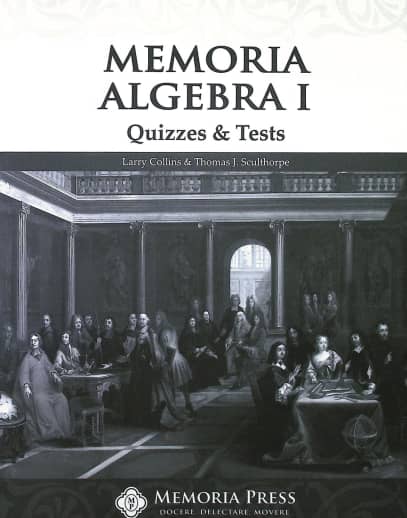

Includes twenty-one quizzes, five tests, and one final exam. Quizzes are given at the end of each section and just cover the material in that section. Tests are cumulative and given at the end of each unit. The final exam covers all units and students should strive to score an 85% or greater on this exam. All quizzes and tests have both an A and B form. Reserve Form B assessments for retakes or final exam review. ~ Gina
Memoria Algebra I Quizzes & Tests
SKU
033692
ISBN
9781547705603
Grade 8-9
These icons are designed to help you quickly understand and learn important information about our products.
Teaching Method
Traditional
Teacher-centered curriculum commonly used in classrooms that may include a text, teacher manual, tests, etc.
Charlotte Mason
A methodology based on the work of a 19th century educator who maintained that children learn best from literature (Living Books), not textbooks.
Classical
A methodology based on the Latin Trivium (three stages of learning), including the grammar stage (memorization and facts), logic stage (critical thinking), and rhetoric stage (developing/defending ideas).
Unit Study
A thematic or topical approach centered around one topic that integrates multiple subject areas.
Montessori (Discovery)
A methodology based on the work of a 20th century educator that emphasizes student and sensory-driven discovery learning and real-life applications.
Other
Other methodologies
Religious Content
Secular
Contains content contrary to common Christian beliefs (i.e. evolution).
Neutral
Avoids religious or theoretical topics or presents multiple viewpoints without preference.
Christian/Religious
Faith-based or including instructional religious content.
Learning Modality
Auditory
Learns through listening, talking out loud or reading out loud.
Visual
Learns through seeing, prefers written instructions and visual materials.
Kinesthetic/Tactile (Hands-On)
Learns through moving, doing and touching.
Multi-Sensory
Curriculum that employ a variety of activities/components.
Presentation
Sequential
Curriculum progresses through well-defined learning objectives. Emphasizes mastery before moving to the next topic.
Spiral
Topics and concepts are repeated from level to level, adding more depth at each pass and connecting with review.
Conceptual/Topical
Focus is on the “why,” often with a unifying concept as well as specific skills; coverage may be broader.
Teacher Involvement
Low Teacher Involvement
Student-led materials; parent acts as a facilitator.
Medium Teacher Involvement
A mix of teacher-led time and independent student work.
High Teacher Involvement
Teacher-led lessons; may utilize discussions, hands-on activities and working together.
Additional Materials Required
No other materials needed
Everything you need is included.
Other Materials Required
There are additional required resources that are a separate purchase.
Other Materials Optional
There are additional resources mentioned or recommended but are not absolutely necessary.
Consumable
Consumable
Designed to be written in; not reusable.
Non-Consumable
Not designed to be written in; reusable.
Our Price
$20.00 $20.00 $17.50
Rainbow Savings: $2.50
Product Overview
- Includes an A and B form of each quiz and test for Memoria Press Algebra I
- Includes some open response questions to ensure students are understanding concepts
Description
Publisher's Description of Memoria Algebra I Quizzes & Tests
The Memoria Algebra I Quizzes & Tests include two versions of each assessment for practice and repeated attempts.
Category Description for Memoria Algebra I
Tom Clark, the author of Videotext Interactive, has co-authored this program with Thomas Sculthorpe. Memoria Algebra 1 uses a logical sequence of study, where each concept is introduced systemically in a way that students should be able to use previous concepts to solve new concepts learned. The teacher guide provides instructional guidance, and each new concept is described in detail with examples shown in the student text. Then students solve problems independently and can check their work in the solution manual. The five units include First-Degree Relations with Two Variables; First-Degree Relations with Three or More Variables; Higher-Degree Relations – Polynomials; Higher-Degree Relations – Algebraic Fractions; and Rational Degree Relations. Equations and inequalities are taught together and concepts are developed in order of degrees. A recitation schedule in the Appendix of the student and teacher manual has mathematical statements students should work on mastering to help with the success of the course. To ensure your student is ready for this course, students can complete the Readiness Exam in the back of the Teacher Manual. Available components include a teacher manual, student text, quizzes and tests, solution key, and instructional videos. Course components can be purchased individually, or as a Set.
The spiral bound Teacher Manual closely aligns with the material in the videos and is the primary instructional resource for the course. If you have an elementary understanding of algebra, you should be able to follow the instructions easily. The teacher manual has reduced copies of the student text with instruction in the sidebars. An answer key for the lesson exercises is also included.
The non-consumable Student Text is also spiral bound and includes an objective for each lesson, review of important terms, and example problems with solutions. The terms and example problems should be mastered before students move on to complete the exercise problems. The appendix includes the recitation schedule and an answer key to the odd problems.
Quizzes & Tests are used to assess the student’s progress. Following the classical approach, quizzes and tests include some open-response questions, asking students to write their understanding of a concept. This is beneficial in really making sure students are comprehending what they are learning. A quiz is given at the conclusion of each section and a test at the conclusion of each unit. Quizzes test only the material in the section, whereas the tests are cumulative. A final exam covers all the material at the end of the course.
Complete, detailed solutions to the student text exercises and quizzes & tests are included in the spiral bound Solutions Key.
Instructional Videos are a supplement to the course. Co-author, Thomas Sculthorpe presents the instruction in the streaming videos. They were recorded when he was teaching a class that met once a week at a classical school. Use these videos as needed to reinforce lesson content. ~ Gina
Details
| Product Format: | Paperback |
|---|---|
| Grades: | 8-9 |
| Brand: | Memoria Press |
| ISBN: | 9781547705603 |
| Length in Inches: | 11 |
| Width in Inches: | 8.5 |
| Height in Inches: | 0.5 |
| Weight in Pounds: | 1.4 |
Videos
Reviews