
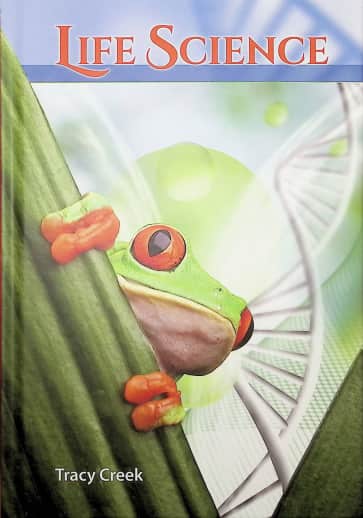
Novare’s Life Science Student Text offers colorful illustrations, clear objectives and textual information, and learning checks to assess student understanding. Beginning with introductory information for teachers that explains the Novare’s core principles of Wonder, Integration, and Mastery, and the Kingdom Perspective and how to teach the course effectively. Students are also given a course introduction. I appreciate how this section explains the course goals of mastery and retention, and then provides the student the study tools and routines they will need to succeed in the course. Topically, students begin with an introduction to life science and learn the scientific method, scale and goals of life science and scientific measurement. The following chapters build on this foundational information and cover molecules and cells with an overview of biochemistry, the human body systems, genetics and plant and animal reproduction, photosynthesis, metabolism, and homeostasis, human and plant sensory systems, ecosystems, climate and the biosphere, major biomes of the world, biodiversity, and evolutionary theory and variations, natural selection, and adaption. The author makes a strong case for Christian students studying and understanding evolutionary theory with a clearly explained chart explaining how various positions (Young Earth Creationism, Old Earth Creationism, Intelligent Design, and Evolutionary Creationism) interpret scripture, view the age of the earth/universe, and view the creation of living things. Families unfamiliar with Novare Science, should note the core philosophy of the authors is that science education in our country needs to be renewed using research, scientific evidence, and forward-thinking strategies while keeping God at the helm.
Novare Life Science Student Text
Product Overview
- Minimal mathematic requirements make Novare’s Life Science an excellent middle school science program
- Colorful illustrations and ample white space are visually appealing, yet not overwhelming
- God-centered worldview that teaches current scientific theories
- Follows a mastery approach, teaching fewer topics with more depth than typical courses while reviewing previously learned key concepts
Description
Life Science, by Tracy Creek, is the text for a year-long course designed for 6th grade. The mathematics in Life Science is minimal, making the text a good fit for 6th grade, but it may also be used successfully in grades 7 or 8.
The study of biology has changed substantially in the twenty-first century. Fifty years ago, texts in the life sciences focused primarily on the structures and features of different types of organisms. Today, however, much of current technology and news is about cellular and molecular biology, and thus a life science text that is relevant for today's students must contain a balance of content addressing important large-scale topics and key micro-scale topics, treated at an appropriate level.
Novare Life Science maintains exactly this balance. Large-scale topics include human organ systems, animal and plant reproduction, and inheritance of traits. Micro-scale topics include cellular respiration, photosynthesis, mitosis, meiosis, and sensory systems. Additionally, there are four crucial chapters treating the energy, populations, nutrient cycles, and biomes of ecosystems. The two final chapters provide an introduction to evolutionary theory and a fascinating description of how mutations in DNA lead to genetic variation.
With minimal mathematics, Novare Life Science provides sixth grade students with an in-depth look at life science from the structures and features of different types of organisms to cellular and molecular biology. Topically, students begin with an introduction to life science and learn the scientific method, scale and goals of life science and scientific measurement. The following chapters build on this foundational information and cover molecules and cells with an overview of biochemistry, the human body systems, genetics and plant and animal reproduction, photosynthesis, metabolism, and homeostasis, human and plant sensory systems, ecosystems, climate and the biosphere, major biomes and biodiversity. Evolutionary theory and variations, natural selection, and adaptation are included.
The author strongly believes Christian students should study and
understand evolutionary theory. Young Earth Creationism, Old Earth Creationism,
Intelligent Design, and Evolutionary Creationism are compared showing how each
interpret scripture, the age of the earth/universe, and the creation of living
things. Families unfamiliar with Novare Science should note the core
philosophy of Novare Science is that science education in our country needs to
be renewed using research, scientific evidence, and forward-thinking strategies
while keeping God at the helm. Students are taught to see God in creation,
while learning current secular scientific theories that support an old-earth
creation. Looking at the scope of content, this course would also meet the
needs of 7th-8th grade students.
Novare Life Science is an academically rigorous course that focuses on content mastery, and not just the cram-pass-forget cycle that is common in middle and high school sciences. Required components include the Student Textbook with introductory information for parents and students and all the student readings, and the Apprentice’s Companion which is a consumable experiment book and field manual. Make sure you download the PDF file of the Teacher’s Guide for the Apprentice's Companion which provides teaching support for the lab activities. Optional components include Digital Resources which offers printable student reviews, quizzes and exams, a lesson schedule, and a convenient Lab Kit. The Novare Life Science Program includes the Student Textbook, Apprentice’s Companion, and the Digital Resources.
| Product Format: | Hardcover |
|---|---|
| Grades: | 6-8 |
| Brand: | Classical Academic Press |
| ISBN: | 9781600514593 |
| Length in Inches: | 9.75 |
| Width in Inches: | 6.75 |
| Height in Inches: | 1 |
| Weight in Pounds: | 2.15 |