These icons are designed to help you quickly understand and learn important information about our products.
Teaching Method
Traditional
Teacher-centered curriculum commonly used in classrooms that may include a text, teacher manual, tests, etc.
Charlotte Mason
A methodology based on the work of a 19th century educator who maintained that children learn best from literature (Living Books), not textbooks.
Classical
A methodology based on the Latin Trivium (three stages of learning), including the grammar stage (memorization and facts), logic stage (critical thinking), and rhetoric stage (developing/defending ideas).
Unit Study
A thematic or topical approach centered around one topic that integrates multiple subject areas.
Montessori (Discovery)
A methodology based on the work of a 20th century educator that emphasizes student and sensory-driven discovery learning and real-life applications.
Other
Other methodologies
Religious Content
Secular
Contains content contrary to common Christian beliefs (i.e. evolution).
Neutral
Avoids religious or theoretical topics or presents multiple viewpoints without preference.
Christian/Religious
Faith-based or including instructional religious content.
Learning Modality
Auditory
Learns through listening, talking out loud or reading out loud.
Visual
Learns through seeing, prefers written instructions and visual materials.
Kinesthetic/Tactile (Hands-On)
Learns through moving, doing and touching.
Multi-Sensory
Curriculum that employ a variety of activities/components.
Presentation
Sequential
Curriculum progresses through well-defined learning objectives. Emphasizes mastery before moving to the next topic.
Spiral
Topics and concepts are repeated from level to level, adding more depth at each pass and connecting with review.
Conceptual/Topical
Focus is on the “why,” often with a unifying concept as well as specific skills; coverage may be broader.
Teacher Involvement
Low Teacher Involvement
Student-led materials; parent acts as a facilitator.
Medium Teacher Involvement
A mix of teacher-led time and independent student work.
High Teacher Involvement
Teacher-led lessons; may utilize discussions, hands-on activities and working together.
Additional Materials Required
No other materials needed
Everything you need is included.
Other Materials Required
There are additional required resources that are a separate purchase.
Other Materials Optional
There are additional resources mentioned or recommended but are not absolutely necessary.
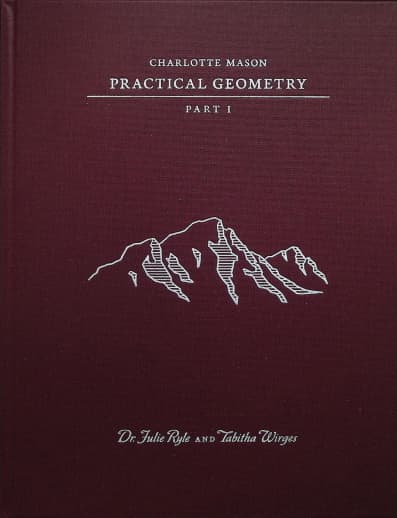
A companion to the Charlotte Mason Elementary Mathematics Book 5, Practical Geometry is an integral part of Simply Charlotte Mason’s Arithmetic sequence. Planned for one day per week (Friday per Charlotte Mason’s writings), Practical Geometry 1 teaches solids, figures and lines, line segments and measurements, circles, and angles. The focus remains on short, concentrated lessons (about 30 minutes a day) and a balance of parent-child interaction and independent work. The course is designed to be twofold: to be practical and applicable to a child’s daily life and to lay a foundation for success at the high school level. Three end-of-term exams are included, as are all answers. Optional lessons are included for families who wish to explore concepts more in-depth. Recommended for the course are a standard ruler (1/16”) and metric ruler (1mm.), drawing compass, protractor, set squares (30/60 and 45/90), and grid paper. Some household items are suggested.
Publisher's Description of Practical Geometry Part 1
The study of practical geometry is a hands-on study of
geometry concepts that lays a foundation for a future formal study of geometry
in high school. Starting in 5th grade, practical geometry lessons come
alongside math lessons for variety and to introduce new mathematical concepts.
These fun, interesting lessons take approximately 30 minutes each. Charlotte
Mason Practical Geometry, Part 1 is designed to be completed in one
36-week school year with lessons done once a week.
Like the The Charlotte Mason Elementary Arithmetic Series, the book
is a beautiful, non-consumable hardcover. One book can be used and re-used with
all your children!
In Charlotte Mason Practical Geometry, Part 1, your student will
learn to use several geometrical tools:
Elementary Mathematics Book 5 from Simply
Charlotte Mason offers parent-child interactive lessons with a greater
focus on independent work. Lesson length is 30 minutes, with 5 minutes of
dedicated oral mental math expected. Concrete objectives are used less, as
students are guided toward more abstract understanding. At this level, the
authors recommend that Elementary Mathematics Book 5 and the Charlotte Mason
Practical Geometry Book 1 be used concurrently, with arithmetic taught four
days per week and geometry one day per week. The course begins with a review of
previously learned material before introducing new concepts. A free placement
test is available for children new to Elementary Mathematics.
Parents will appreciate the “open and go” daily lessons and straightforward
instructions. A ½”
Gridded Notebook is recommended and available separately or in a convenient package with
the Charlotte Mason
Arithmetic Book 5. Optional Number Sentence
Cards are recommended for children who need additional practice with math
facts.