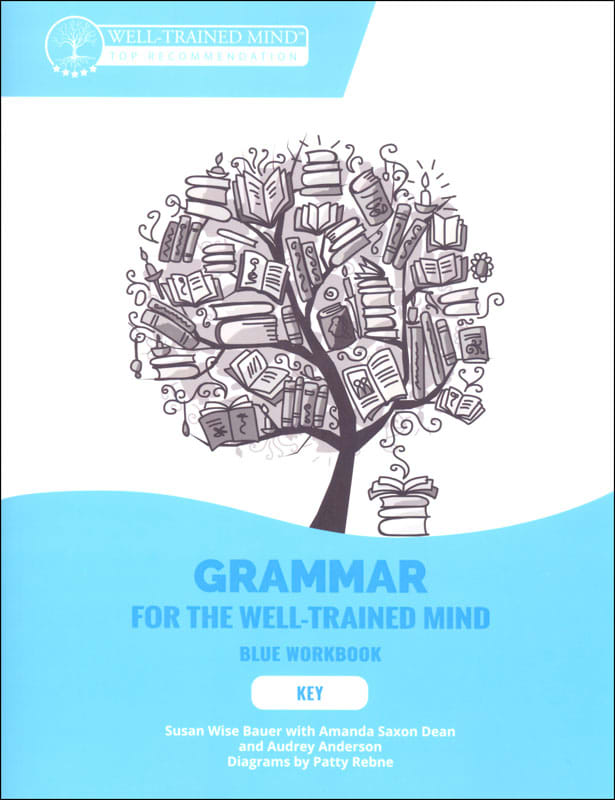
For those willing to devote the necessary time and energy,
Grammar for the Well-Trained Mind covers and builds mastery in all aspects
of English grammar. To compose and read well, the author believes that students
should understand grammar well. Designed to be the next step after First
Language Lessons for the Well-Trained Mind, this course builds a
pattern of teaching rules and definitions (in Grammar, Usage, and Mechanics). Students
follow a Classical methodology, and identify, diagram, and practice all levels
of grammar using the over 400 exercises per book. To start the program, you’ll
need the Well-Trained
Mind Guidebook and Core Instructor Text. Then, select a color level—each
level requires 3 components: a consumable Student Workbook (with
exercises, grammar rules, definitions, information, and sample sentences) and a
corresponding Key (answers with detailed explanatory notes for
130 lessons). The
Diagramming Dictionary serves as a reference.
There are four non-sequential courses: Red, Purple, Blue,
and Yellow—each teaching the same concepts in the same order, with new
sentences and passages. Grammar mastery is based on four years of progression.
Each level follows the same progression: Lessons 1-40 cover basic grammar.
Lessons 41-80 cover Intermediate grammar and Lessons 81-130, Advanced (college
level).
Convenience sets for each level are available and include
the consumable Student Workbook and the Key. As you work through the remaining
levels, the publisher strongly recommends the Grammar Guidebook as an
additional reference.
Exercises use real-world model sentences from published
authors (with a strong emphasis on timeless literature). These reading passages
are interesting and accessible—challenging but still exemplifying good writing.
It’s assumed that students will not grasp grammar concepts at first, but will
gradually improve through repeating exercises. Concepts will be mastered as
they continually apply the skills.
Instruction is done through teacher-student
dialogues—requiring a teacher investment (probably 15-20 minutes per lesson).
The teacher material, however, is scripted with little to no prep needed.
Lessons are scheduled approximately 4 days/week for 36 weeks. At lesson 21, students
may need to slow down the pace. Grammar concepts are presented, rules taught,
and the provided examples discussed. Then, students practice concepts. The
individual exercises vary: some underlining, labeling, diagramming, and some construction
of new sentences, etc. Students are encouraged to check their own work and
discuss any discrepancies. After every 3 weeks, a Student Review provides
a “brush up” of each lesson’s key grammar concept. Starting at Review 9,
schedule one week to complete each review. During review weeks, students
complete 3 exercises daily. However, after week 27, the number of review
exercises doubles. The course ends with a final review.
While the course intent is for repetition annually over four
years, you have the freedom to choose how to complete the 4-year sequence. Make
the course a tighter spiral by completing the lessons in one color text by
skill level (such as basic grammar, lessons 1-40) and then choosing the next
color to review those same lessons. If you have multiple students, you could
also have each student use a different color while teaching the same concepts
simultaneously. If your student has not had grammar study, one level could be
used as a 9th grade grammar. As with each of the levels, from week 20 on, the
grammar challenge becomes more difficult. No worries! The author recommends
going at your own pace. Since you start with the color of your choosing, you’ll
get an annual rotation of concepts (from the course’s beginning to end). Also,
regular reviews occur every three weeks, starting at week 28. Note: review weeks
are designed to be taken slowly. The student workbook is reproducible
only for use within your own household.
In conjunction, How to Diagram Any Sentence
(134 pages, softcover) provides practice of concepts presented in with the
Diagramming Dictionary. These two resources assist in strengthening grammar/writing
skills, whether as part of a separate composition course, to teach diagramming,
or to help you as teacher in your understanding of this course. The sentences
presented and practiced in these companion books are drawn from the four course
levels. A convenient
package of both these products is available. ~ Ruth