- Bargain Items are brand-new products that have been dinged, dented, or scuffed, but are otherwise in usable condition.
- Bargain Items have limited inventory, and they are only reserved for you when checkout is completed.
- Bargain Items are non-returnable and non-refundable.
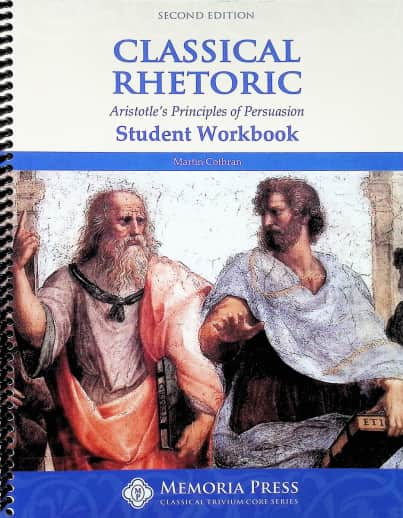
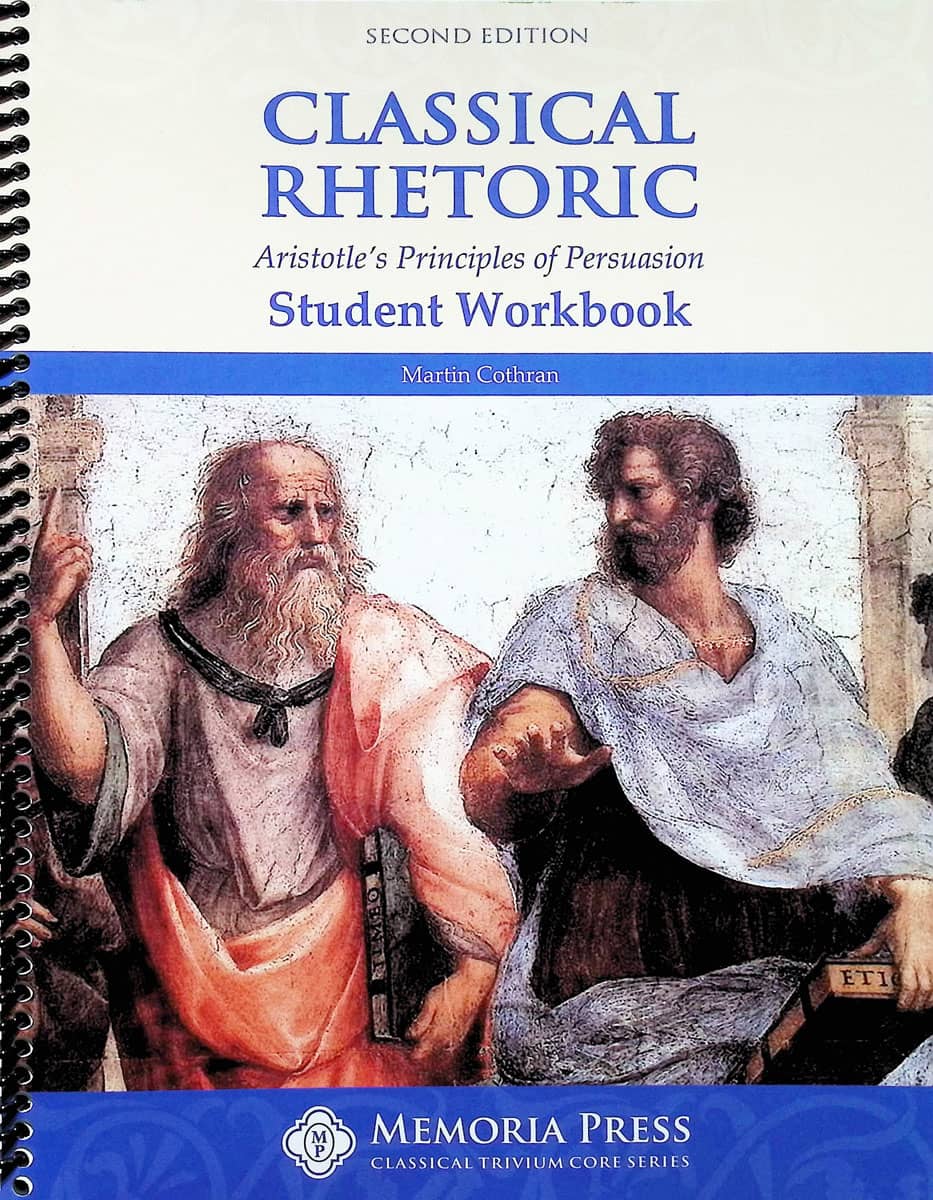
Memoria Press Classical Rhetoric Student Workbook (2nd Edition)
SKU
018491
ISBN
9781547704903
Grade 10-12
Classical
Christian/Religious
Low Teacher Involvement
Visual
Other Materials Required
These icons are designed to help you quickly understand and learn important information about our products.
Teaching Method
Traditional
Teacher-centered curriculum commonly used in classrooms that may include a text, teacher manual, tests, etc.
Charlotte Mason
A methodology based on the work of a 19th century educator who maintained that children learn best from literature (Living Books), not textbooks.
Classical
A methodology based on the Latin Trivium (three stages of learning), including the grammar stage (memorization and facts), logic stage (critical thinking), and rhetoric stage (developing/defending ideas).
Unit Study
A thematic or topical approach centered around one topic that integrates multiple subject areas.
Montessori (Discovery)
A methodology based on the work of a 20th century educator that emphasizes student and sensory-driven discovery learning and real-life applications.
Other
Other methodologies
Religious Content
Secular
Contains content contrary to common Christian beliefs (i.e. evolution).
Neutral
Avoids religious or theoretical topics or presents multiple viewpoints without preference.
Christian/Religious
Faith-based or including instructional religious content.
Learning Modality
Auditory
Learns through listening, talking out loud or reading out loud.
Visual
Learns through seeing, prefers written instructions and visual materials.
Kinesthetic/Tactile (Hands-On)
Learns through moving, doing and touching.
Multi-Sensory
Curriculum that employ a variety of activities/components.
Presentation
Sequential
Curriculum progresses through well-defined learning objectives. Emphasizes mastery before moving to the next topic.
Spiral
Topics and concepts are repeated from level to level, adding more depth at each pass and connecting with review.
Conceptual/Topical
Focus is on the “why,” often with a unifying concept as well as specific skills; coverage may be broader.
Teacher Involvement
Low Teacher Involvement
Student-led materials; parent acts as a facilitator.
Medium Teacher Involvement
A mix of teacher-led time and independent student work.
High Teacher Involvement
Teacher-led lessons; may utilize discussions, hands-on activities and working together.
Additional Materials Required
No other materials needed
Everything you need is included.
Other Materials Required
There are additional required resources that are a separate purchase.
Other Materials Optional
There are additional resources mentioned or recommended but are not absolutely necessary.
Consumable
Consumable
Designed to be written in; not reusable.
Non-Consumable
Not designed to be written in; reusable.
Our Price
$29.95 $29.95 $25.95
Rainbow Savings: $4.00

Description
This text is by the same author and follows the same standards and format as Traditional Logic. Basically, it is a guided tour through Aristotle's Rhetoric, and you will need a copy of that book to complete the course. It covers the first two books of Aristotle's thoughts on writing and oratory, basically concerning the speaker and the audience. Those familiar with Aristotle will know that he valued content and quality of writing more than technique, and this study reflects that philosophy. It should be noted that this is not an introductory course on writing, but is meant to refine those skills that students should already have, for the specific purpose of persuasion. The book is well laid out and is designed so that students can be taught even by those with little experience with this topic. The course is designed to be consumable and will lead students every step of the way through a study on rhetoric over the course of a year. Tips on how teachers can grade the work and keep students accountable are included in the book. The first part of the course covers Book One of Aristotle's Rhetoric: "Rhetoric as it Concerns the Speaker". It starts with lessons on the scope and purpose of rhetoric and the definition and division of rhetoric. The rest of the speaker section is then divided into political, ceremonial, and forensic rhetoric, with several lessons per topic. The second part of the book then covers Book Two of Aristotle's Rhetoric: "Rhetoric as it Concerns the Audience". It then gives a basic introduction to Aristotle's views on the subject and gives lessons covering Pathos, Ethos, and Logos. The text includes several ways to test students and helps them to thoroughly review and understand the content. Reading Comprehension Questions are the main part of the course and are designed to help students glean as much from Aristotle's Rhetoric as possible by completing short answer questions. Evaluating Writing Assignments require that the student not only know what Aristotle said, but assess it on the basis of their own assumptions, which may differ from Aristotle's. Weekly Research and Writing Assignments are designed to apply the lessons the student has learned. Reading Lessons are made up of questions based on Mortimer Adler's How to Read a Book, which are designed to help the student fully understand what, how, and why Aristotle says what he does. Logic and Latin Review Questions are review questions related to Traditional Logic. Though that book is not a prerequisite for this course and these questions can be skipped, the author does recommend completing that before beginning this. Finally, there are Case Study Analyses focusing on four speeches, which are classic examples of the three kinds of speeches discussed by Aristotle. Each case study is accompanied by questions relevant to the section of Aristotle just covered. These are designed as models for the students to imitate in their own persuasive discourse. The user-friendly format and multiple-aspects of reviewing make this a very complete review and guide for Aristotle's Rhetoric. A Teacher Key can be purchased separately and provides detailed answers for the lessons and exercises. ~ Rachel S.
Publisher's Description of Memoria Press Classical Rhetoric Student Workbook (2nd Edition)
The Classical Rhetoric Student Workbook contains reading comprehension questions, evaluative writing assignments, reading lessons, case studies, and more, centered around Aristotle’s Rhetoric, but also with review questions from Traditional Logic. It also contains optional exercises for Arthur Quinn’s Figures of Speech.
Category Description for Classical Rhetoric with Aristotle
Classical Rhetoric with Aristotle from Memoria Press is a rigorous, one-year (33-week) high school course that teaches students the art of persuasive writing and speaking through the foundational work of Aristotle.
Students analyze Aristotle’s principles, study great
speeches as models, and apply classical rhetoric techniques to improve their
own persuasive communication, with a strong focus on the speaker-audience
relationship and effective argumentation.
Key Curriculum Features:
- In-depth study of Aristotle’s Rhetoric with guided reading and analysis
- Weekly writing assignments and research tasks
- Practice with figures of speech and rhetorical devices
- Imitation of masterful speeches through 7 special case studies
- Development of logical, ethical, and emotional appeals (Logos, Ethos, Pathos)
- Quizzes, tests, and a final exam to reinforce learning
Program Components:
- Student Text: Consumable book with daily exercises and questions
- Quizzes & Tests: Consumable booklet with lesson quizzes and final exam
- Teacher Key: Answers for student exercises, quizzes, and tests
- Instructional DVDs : Optional 1-hour lecture videos for each lesson
- Figures of Speech: Recommended additional resource by Arthur Quinn
Required Resources:
- Aristotle’s Rhetoric
- Mortimer Adler’s How to Read a Book
Classical Rhetoric with Aristotle stands out for its scholarly depth and classical methodology, making it an excellent choice for high school students seeking advanced training in persuasive writing, critical thinking, and rhetoric.
Browse all Classical Rhetoric with Aristotle materials and sets below!
Details
| Product Format: | Softcover Book |
|---|---|
| Grades: | 10-12 |
| Brand: | Memoria Press |
| ISBN: | 9781547704903 |
| Length in Inches: | 10.875 |
| Width in Inches: | 8.375 |
| Height in Inches: | 0.5 |
| Weight in Pounds: | 1.2 |
Videos
Reviews