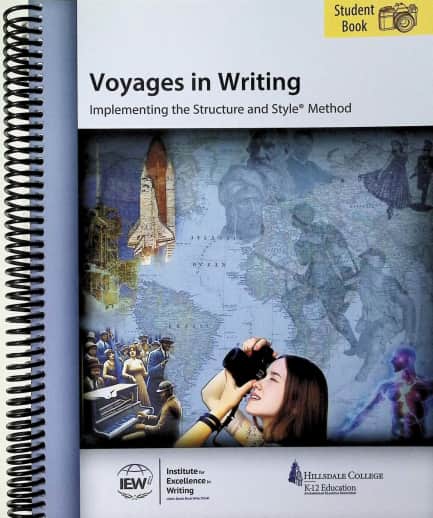

Aimed at a strong grade 8 level, this writing course helps students learn to summarize, respond to literature, practice developing formal essays, and more. Your student will work with source texts including narratives, historical topics such as the Cold War, musical theater, and individuals like Al-Khwarizmi (father of algebra). While every weekly lesson uses source material, students will also create responses to literature. This course requires the Voyages in Writing Teacher’s Manual. Purchase of this student book provides free access to PDF downloads of vocabulary cards, reproducible checklists, and exemplars. Consumable, spiral-bound, 296 pgs. ©2026 ~ Ruth
IEW Voyages in Writing Student Book
SKU
015753
ISBN
9781623414283
Grade 6-8
These icons are designed to help you quickly understand and learn important information about our products.
Teaching Method
Traditional
Teacher-centered curriculum commonly used in classrooms that may include a text, teacher manual, tests, etc.
Charlotte Mason
A methodology based on the work of a 19th century educator who maintained that children learn best from literature (Living Books), not textbooks.
Classical
A methodology based on the Latin Trivium (three stages of learning), including the grammar stage (memorization and facts), logic stage (critical thinking), and rhetoric stage (developing/defending ideas).
Unit Study
A thematic or topical approach centered around one topic that integrates multiple subject areas.
Montessori (Discovery)
A methodology based on the work of a 20th century educator that emphasizes student and sensory-driven discovery learning and real-life applications.
Other
Other methodologies
Religious Content
Secular
Contains content contrary to common Christian beliefs (i.e. evolution).
Neutral
Avoids religious or theoretical topics or presents multiple viewpoints without preference.
Christian/Religious
Faith-based or including instructional religious content.
Learning Modality
Auditory
Learns through listening, talking out loud or reading out loud.
Visual
Learns through seeing, prefers written instructions and visual materials.
Kinesthetic/Tactile (Hands-On)
Learns through moving, doing and touching.
Multi-Sensory
Curriculum that employ a variety of activities/components.
Presentation
Sequential
Curriculum progresses through well-defined learning objectives. Emphasizes mastery before moving to the next topic.
Spiral
Topics and concepts are repeated from level to level, adding more depth at each pass and connecting with review.
Conceptual/Topical
Focus is on the “why,” often with a unifying concept as well as specific skills; coverage may be broader.
Teacher Involvement
Low Teacher Involvement
Student-led materials; parent acts as a facilitator.
Medium Teacher Involvement
A mix of teacher-led time and independent student work.
High Teacher Involvement
Teacher-led lessons; may utilize discussions, hands-on activities and working together.
Additional Materials Required
No other materials needed
Everything you need is included.
Other Materials Required
There are additional required resources that are a separate purchase.
Other Materials Optional
There are additional resources mentioned or recommended but are not absolutely necessary.
Consumable
Consumable
Designed to be written in; not reusable.
Non-Consumable
Not designed to be written in; reusable.
Our Price
$35.00 Product Overview
- Practice the IEW® writing method using different topics
- Consumable text for this Hillsdale K-12 inspired course
- Course can be easily used in a co-op setting
- Add suggested literature for a complete language arts course
Description
Publisher's Description of IEW Voyages in Writing Student Book
EXTRA STUDENT BOOK ONLY – Purchase this Student Book for each of your
students if you already own the Voyages in Writing Teacher's Manual.
Explore a wide variety of fascinating subjects in Voyages in Writing! Students write about adventurous topics such as the English Channel, human electricity, D-Day, and other interesting subjects while they learn to write with the Structure and Style® writing method. Offering a full year of Writing Across the Curriculum for students in 8th grade, these lessons cover the nine IEW Units. Literature suggestions and access to vocabulary cards and other helpful PDF downloads are included. Voyages in Writing was written in collaboration with Hillsdale College K-12 Education.
Explore a wide variety of fascinating subjects in Voyages in Writing! Students write about adventurous topics such as the English Channel, human electricity, D-Day, and other interesting subjects while they learn to write with the Structure and Style® writing method. Offering a full year of Writing Across the Curriculum for students in 8th grade, these lessons cover the nine IEW Units. Literature suggestions and access to vocabulary cards and other helpful PDF downloads are included. Voyages in Writing was written in collaboration with Hillsdale College K-12 Education.
Category Description for Voyages in Writing (IEW)
This theme-based study, Voyages in Writing, provides a year’s worth of curriculum for any student desiring to practice the IEW® Structure and Style© method. Writing assignments follow the patterns developed by author Andrew Pudewa. Students will read selections written by professional authors. Vocabulary studies are also pulled from these. Students will write from notes and form outlines. Following these skills, they’ll practice retelling narratives and summarize writings about the Harlem Renaissance, mathematician Al-Khwarizmi, and D-Day. Then they’ll write from pictures of a pyramid tomb and from the Great Depression.
When it’s time for formal essays, the course provides “essay structures” (outlines), planning charts, methods to integrate questions and quotations into writing, and more. A large focus of this theme-based level is learning how to engage with primary sources and to summarize key documents in research. Therefore, in the latter half of the year, students practice summarizing multiple references (including the “Cold War”). Next, students practice the five-paragraph model (including an intro and conclusion), creating inventive writing, a formal essay, and a critique of literature.
If you wish to add literature studies to make a more complete language arts course, you’ll find Appendix I provides a list of suggested fiction and poetry organized by month. If you choose to include these, each of the novels is scheduled for 2 months. Start the year with To Kill a Mockingbird; then Lord of the Flies; Robinson Crusoe; and Much Ado about Nothing. You can select the version you desire and add discussion questions or literature guides to promote more analysis. For each month, the curriculum also recommends students study and memorize a famous poem. During March, students will read 6 short stories from such authors as Chekhov and Tolstoy. The last month is solely dedicated to studying a list of 10 suggested poems. Poems include, “Do Not go Gentle into That Good Night,” by Dylan Thomas; “God Sees the Truth, But Waits,” and “An Honest Thief,” by Fyodor Dostoevsky.
The nonreproducible Teacher’s Manual includes a scope and sequence for 30 weeks of lessons, listing the topic of the composition style practiced, the style focus (alliteration, openers, etc.), and the weekly vocabulary words (typically 4 with each lesson). A quick list of the year’s vocabulary is found in the appendices. The teacher manual provides reduced student pages with teacher guidance and helps in the margin. You’ll find appendices for adding literature, handling grammar, mechanics, review games, vocabulary from each lesson with definitions, and chapter quizzes for each chapter. Purchase of this manual includes access to PDF downloads of Vocabulary Cards, reproducible assignment checklists, and Writing Exemplars.
The consumable Student Book provides all your student needs for each lesson, along with digital access to Vocabulary Cards, reproducible checklists, and exemplars. This text includes a scope and sequence and appendices on adding literature, mechanics review, and vocabulary by lesson. Both the student consumable book and the Teacher’s Manual are required for this composition course and can be purchased as a combo. Student and Teacher texts are ©2026. See individual descriptions for specific details. ~ Ruth
Details
| Product Format: | Paperback Book |
|---|---|
| Grades: | 6-8 |
| Brand: | Institute for Excellence in Writing |
| ISBN: | 9781623414283 |
| Length in Inches: | 11 |
| Width in Inches: | 9.125 |
| Height in Inches: | 0.9375 |
| Weight in Pounds: | 1.5 |
Videos
Reviews