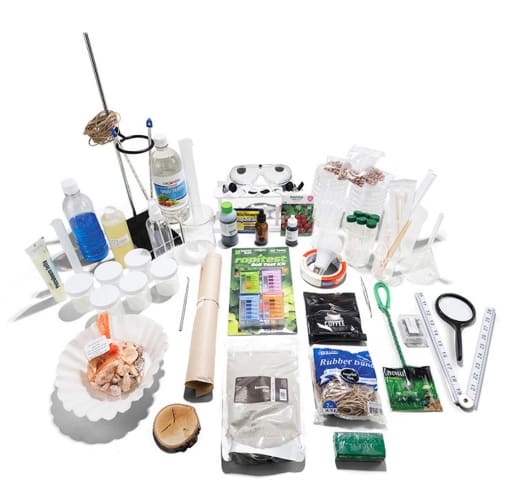
Save time with this convenient curriculum kit for high school! Contains hard-to-find items for doing the hands-on labs in the Novare Environmental Science curriculum.
Contents list: 6x9 ziplock bags 9x12 ziplock bags
Beaker, glass, 100 mL
Beaker, glass, 250 mL
Beaker, glass, 400 mL
Beaker, plastic, 500 mL
Bottle, dropper, 30 mL
Bromothymol Blue, 100 mL
Bubble solution, with wand
Bulb, LED, 400-740nm
Butcher Paper
Clay
Clay, powder
Clear 17oz bottle with cap
Coffee Filter
Dissection Pins
Dried Pinto Beans
Fish Net
Folding Meter Stick
Forceps
Funnel, glass, 90 mm dia.
Gloves, Medium, 2 Pairs
Graduated Cylinder, plastic, 100 mL
Graduated Cylinder, plastic, 25 mL
Ground Coffee Packet
Jar, plastic
Magnifying Glass
Masking Tape
Methylene Blue
Petri Dishes, 20 pack
Petroleum jelly
pH Papers, 80 pack
Pipet, 10 pack
Probe & Seeker
Rapitest Soil Test Kit
Ring Support, 3"
Rubber bands, bag
Safety Goggles
Seashell Pack
Seeds, radish
Spray bottle
Straws, clear plastic
String
Support Stand, 4" x 6" base, 18" rod
Swab applicator, 2 pack
Test Tube Rack, 6 holes
Test Tubes, plastic, 6 pack
Thermometer
Tree Ring
Vegetable Oil
Vinegar
Wooden skewer
Yeast packet
Novare Environmental Science Lab Kit
SKU
015011
Grade 12
These icons are designed to help you quickly understand and learn important information about our products.
Teaching Method
Traditional
Teacher-centered curriculum commonly used in classrooms that may include a text, teacher manual, tests, etc.
Charlotte Mason
A methodology based on the work of a 19th century educator who maintained that children learn best from literature (Living Books), not textbooks.
Classical
A methodology based on the Latin Trivium (three stages of learning), including the grammar stage (memorization and facts), logic stage (critical thinking), and rhetoric stage (developing/defending ideas).
Unit Study
A thematic or topical approach centered around one topic that integrates multiple subject areas.
Montessori (Discovery)
A methodology based on the work of a 20th century educator that emphasizes student and sensory-driven discovery learning and real-life applications.
Other
Other methodologies
Religious Content
Secular
Contains content contrary to common Christian beliefs (i.e. evolution).
Neutral
Avoids religious or theoretical topics or presents multiple viewpoints without preference.
Christian/Religious
Faith-based or including instructional religious content.
Learning Modality
Auditory
Learns through listening, talking out loud or reading out loud.
Visual
Learns through seeing, prefers written instructions and visual materials.
Kinesthetic/Tactile (Hands-On)
Learns through moving, doing and touching.
Multi-Sensory
Curriculum that employ a variety of activities/components.
Presentation
Sequential
Curriculum progresses through well-defined learning objectives. Emphasizes mastery before moving to the next topic.
Spiral
Topics and concepts are repeated from level to level, adding more depth at each pass and connecting with review.
Conceptual/Topical
Focus is on the “why,” often with a unifying concept as well as specific skills; coverage may be broader.
Teacher Involvement
Low Teacher Involvement
Student-led materials; parent acts as a facilitator.
Medium Teacher Involvement
A mix of teacher-led time and independent student work.
High Teacher Involvement
Teacher-led lessons; may utilize discussions, hands-on activities and working together.
Additional Materials Required
No other materials needed
Everything you need is included.
Other Materials Required
There are additional required resources that are a separate purchase.
Other Materials Optional
There are additional resources mentioned or recommended but are not absolutely necessary.
Consumable
Consumable
Designed to be written in; not reusable.
Non-Consumable
Not designed to be written in; reusable.
Our Price
$237.95 Description
Publisher's Description of Novare Environmental Science Lab Kit
Category Description for Novare Environmental Science
Novare Environmental Science offers upper-level science students a vital course of study that teaches a creation care mandate alongside current scientific theory. The course covers the complete AP syllabus for Environmental Science and teaches Christian creation care, historical milestones, eco-justice topics, roles of the government and non-profit organizations, and political policies. The course is challenging as it guides the next generation into a study of today’s environmental challenges from the exploitation of natural resources, pollution, and climate change. Required for the course are the hardcover 600+ page Textbook, the Apprentice’s Companion for Environmental Science, and the Novare Environmental Science Digital Resources. ~Deanne
Details
| Product Format: | Other |
|---|---|
| Grade: | 12 |
| Brand: | Home Science Tools |
| Length in Inches: | 19.5 |
| Width in Inches: | 13.3125 |
| Height in Inches: | 12.3125 |
| Weight in Pounds: | 12.7 |
Videos
Reviews