
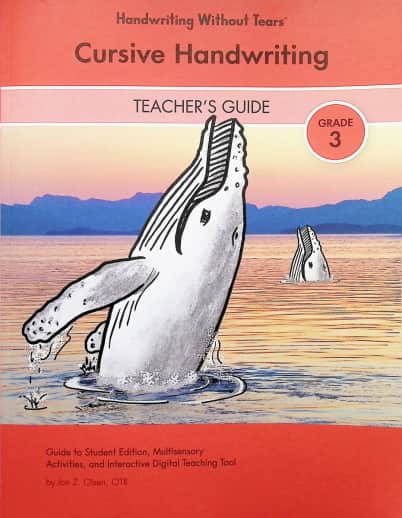
his wrap-around format easily guides you in teaching your student cursive writing. Letter stories, visual cues, rhyme-like reminders—these are some of the multisensory methods used that help the cursive teaching “stick” for students. “Tow-truck,” “ninja kick,” and “skateboard loops” are some of the fun terminology students will learn as they practice their cursive. These methods, combined with the unique manipulatives, help the skills sink in and become more automatic for students. Lead students by demonstrating the writing models; guide them as they practice and in the provided discussion and extension activities (reading, writing, and additional reading connections). The Digital Tools mentioned are not needed for homeschool learning. Lessons are provided for 27 weeks. 142 pgs, sc. ~ Ruth
Handwriting Without Tears Cursive Handwriting 2025 Edition Teacher's Guide
Product Overview
- Clearly identifies corresponding student pages and teacher directions
- Daily enrichment ideas provided in reading, writing, and other subjects
- Multisensory teaching supports student learning
Description
Handwriting Without Tears is a dedicated handwriting solution offering dynamic solutions that are both intuitive and customizable to classroom needs. Designed for adaptability and flexibility, the HWT 2025 editions match teaching to the best way to learn with explicit instruction that is simple to understand. We save you time and cost in producing superior outcomes.
Cursive Handwriting Teacher’s Guide is designed to minimize teacher prep time. Lessons include explicit cursive handwriting instruction with exact language for teaching each lesson. The multisensory activities, differentiation strategies, ideas for multilingual learners, and progress monitoring suggestions are also included on the lesson pages. Intentional connections to grade level literacy skills support any core ELA program to ensure literacy success:
- Reading Connections include phonologic and phonemic awareness, print concepts, phonics, and word recognition
- Writing Connections include grammar and composition
- Knowledge Building extensions related to Science, Social Studies, Math, Music, and Art
- Teach It includes best practices, A Click Aways and guidance on using classroom resources
- Digital Teaching provides reminders about digital teacher and student resources for each lesson
In this level, students’ books are vertical format, and the program’s unique cursive is created on double-lined (rather than triple) writing spaces. This course highly recommends the Ready for Cursive Poster Set, the Blackboard with Double Lines, chalk bits, and little sponge cubes. “Pause and Practice” sections occur every 10-12 pages, practicing previously learned letters to fine-tune handwriting fluency. After students review capital letters, they’ll enjoy unique handwriting practice tasks that include punctuation, prefixes, political maps of North America, and even learning special keyboard symbols. Using both student and teacher books is strongly recommended, as well as adding manipulatives during instruction sessions. Note: Digital tools such as the IDTT (Interactive Digital Teaching Tool) are available for traditional classrooms only and are truly unnecessary in a small classroom/homeschool setting (for example, a giant smart board projection of the letter K). References to these digital tools are clearly identified with a laptop/tablet icon.
| Product Format: | Paperback |
|---|---|
| Grade: | 3 |
| Brand: | Handwriting Without Tears |
| ISBN: | 9798885664554 |
| Length in Inches: | 10.875 |
| Width in Inches: | 8.5 |
| Height in Inches: | 0.375 |
| Weight in Pounds: | 0.9 |