
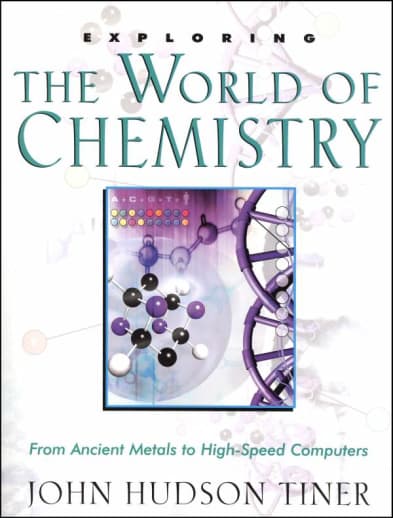

An introductory history of chemistry, this extremely readable text covers discoveries and developments from ancient to present times. Major emphasis is placed on the contributions of individual scientists (such as Cavendish, Mendeleev, Boyle, and Rutherford) and how they made their discoveries. The focus is not on balancing chemical equations or learning the number of electrons in specific elements. 16 chapters cover: ancient metals (iron, lead, tin), money metals (gold, silver, copper), the search for gold, gases in the air, the use of currents to separate elements, the first periodic table, using a spectroscope to identify elements, cathode ray tubes and alpha particle experiments, compounds by electric attraction, water and its unique properties, carbon and its compounds, organic chemistry, nitrogen and its compounds, silicon and its compounds, modern metals, and chemistry in today's world.
Exploring the World of Chemistry
Description
Chemistry is an amazing branch of science that affects us every day, yet few people realize it, or even give it much thought. Without chemistry, there would be nothing made of plastic, there would be no rubber tires, no tin cans, no television, no microwave ovens, or something as simple as wax paper.
This book presents an exciting and intriguing tour through the realm of chemistry as each chapter unfolds with facts and stories about the discoveries and discoverers. Find out why pure gold is not used for jewelry or coins. Join Humphry Davy as he made many chemical discoveries, and learn how they shortened his life. See how people in the 1870s could jump over the top of the Washington Monument.
Exploring the World of Chemistry brings science to life and is a wonderful learning tool with many illustrations, biographical information, chapter tests, and an index for easy referencing.
Survey of Science History & Concepts from Master Books is a full-year, high school science survey course that explores the history and foundational concepts of biology, chemistry, physics, and mathematics. Firmly rooted in a biblical worldview, it goes beyond facts to highlight the discoveries and discoverers who kept faith at the center of their scientific work.
The engaging, narrative style makes complex ideas accessible while reinforcing the harmony between science and Scripture.
Key Curriculum Features:
- Four topical books covering the history and concepts of Biology, Chemistry, Physics, and Mathematics
- Engaging stories of scientific discoveries and famous scientists
- Biblical worldview integrated throughout
- Reproducible worksheets, quizzes, and tests for family use
- Flexible pacing: 30–45 minutes per lesson, 3–4 days per week
- No formal labs required, but extension activities are suggested
Program Components:
- Four Exploring the World Books: Exploring the World of Biology, Exploring the World of Chemistry, Exploring the World of Physics, and Exploring the World of Mathematics
- Teacher Guide: Weekly lesson schedule, reproducible worksheets, quizzes/tests, answer keys, and teaching direction
Important Notes:
- This is a survey course suitable for a full high school science credit
- No dedicated lab manual or directions for lab credit
Survey of Science History & Concepts stands out for its narrative approach, strong biblical integration, and broad coverage of science history and concepts. It is an excellent choice for Christian homeschool families seeking an engaging, faith-based high school science survey that connects history, discovery, and worldview.
Browse all Survey of Science History & Concepts sets and components below! The Exploring the World books can also be found here.
| Product Format: | Softcover Book |
|---|---|
| Grades: | 6-9 |
| Brand: | Master Book Publishers |
| Author: | John Hudson Tiner |
| ISBN: | 9780890512951 |
| Length in Inches: | 11 |
| Width in Inches: | 8.5 |
| Height in Inches: | 0.5 |
| Weight in Pounds: | 0.95 |
| Edition: | Illustrated |
| Pages: | 160 |
| Publication Date: | 9/1/2000 |