WriteShop Junior Book D Student Workbooks

SKU
WSJSBD
Grade 3-5
Teaching Method
Traditional
Teacher-centered curriculum commonly used in classrooms that may include a text, teacher manual, tests, etc.
Charlotte Mason
A methodology based on the work of a 19th century educator who maintained that children learn best from literature (Living Books), not textbooks.
Classical
A methodology based on the Latin Trivium (three stages of learning), including the grammar stage (memorization and facts), logic stage (critical thinking), and rhetoric stage (developing/defending ideas).
Unit Study
A thematic or topical approach centered around one topic that integrates multiple subject areas.
Montessori (Discovery)
A methodology based on the work of a 20th century educator that emphasizes student and sensory-driven discovery learning and real-life applications.
Other
Other methodologies
Religious Content
Secular
Contains content contrary to common Christian beliefs (i.e. evolution).
Neutral
Avoids religious or theoretical topics or presents multiple viewpoints without preference.
Christian/Religious
Faith-based or including instructional religious content.
Learning Modality
Auditory
Learns through listening, talking out loud or reading out loud.
Visual
Learns through seeing, prefers written instructions and visual materials.
Kinesthetic/Tactile (Hands-On)
Learns through moving, doing and touching.
Multi-Sensory
Curriculum that employ a variety of activities/components.
Presentation
Sequential
Curriculum progresses through well-defined learning objectives. Emphasizes mastery before moving to the next topic.
Spiral
Topics and concepts are repeated from level to level, adding more depth at each pass and connecting with review.
Conceptual/Topical
Focus is on the “why,” often with a unifying concept as well as specific skills; coverage may be broader.
Teacher Involvement
Low Teacher Involvement
Student-led materials; parent acts as a facilitator.
Medium Teacher Involvement
A mix of teacher-led time and independent student work.
High Teacher Involvement
Teacher-led lessons; may utilize discussions, hands-on activities and working together.
Additional Materials Required
No other materials needed
Everything you need is included.
Other Materials Required
There are additional required resources that are a separate purchase.
Other Materials Optional
There are additional resources mentioned or recommended but are not absolutely necessary.
Consumable
Consumable
Designed to be written in; not reusable.
Non-Consumable
Not designed to be written in; reusable.
$81.00
Package Contents
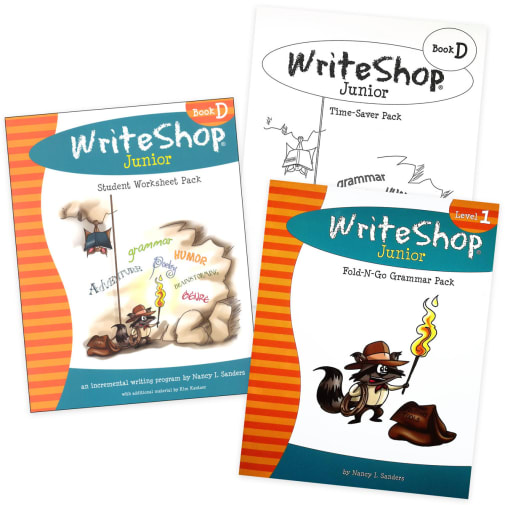
WriteShop Junior Book D Student Workbooks
SKU
WSJSBD
Grade 3-5

$81.00

Description

Publisher's Description of WriteShop Junior Book D Student Workbooks

Develop your student’s love of writing through their elementary school years with WriteShop Junior! This stress-free approach to learning gives you the tools to tailor every lesson to your student’s pace and learning preferences and sets them on the path to writing independence. From multisensory experiences to flexible schedules and practical instructor tips, WriteShop Junior makes writing fun and accessible to every young learner.

Book D focuses on brainstorming and organizing stories, fiction, and nonfiction writing. Your student will learn how to write in different fiction genres, develop their voice and show emotion, and revise their work with guidance from their instructor. Review of mechanics, including punctuation, grammar, and quotation marks, are also made.

The WriteShop Junior Book D Student Workbooks are ideal for instructors who already own the Teacher’s Guide and need the accompanying worksheets, Fold-N-Go Grammar Pack, and Time Saver Pack for their students. These items are consumable, and one is recommended for each student completing Book D.

Category Description for WriteShop Junior Level D (Grades 3-5)

Upper elementary ages (8-11 years) would begin with Level D if they need to learn to identify and use proper grammar and punctuation, how to choose strong words, brainstorming before writing, writing a paragraph, writing research-based articles, or self-editing and revising their own work. This level could be stretched into grades 6-7 for a child with learning struggles (although the worksheets may seem childish). Children who are comfortable with basic sentence structure and have learned basic paragraph skills would begin with Level E.

Topics covered include grammar and punctuation; narrowing topic; brainstorming; sentence structure, basic paragraph; using emotion and five senses; choosing strong words; self-editing and revising; and creative publishing. Writing topics include humor, adventure, science fiction, mystery, poetry/haiku, folktales, historical fiction, personal narrative and expository writing.

Details
More Information
Product Format:Product Bundle
Grades:3-5
Brand:Rainbow Resource Center
Videos
This product doesn't have a video
Reviews
Product Q&A