
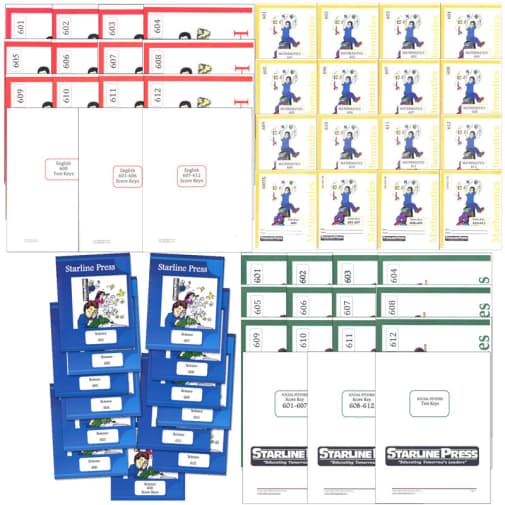
English: Sixth grade students compose different types of sentence structure including simple, compound, and complex sentences. They learn the proper use of verb tenses, indefinite pronouns, compound subjects, salutation punctuation, and capitalization. The students study metaphors, similes, hyperboles, personification and narration. Sixth grade students prepare and present oral and written reports using outlines, themes, narrative, and concrete language. They use email, use computer documents, use keyword searches, and use bulletin boards. The students prepare and finish a multimedia presentation. Sixth grade students use persuasive writing and speaking to give a problem-solving speech.
Math: Students will multiply and divide using whole numbers and decimals. They solve equations and problems using fractions and mixed numbers. Study of geometric formulas, data analysis and mathematical reasoning is included. Students will work with percent, ratios, and proportions. Probability and statistics are studied using data analysis and estimation. Geometry, symmetry and spatial relationships are taught.
Science: Students study earthquakes, volcanoes, the outer layer, the metallic core and oceanic plates. Critical thinking skills are developed with laboratory-oriented projects including artesian wells, erosion by water, simple machines and photosynthesis. Activities primarily use commonly found items. Ecosystems, fossil fuels, solar energy, thermodynamics and biodiversity are also learned. Students also study worldwide weather, the five biomes, and energy and matter in the environment. Traditional assessment tools, such as oral presentations, science fair projects and cooperative activities are incorporated into the sixth-grade program.
Social Studies: The secular theory of early humans is presented: hunter-gather societies, Neanderthal and Cro-Magnon Humans, and prehistoric tools. The theory of evolution is discussed alongside what is revealed in scientific evidence. Ancient history including Mesopotamia, Egypt, Kush and Nubia are studied and a report is given by the student. Students are expected to choose a topic, research ideas, take notes, organize an outline, write a rough draft, complete a bibliography, write a final copy and give an oral report. Map skills are utilized throughout the year, and learners will be challenged to demonstrate their knowledge of The Balkan Peninsula, Greece, Egypt, Rome and China. The regions, events and people of China and Rome are studied. Also studied are Ancient Rome, the birth of Christianity, Moses and the Ten Commandments, and Abraham, the Father of Many nations. ~Sara