
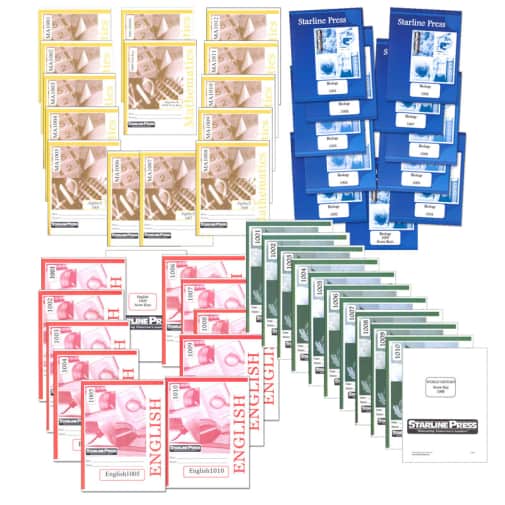
English: Students study Old English, Middle English, Early Modern English and Late Modern English. They learn suffixes, prefixes, roots, changing connotations, and problems in diction. Students also learn paragraph order, develop paragraphs, and create unity in paragraphs. Various types of speeches are demonstrated: manuscript, memorized, impromptu, and extemporaneous. Students learn to write an introduction, complete the structure of an argument, and apply amplification and conclusion to their speeches. They learn to give interviews, listen actively, and practice note taking techniques. Also included is the history of radio, television, motion pictures and newspapers. Book reports are completed throughout the year based on novels read in many different genres: science fiction, mystery, humor, adventure, tragedy and drama.
Math: ALGEBRA II: Students add, subtract, multiply and divide polynomials. They will also work with complex fractions, ratios, and proportions. The basics of quadratic equations, the square root method, and solving absolute value equations are also learned. Students learn about linear inequalities including their addition and multiplication properties. They also study logarithms and antilogarithms and how to work these problems on a calculator. Pascal's Triangle and the Binomial Theorem are studied. Students make and interpret scatter plots, as well as parabola basics and graphing parabolas. See the Scope and Sequence PDF for more details on which topics are covered in each booklet.
Science: Biology: The beginning of biology, the attributes of life and the meaning of science lays the foundation of this course. Students also study matter, acids, bases, buffers, energy, lipids and proteins. Differentiation of cells, sexual reproduction, linked genes, DNA and DNA structure, protein construction, mutations, pedigrees and the Human Genome Project are studied. Body system foundation including the nervous system, endocrine system, reproductive system, digestive system, excretory system, and the muscular system is learned. Students record and analyze observations, conduct calculations, use tables and graphs, apply concepts, formulate hypothesis, and design experiments. Lab supplies needed include Elodea sprigs, aquarium (or beakers), microscope, microorganism reference chart, dropper pipettes, test tubes, glass slides and cover slips, test tube rack, graduated cylinder and beakers.,/p>
Social Studies: World history is the focus of this year. Ancient empires of Egypt, India, Greece and Rome are studied. Students study Judaism and Christianity, as well as Greek and Roman philosophy and religion. The origins of England, France, Spain and Russia are studied. They will also learn about the American and French Revolutions, the English Bill of Rights, and the French Declaration of Rights of Man. The Russian Revolution, the Nazis of Germany and allied leaders are studied. Students will learn the ten steps to writing a term paper, from selecting a topic, to conducting research and recording the location of your sources, to writing a final draft paper.~Sara