These icons are designed to help you quickly understand and learn important information about our products.
Teaching Method
Traditional
Teacher-centered curriculum commonly used in classrooms that may include a text, teacher manual, tests, etc.
Charlotte Mason
A methodology based on the work of a 19th century educator who maintained that children learn best from literature (Living Books), not textbooks.
Classical
A methodology based on the Latin Trivium (three stages of learning), including the grammar stage (memorization and facts), logic stage (critical thinking), and rhetoric stage (developing/defending ideas).
Unit Study
A thematic or topical approach centered around one topic that integrates multiple subject areas.
Montessori (Discovery)
A methodology based on the work of a 20th century educator that emphasizes student and sensory-driven discovery learning and real-life applications.
Other
Other methodologies
Religious Content
Secular
Contains content contrary to common Christian beliefs (i.e. evolution).
Neutral
Avoids religious or theoretical topics or presents multiple viewpoints without preference.
Christian/Religious
Faith-based or including instructional religious content.
Learning Modality
Auditory
Learns through listening, talking out loud or reading out loud.
Visual
Learns through seeing, prefers written instructions and visual materials.
Kinesthetic/Tactile (Hands-On)
Learns through moving, doing and touching.
Multi-Sensory
Curriculum that employ a variety of activities/components.
Presentation
Sequential
Curriculum progresses through well-defined learning objectives. Emphasizes mastery before moving to the next topic.
Spiral
Topics and concepts are repeated from level to level, adding more depth at each pass and connecting with review.
Conceptual/Topical
Focus is on the “why,” often with a unifying concept as well as specific skills; coverage may be broader.
Teacher Involvement
Low Teacher Involvement
Student-led materials; parent acts as a facilitator.
Medium Teacher Involvement
A mix of teacher-led time and independent student work.
High Teacher Involvement
Teacher-led lessons; may utilize discussions, hands-on activities and working together.
Additional Materials Required
No other materials needed
Everything you need is included.
Other Materials Required
There are additional required resources that are a separate purchase.
Other Materials Optional
There are additional resources mentioned or recommended but are not absolutely necessary.
Publisher's Description of Novare Earth Science Program
Earth Science: God's World, Our Home is designed to draw middle-school students into close engagement with the subject matter and provide a solid education while fostering a sense of wonder and responsibility for God’s amazing world. Within the context of the fascinating study of landforms, minerals, and planetary phenomena, many other timely and important topics are covered including conservation of natural resources, climate change, pollution, and environmental justice, as well as the current scientific consensus concerning geologic history.
Earth Science should be about much more than learning about rocks and mountains and the seasons. Think about God’s exciting mandate to steward and exhibit vice regency over creation! Author Kevin Nelstead regularly draws the reader to appreciate the intricacy and excellence of God’s works.
Full program includes:
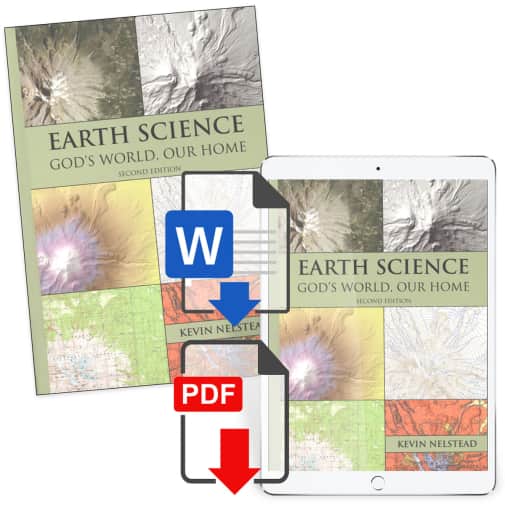
Earth Science: God's World, Our Home, 2nd edition. Written for middle school-aged students, this book includes all the popular characteristics of Novare textbooks: smaller profile; vibrant, original, and relevant graphics; lucid conversational prose, and an approach that connects students with real-world science as stewards of God’s creation.
Digital Resources for Earth Science These documents to help the teacher conduct class include quizzes, semester exams, answer keys, instructions for 8 experiments, weekly review guides, and more.
Novare
Earth Science offers
an engaging, well-illustrated earth science course. As students learn earth
science concepts and topics, they will be inspired to responsibly care for and
protect God’s amazing world. From our solar system to our home planet, students
see God’s hand in our creation, as they learn the current scientific consensus
on geological history, climate change, pollution, and environmental justice.
There is an in-depth study of historical geology which includes differing views
on the age of the earth, uranium dating, and the geological column. Students are taught to see God in creation,
while learning current secular scientific theories that support an old-earth
creation. Students will create lab reports and the introduction to the textbook
provides step-by-step guidance. Lab instructions are found in the Digital
Resources. An optional Student Lab Report Handbook is available for families who want support. Required
components include the Student Textbook and the Digital Resources, which are available individually or in a convenient
package. An optional lab kit with most of the harder to find
materials is available.