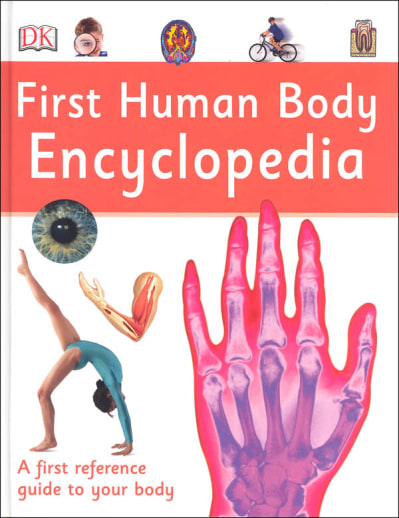
Filled with brightly colored photographs and bite sized facts, this book presents our human body and how it functions in a fun, appealing manner. Contents include: Human Body, Skeleton and Bones, Moving Muscles, Brain and Senses, Heart and Blood, Lungs and Breathing, Skin, Nails and Hair, Fighting Diseases, Digestive System, Urinary System, Reproduction System (including a brief explanation of male/female sex hormones that "turn young boys/girls into men/women"), Life Cycle, Staying Healthy, Communication and a helpful Reference section. Each topic is presented in a 2-page spread and includes a "test yourself" question at the bottom (with answer located on opposite page). hc, 128 pgs. ~ Deanne
First Human Body Encyclopedia
SKU
026760
ISBN
9781465443489
Grade 1-7
These icons are designed to help you quickly understand and learn important information about our products.
Teaching Method
Traditional
Teacher-centered curriculum commonly used in classrooms that may include a text, teacher manual, tests, etc.
Charlotte Mason
A methodology based on the work of a 19th century educator who maintained that children learn best from literature (Living Books), not textbooks.
Classical
A methodology based on the Latin Trivium (three stages of learning), including the grammar stage (memorization and facts), logic stage (critical thinking), and rhetoric stage (developing/defending ideas).
Unit Study
A thematic or topical approach centered around one topic that integrates multiple subject areas.
Montessori (Discovery)
A methodology based on the work of a 20th century educator that emphasizes student and sensory-driven discovery learning and real-life applications.
Other
Other methodologies
Religious Content
Secular
Contains content contrary to common Christian beliefs (i.e. evolution).
Neutral
Avoids religious or theoretical topics or presents multiple viewpoints without preference.
Christian/Religious
Faith-based or including instructional religious content.
Learning Modality
Auditory
Learns through listening, talking out loud or reading out loud.
Visual
Learns through seeing, prefers written instructions and visual materials.
Kinesthetic/Tactile (Hands-On)
Learns through moving, doing and touching.
Multi-Sensory
Curriculum that employ a variety of activities/components.
Presentation
Sequential
Curriculum progresses through well-defined learning objectives. Emphasizes mastery before moving to the next topic.
Spiral
Topics and concepts are repeated from level to level, adding more depth at each pass and connecting with review.
Conceptual/Topical
Focus is on the “why,” often with a unifying concept as well as specific skills; coverage may be broader.
Teacher Involvement
Low Teacher Involvement
Student-led materials; parent acts as a facilitator.
Medium Teacher Involvement
A mix of teacher-led time and independent student work.
High Teacher Involvement
Teacher-led lessons; may utilize discussions, hands-on activities and working together.
Additional Materials Required
No other materials needed
Everything you need is included.
Other Materials Required
There are additional required resources that are a separate purchase.
Other Materials Optional
There are additional resources mentioned or recommended but are not absolutely necessary.
Consumable
Consumable
Designed to be written in; not reusable.
Non-Consumable
Not designed to be written in; reusable.
Our Price
$17.99 $17.99 $12.25
Rainbow Savings: $5.74
Description
Category Description for Sassafras Science
Sassafras Science Adventures is a fun, Charlotte Mason-inspired, hands-on science program from the publisher of Elemental Science. It follows the Sassafras Twins on exciting around-the-world adventures with their eccentric Uncle Cecil and his lab assistant, a prairie dog named President Lincoln. Through an engaging story, children discover that science is anything but boring!
The premise is simple: read a story, perform experiments,
and keep a log. This living books approach combines rich narration, real
experiments, notebooking, copywork, and discussion to help students develop a
genuine love for science while building strong observation and thinking skills.
It works especially well for multi-age learning.
Sassafras Science Curriculum Components
Each semester-long Adventure requires three core components:
- Reader: The heart of the program, it is a lively story that carries the science lessons as the twins travel and explore.
- Guide: Provides chapter summaries, discussion questions, vocabulary, encyclopedia suggestions, experiment instructions, copywork & dictation, additional activities, and more. Includes an appendix with reproducible pages for family use.
- Scidat Logbook: A consumable student notebook where children record observations, color maps, draw illustrations, complete copywork/dictation, and document experiments and projects. The Logbook becomes a beautiful record of your child’s journey!
The Scidat Logbook is not reproducible, so you’ll need one per child. A fair amount of writing is involved, making this program slightly more intensive than some other Charlotte Mason-style science curricula. Younger children may need parental help.
Available Adventures by Volume
- Volume 1: Zoology
- Volume 2: Anatomy
- Volume 3: Botany
- Volume 4: Earth Science
- Volume 5: Geology
- Volume 6: Astronomy
- Volume 7: Chemistry
- Volume 8: Physics
Sassafras Science is an excellent choice for families who want living-books science that is engaging, memorable, and gently rigorous. It’s perfect for fostering a true love for science in a multi-age homeschool!
Browse all Sassafras Science Adventures, including Readers, Guides, Scidat Logbooks, and complete Sets below!
Details
| Product Format: | Hardcover Book |
|---|---|
| Grades: | 1-7 |
| Brand: | Dorling Kindersley |
| ISBN: | 9781465443489 |
| Length in Inches: | 11 |
| Width in Inches: | 9 |
| Height in Inches: | 0.625 |
| Weight in Pounds: | 1.75 |
Videos
Reviews