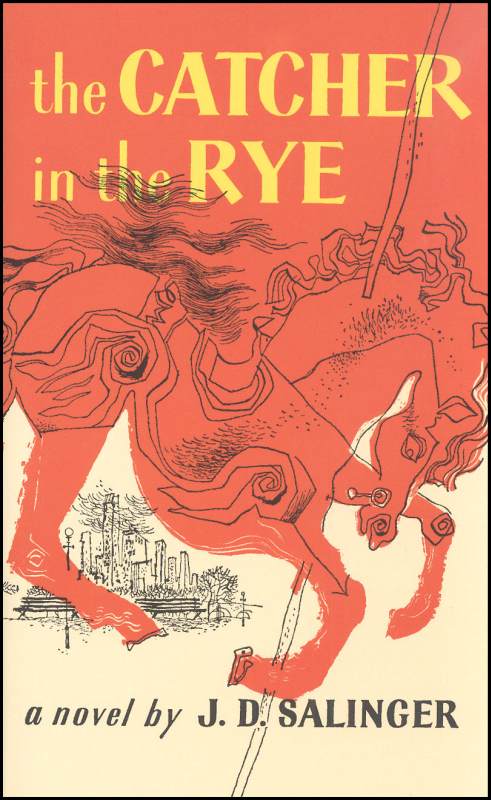
Catcher in the Rye

SKU
024218
ISBN
9780316769488
Grade 7-AD
Teaching Method
Traditional
Teacher-centered curriculum commonly used in classrooms that may include a text, teacher manual, tests, etc.
Charlotte Mason
A methodology based on the work of a 19th century educator who maintained that children learn best from literature (Living Books), not textbooks.
Classical
A methodology based on the Latin Trivium (three stages of learning), including the grammar stage (memorization and facts), logic stage (critical thinking), and rhetoric stage (developing/defending ideas).
Unit Study
A thematic or topical approach centered around one topic that integrates multiple subject areas.
Montessori (Discovery)
A methodology based on the work of a 20th century educator that emphasizes student and sensory-driven discovery learning and real-life applications.
Other
Other methodologies
Religious Content
Secular
Contains content contrary to common Christian beliefs (i.e. evolution).
Neutral
Avoids religious or theoretical topics or presents multiple viewpoints without preference.
Christian/Religious
Faith-based or including instructional religious content.
Learning Modality
Auditory
Learns through listening, talking out loud or reading out loud.
Visual
Learns through seeing, prefers written instructions and visual materials.
Kinesthetic/Tactile (Hands-On)
Learns through moving, doing and touching.
Multi-Sensory
Curriculum that employ a variety of activities/components.
Presentation
Sequential
Curriculum progresses through well-defined learning objectives. Emphasizes mastery before moving to the next topic.
Spiral
Topics and concepts are repeated from level to level, adding more depth at each pass and connecting with review.
Conceptual/Topical
Focus is on the “why,” often with a unifying concept as well as specific skills; coverage may be broader.
Teacher Involvement
Low Teacher Involvement
Student-led materials; parent acts as a facilitator.
Medium Teacher Involvement
A mix of teacher-led time and independent student work.
High Teacher Involvement
Teacher-led lessons; may utilize discussions, hands-on activities and working together.
Additional Materials Required
No other materials needed
Everything you need is included.
Other Materials Required
There are additional required resources that are a separate purchase.
Other Materials Optional
There are additional resources mentioned or recommended but are not absolutely necessary.
Consumable
Consumable
Designed to be written in; not reusable.
Non-Consumable
Not designed to be written in; reusable.
Our Price
$9.99 $9.99 $7.50
Rainbow Savings: $2.49

Description

This classic book provides a not-so-typical coming of age tale of Holden Caulfield, who narrates his own (fictional) story. The story begins with Holden in psychiatric care, and the narrative basis of the novel comes from the teenager's recollection of his life events since the previous Christmas. The reader follows Holden through his expulsion from school to his bouts of delusion (and the many other experiences in between) that triggers Holden's nervous breakdown and ultimate leads to his placement in psychiatric care. Since its first publication in 1951, The Catcher in the Rye has repeatedly opened doors to debate and controversy (it has been known to be banned from schools, libraries, bookstores, etc). Many attribute this to the fact that it is a novel of "radical social opinion" (as it centers around issues such as profanity, sexual exploration, vulgarity, and more) even though it was written during a conservative time in American history. Although often criticized, the book provids a critical look at the many problems and concerns facing the American youth in the 1950s and society's attitude of the resulting human condition. By J.D. Salinger, 224 pgs, pb. ~ Enh

Category Description for Novel Units Literature Guides

Novel Units Literature Guides are one of the most extensive collections of individual novel study guides available, covering hundreds of popular books from elementary through high school.

These practical, easy-to-use guides help students develop reading comprehension, literary analysis, vocabulary, and critical thinking skills through high-quality literature. They are ideal for homeschool families, classrooms, and literature circles.

Key Curriculum Features:

  • Chapter-by-chapter or section-by-section coverage including vocabulary, comprehension, and discussion questions
  • Pre-reading activities and background information on the book and author
  • Suggested activities, writing ideas, and reproducible graphic organizers
  • Culminating projects and assessment ideas
  • Focus on literary elements and critical thinking

Program Components:

  • Teacher Guides: 30–40 page guides with answers, discussion questions, activity suggestions, and reproducible assessment pages
  • Student Packets: Non-reproducible activity pages, graphic organizers, writing prompts, quizzes, unit tests, and rubrics. Only available for some books
  • Novel Unit Sets: Bundles that include the Teacher Guide and/or Student Packet plus the matching novel

Teacher Guides work well for discussion-focused or parent-led studies, while Student Packets are excellent for independent student work. The two components have minimal overlap and can be used separately as standalone products or together for a more complete novel study.

Novel Units Literature Guides stand out for their wide selection of titles, practical format, and flexibility. They are an excellent choice for families who want targeted, book-specific literature studies without a full-year curriculum.

Browse all Novel Units Literature Guides, Student Packets, and book bundles below!

Details
More Information
Product Format:Softcover Book
Grades:7-AD
Brand:Warner Books
ISBN:9780316769488
Length in Inches:6.75
Width in Inches:4.25
Height in Inches:0.75
Weight in Pounds:0.25
Edition:Reprint
Pages:224
Publication Date:5/1/1991
Videos
This product doesn't have a video
Reviews
Product Q&A