
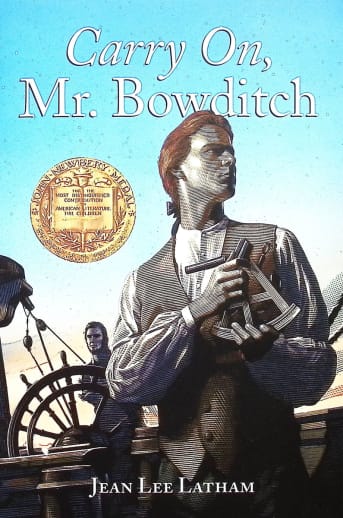
1956 Newbery Medal winner. This is the true story of Nathaniel Bowditch, who becomes an indentured servant at the age of twelve when his father apprenticed him to a chandlery after his mother died. This ends his dreams of attending Harvard. Through hard work and perseverance, Nat continues his studies on his own. Was Nathaniel destined to be a bookkeeper all his life, or could he find a way to better use his skills in mathematics? His discoveries in the field of navigation are put to the test when Nat becomes captain of his own ship.
Carry On, Mr. Bowditch by Jean Lee Latham
SKU
007700
ISBN
9780618250745
Grade 4-AD
These icons are designed to help you quickly understand and learn important information about our products.
Teaching Method
Traditional
Teacher-centered curriculum commonly used in classrooms that may include a text, teacher manual, tests, etc.
Charlotte Mason
A methodology based on the work of a 19th century educator who maintained that children learn best from literature (Living Books), not textbooks.
Classical
A methodology based on the Latin Trivium (three stages of learning), including the grammar stage (memorization and facts), logic stage (critical thinking), and rhetoric stage (developing/defending ideas).
Unit Study
A thematic or topical approach centered around one topic that integrates multiple subject areas.
Montessori (Discovery)
A methodology based on the work of a 20th century educator that emphasizes student and sensory-driven discovery learning and real-life applications.
Other
Other methodologies
Religious Content
Secular
Contains content contrary to common Christian beliefs (i.e. evolution).
Neutral
Avoids religious or theoretical topics or presents multiple viewpoints without preference.
Christian/Religious
Faith-based or including instructional religious content.
Learning Modality
Auditory
Learns through listening, talking out loud or reading out loud.
Visual
Learns through seeing, prefers written instructions and visual materials.
Kinesthetic/Tactile (Hands-On)
Learns through moving, doing and touching.
Multi-Sensory
Curriculum that employ a variety of activities/components.
Presentation
Sequential
Curriculum progresses through well-defined learning objectives. Emphasizes mastery before moving to the next topic.
Spiral
Topics and concepts are repeated from level to level, adding more depth at each pass and connecting with review.
Conceptual/Topical
Focus is on the “why,” often with a unifying concept as well as specific skills; coverage may be broader.
Teacher Involvement
Low Teacher Involvement
Student-led materials; parent acts as a facilitator.
Medium Teacher Involvement
A mix of teacher-led time and independent student work.
High Teacher Involvement
Teacher-led lessons; may utilize discussions, hands-on activities and working together.
Additional Materials Required
No other materials needed
Everything you need is included.
Other Materials Required
There are additional required resources that are a separate purchase.
Other Materials Optional
There are additional resources mentioned or recommended but are not absolutely necessary.
Consumable
Consumable
Designed to be written in; not reusable.
Non-Consumable
Not designed to be written in; reusable.
Our Price
$15.99 $15.99 $11.95
Rainbow Savings: $4.04
Description
Publisher's Description of Carry On, Mr. Bowditch by Jean Lee Latham
Readers today are still fascinated by "Nat, an eighteenth-century nautical wonder and mathematical wizard. Nathaniel Bowditch grew up in a sailor's worldSalem in the early days, when tall-masted ships from foreign ports crowded the wharves. But Nat didn't promise to have the makings of a sailor; he was too physically small. Nat may have been slight of build, but no one guessed that he had the persistence and determination to master sea navigation in the days when men sailed only by "log, lead, and lookout. Nat's long hours of study and observation, collected in his famous work, The American Practical Navigator (also known as the "Sailors' Bible), stunned the sailing community and made him a New England hero.
Category Description for Ready Readers
Ready Readers are literature study guides designed to complement the Socratic methodology taught in Teaching the Classics by Adam & Missy Andrews.
These ready-to-use guides provide fleshed-out lesson plans and Socratic discussion questions for whole-book studies, making it easier for parents to lead meaningful literary analysis with their children.
Key Curriculum Features:
- Discussion-based studies focusing on setting, characters, conflict, plot, theme, literary devices, and context
- Carefully crafted Socratic questions with talking-point answers for the teacher
- Story charts and one-page book summaries included for each title
- Flexible use with students of varying ages (often slightly below the student’s reading level to build confidence)
- Can be used with any unabridged edition of the selected book
- Excellent bridge between Teaching the Classics methodology and actual book studies
Program Components:
- Each Ready Reader volume contains complete studies for multiple books at a specific reading level
- Includes Socratic discussion questions, teacher talking points, story charts, and summaries
- Designed to work alongside Teaching the Classics seminar for best results
Ready Readers stand out for their practical, ready-to-go format that helps parents confidently lead rich literature discussions. They are an excellent choice for families who want structured guidance in teaching literary analysis while using quality literature.
Browse all Ready Readers volumes below!
Details
| Product Format: | Softcover Book |
|---|---|
| Grades: | 4-AD |
| Brand: | Houghton Mifflin |
| Author: | Jean Lee Latham |
| ISBN: | 9780618250745 |
| Length in Inches: | 8.25 |
| Width in Inches: | 5.5 |
| Height in Inches: | 0.75 |
| Weight in Pounds: | 0.5 |
| Ages: | 12+ |
| Edition: | Illustrated |
| Pages: | 256 |
| Publication Date: | 5/3/2013 |
Videos
Reviews