
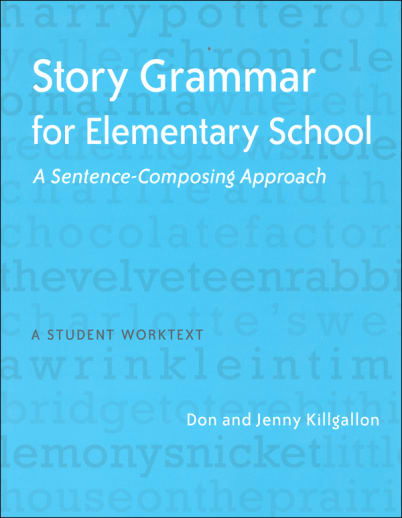
Story Grammar for Elementary School: Sentence-Composing Approach

SKU
028435
ISBN
9780325012469
Grade 3-6
Teaching Method
Traditional
Teacher-centered curriculum commonly used in classrooms that may include a text, teacher manual, tests, etc.
Charlotte Mason
A methodology based on the work of a 19th century educator who maintained that children learn best from literature (Living Books), not textbooks.
Classical
A methodology based on the Latin Trivium (three stages of learning), including the grammar stage (memorization and facts), logic stage (critical thinking), and rhetoric stage (developing/defending ideas).
Unit Study
A thematic or topical approach centered around one topic that integrates multiple subject areas.
Montessori (Discovery)
A methodology based on the work of a 20th century educator that emphasizes student and sensory-driven discovery learning and real-life applications.
Other
Other methodologies
Religious Content
Secular
Contains content contrary to common Christian beliefs (i.e. evolution).
Neutral
Avoids religious or theoretical topics or presents multiple viewpoints without preference.
Christian/Religious
Faith-based or including instructional religious content.
Learning Modality
Auditory
Learns through listening, talking out loud or reading out loud.
Visual
Learns through seeing, prefers written instructions and visual materials.
Kinesthetic/Tactile (Hands-On)
Learns through moving, doing and touching.
Multi-Sensory
Curriculum that employ a variety of activities/components.
Presentation
Sequential
Curriculum progresses through well-defined learning objectives. Emphasizes mastery before moving to the next topic.
Spiral
Topics and concepts are repeated from level to level, adding more depth at each pass and connecting with review.
Conceptual/Topical
Focus is on the “why,” often with a unifying concept as well as specific skills; coverage may be broader.
Teacher Involvement
Low Teacher Involvement
Student-led materials; parent acts as a facilitator.
Medium Teacher Involvement
A mix of teacher-led time and independent student work.
High Teacher Involvement
Teacher-led lessons; may utilize discussions, hands-on activities and working together.
Additional Materials Required
No other materials needed
Everything you need is included.
Other Materials Required
There are additional required resources that are a separate purchase.
Other Materials Optional
There are additional resources mentioned or recommended but are not absolutely necessary.
Consumable
Consumable
Designed to be written in; not reusable.
Non-Consumable
Not designed to be written in; reusable.
Our Price
$33.27 $33.27 $32.75
Rainbow Savings: $0.52

Description

What better way to convince young writers that "grammar" is a significant component of quality writing than to illustrate the concept over and over again with examples from some of their favorite authors? That is exactly the premise of this unusual elementary school grammar worktext. "Without grammar there would be no sentences. Without sentences, there would be no stories." Actually, it might be more fair to call this little course a writing worktext. The format is actually rather simple, but it may take a little while to really appreciate what is happening here. Starting with instruction in how to break sentences down into various components (chunking) and continuing through an examination of those components, the student is first shown examples always taken from the stories of well-known authors (we'll talk more about that later). Then they are led step-by-step through replication exercises until they have mastered a basic skill, then on to the next. Sentence parts (subjects and predicates), then those elements that give variety to sentences (clauses and phrases), and lastly, how one fits a collection of sentences together to form a story (parts of a story). At first the student is merely copying sentences without slashes or inserting slashes, but then they progress to inserting words, rearranging clauses or sentence parts, and inserting clauses or phrases. Always, always with an eye to a particular sentence model to follow or imitate. The ultimate goal, of course, is the student writing their own sentences and combining them into their own story. By the time they reach those types of assignments (in the last unit), they are familiar with a wide variety of sentence types and are ready to compose an interesting story.

The exercises in this worktext use sentences from hundreds of stories, surrounding the student with authors who are really good at writing, learning how good writers build their sentences, and developing practical ways to emulate what they do. You'll find examples from your student's favorite books The Hobbit, Trumpet of the Swan, Hardy Boys, Secret Garden, Velveteen Rabbit, Harry Potter to name just a few. (The index at the back of the worktext lists 157 titles.) A few authors are used extensively as examples and in those cases, the instructional wordplay parallels the author's work. For example, the final unit showcases sentences from the Harry Potter novels and tells the student "you'll conjure up everything you've learned to compose your own magic sentences." Because often the "answers will vary," there is no answer key. This is a bit disappointing in a few instances, but you'll soon get the "feel" of what the course is all about and not miss it at all. 111 pgs, pb ~ Janice

Publisher's Description of Story Grammar for Elementary School: Sentence-Composing Approach
Don and Jenny Killgallon's sentence-composing approach has transformed how writing is taught in thousands of elementary classrooms, helping students all across America develop into more proficient and sophisticated writers. Now in this unique, powerful student worktext, the Killgallons use their highly effective method to link good writing to that perennially difficult-to-teach subjectgrammar.Story Grammar for Elementary School: A Sentence Composing Approach offers varied practice in building better sentences by exploring and imitating the grammatical structures of children's favorite stories, including Harry Potter, A Series of Unfortunate Events, Chronicles of Narnia, Bridge to Terabithia, How to Eat Fried Worms, Tales of a Fourth Grade Nothing, Charlie and the Chocolate Factory, The Hobbit, A Wrinkle in Time, and hundreds more.A narrative treasury in miniature, Story Grammar teaches the story in the sentence (interesting content) plus the sentence in the story (grammatical structure). It links stories and grammar in ways that are innovativeand fun. Through chunking, combining, unscrambling, imitating, and expanding, students learn and use the same grammar authors use to build sentences. No Dick-and-Jane sentences here. Instead, engaging sentences from stories for students to imitate.An online teacher's guide accompanies Story Grammar for Elementary School: A Sentence-Composing Approach and includes advice, tips, resources, answer keys, and even curricular plans for teachers who are either new to the Killgallon approach or sentence-composing veterans.No one can forge the link between grammar and writing like Don and Jenny Killgallon. Discover or rediscover for yourself how powerful the sentence-composing approach can be, and watch how elementary students can be eased into grammar like never beforeand grow as writers too. From writers of yesterday, for writers of tomorrow, something for today: a story grammar book for building better sentences.
Category Description for Sentence Composing Approach

The Sentence Composing method by Don and Jenny Killgallon is a highly effective, literature-based writing method that teaches students to write with greater maturity, variety, and style. Using proven techniques of imitation, students analyze and practice sentences from master writers to dramatically improve their own composition skills.

This series develops sentence sense, grammatical understanding, and compositional fluency by having students unpack, manipulate, combine, imitate, and expand high-quality sentence models.

Key Curriculum Features:

  • Uses real sentences from acclaimed authors as models (from Roald Dahl and Katherine Paterson in elementary to Harper Lee, Orwell, and Angelou in high school)
  • Progressive techniques including matching, unscrambling, combining, imitating, expanding, and multiplying sentences
  • Strong integration of grammar taught in the context of real writing
  • Spiral development of skills from elementary through high school
  • Focus on sentence maturity as the foundation for strong paragraphs and essays

Program Levels & Series:

  • Getting Started series: Introduces the Sentence Composing method used in the core program at each of the Elementary, Middle School, and High School levels
  • Sentence Composing series: Core program for Elementary, Middle School, and High School
  • Additional focused series: Grammar, Paragraphs, and Nonfiction at all 3 school levels

Program Components:

  • Student Worktexts: Non-consumable books with clear instruction, models, and practice exercises
  • Answer keys and reference sections included in most books

The Sentence Composing approach stands out for its unique “imitation leads to originality” philosophy and its remarkable ability to help students write richer, more varied, and more sophisticated sentences. It is an excellent choice for homeschool families seeking a powerful, focused writing and grammar program that produces confident, skilled writers.

Browse all Sentence Composing books and series below!

Details
More Information
Product Format:Softcover Book
Grades:3-6
Brand:Heinemann Publishing
Author:Don and Jenny Killgallon
ISBN:9780325012469
Length in Inches:11
Width in Inches:8.5
Height in Inches:0.25
Weight in Pounds:0.65
Videos
This product doesn't have a video
Reviews
Product Q&A