
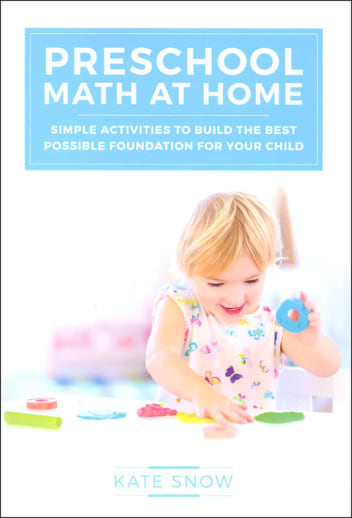
Preschool Math at Home

SKU
022375
ISBN
9781933339917
Grade PK
Neutral
High Teacher Involvement
Multi-Sensory
Other Materials Required
Sequential
Teaching Method
Traditional
Teacher-centered curriculum commonly used in classrooms that may include a text, teacher manual, tests, etc.
Charlotte Mason
A methodology based on the work of a 19th century educator who maintained that children learn best from literature (Living Books), not textbooks.
Classical
A methodology based on the Latin Trivium (three stages of learning), including the grammar stage (memorization and facts), logic stage (critical thinking), and rhetoric stage (developing/defending ideas).
Unit Study
A thematic or topical approach centered around one topic that integrates multiple subject areas.
Montessori (Discovery)
A methodology based on the work of a 20th century educator that emphasizes student and sensory-driven discovery learning and real-life applications.
Other
Other methodologies
Religious Content
Secular
Contains content contrary to common Christian beliefs (i.e. evolution).
Neutral
Avoids religious or theoretical topics or presents multiple viewpoints without preference.
Christian/Religious
Faith-based or including instructional religious content.
Learning Modality
Auditory
Learns through listening, talking out loud or reading out loud.
Visual
Learns through seeing, prefers written instructions and visual materials.
Kinesthetic/Tactile (Hands-On)
Learns through moving, doing and touching.
Multi-Sensory
Curriculum that employ a variety of activities/components.
Presentation
Sequential
Curriculum progresses through well-defined learning objectives. Emphasizes mastery before moving to the next topic.
Spiral
Topics and concepts are repeated from level to level, adding more depth at each pass and connecting with review.
Conceptual/Topical
Focus is on the “why,” often with a unifying concept as well as specific skills; coverage may be broader.
Teacher Involvement
Low Teacher Involvement
Student-led materials; parent acts as a facilitator.
Medium Teacher Involvement
A mix of teacher-led time and independent student work.
High Teacher Involvement
Teacher-led lessons; may utilize discussions, hands-on activities and working together.
Additional Materials Required
No other materials needed
Everything you need is included.
Other Materials Required
There are additional required resources that are a separate purchase.
Other Materials Optional
There are additional resources mentioned or recommended but are not absolutely necessary.
Consumable
Consumable
Designed to be written in; not reusable.
Non-Consumable
Not designed to be written in; reusable.
Our Price
$21.95 $21.95 $13.75
Rainbow Savings: $8.20

Description

Math understanding doesn't magically occur when a child begins their academic years kindergarten and up. Their brains are developing from the time they are born, and you, the parent, can do things to help with that development and lay the foundation as they approach kindergarten. Games my favorite way to teach young children! This 100-page, softcover book is full of games to help your young child develop an understanding of number concepts counting, comparing and ordering, recognizing written numerals, and beginning addition and subtraction. You may already be doing some of the activities found in this book, but this book lays out the content in a categorized fashion. There are seven chapters counting to five, counting to ten, numbers from zero to five, numbers from six to ten, written numerals from 0 to 10, comparing quantities and numbers, and addition and subtraction stories. This isn't a workbook, but a great resource for parents.

Typically, you will be able to use these activities with a child who is about 4, but you know your child best and can begin when you believe they are ready. The author suggests that you do the activities in this book in the order they are presented, take as much time as needed with each, and a questionnaire at the end of each chapter will help you determine whether your child is ready to move on. Children may progress at different rates, so be patient as you work with your child. Most importantly, have fun while incorporating these activities into your child's day. You don't want them to hate math before they even get going strong. The activities use items from around your home or are easily accessible. You may want to put together a math basket with the following items: 20 small counters, resource pages from the back of the book, one nickel and ten pennies, blank paper and a writing tool. Additional items that may be used occasionally are: ten small toys, four stuffed animals, small blanket, two small paper bags, two regular dice, tape, two different small objects for game tokens, two different-coloring writing utensils, toy cups, plates, spoons, and play food items, dot stickers, small food items, large index cards, and small stickers.

Use these simple activities to solidify your child's math foundation and only spend a few minutes a day doing so. Get them ready for kindergarten math and have fun in the process. ~ Donna

Category Description for Math with Confidence

Are you looking for a “Goldilocks math curriculum?" You know, the one that is not too hard, not too easy, but just right. Math with Confidence may pass the Goldilocks test for your child! Not only does it provide the right level of challenge for most children, but it also passes the Goldilocks test for parents with well defined goals, sequenced lessons, open-and-go scripted lessons, and easy-to-implement activities. The curriculum focuses on mastery with topical units and spiral review. Currently grades K-5 are available with Grade 6 expected in 2026.

Instructor Guides begin with introductory information and a helpful “how to use” section, which gives parents the tools to confidently teach math. Scripted lessons for the teacher and easy to implement activities that use household items, along with a few common math manipulatives, enable the Instructor Guide to equip parents to be successful. From kindergarten through 2nd grade, there are four teaching days and one optional enrichment or review day for a total of 32 weeks. Beginning in grade 3, the text is divided into 16 units with each unit containing 6-13 lessons for a total of 144 lessons. Each unit concludes with an optional enrichment lesson. Weekly lessons have the same format: Overview of the week, lesson notes, and materials list for activities. The amount of time spent on each lesson will vary depending on the grade level. Kindergarten lessons will take about 15-20 minutes, with fifth grade expecting 30-45 minutes per lesson. Teaching is interactive at all grade levels with independent workbook pages. Interactive activities and games are integral for grades K-4. Enrichment or review activities focus on games/activities or a suggested read aloud math book of the week.

Student Workbooks are colorful and consumable and provide independent daily work. Beginning with Grade 3, the Student Workbook is divided into 2 parts: Part A covers the first half of the year, and Part B the second half. This provides more schedule flexibility over grouping lessons by week. Each unit concludes with an optional enrichment activity and suggested math enrichment books to read together. Workbooks may be reproduced for your immediate family. Manipulative Kits are available for your convenience and provide commonly used items for the lessons.

Details
More Information
Product Format:Paperback
Grade:PK
Brand:Well-Trained Mind Press
Author:Kate Snow
ISBN:9781933339917
Length in Inches:9.75
Width in Inches:6.75
Height in Inches:0.25
Weight in Pounds:0.5
Videos
Reviews
Product Q&A