
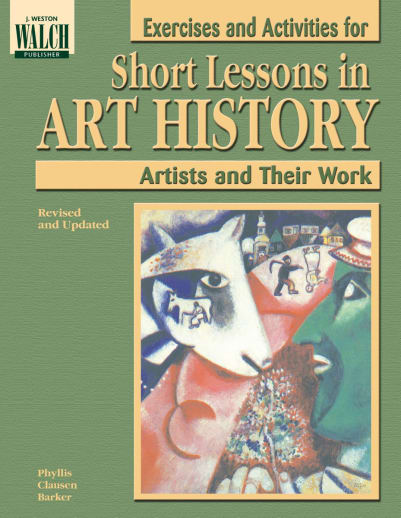

A novel way to engage art or art history students. The companion guide to Short Lessons in Art History: Artists and Their Work, this lively volume features separate chapters on 35 European and American masters, showcasing a variety of activities, questions, and projects concerning the artists and their work.
For Botticelli, for example, choose from multiple choice questions, short answer questions, a writing project, and an art project. For Raphael, figure out the anagrams related to his life. For El Greco, work on a word puzzle. For Winslow Homer, paint or draw the sea and sky. For Andrew Wyeth, solve a crossword puzzle. For Picasso, construct a collage. Included are an answer key and suggestions for additional projects.
For students who learn in different ways, this combination of traditional assessments and art-making projects opens the door to reinforcing knowledge and self-expression.
Short Lessons in Art History Exercises and Activities
SKU
020184
ISBN
9780825142468
Grade 6-12
These icons are designed to help you quickly understand and learn important information about our products.
Teaching Method
Traditional
Teacher-centered curriculum commonly used in classrooms that may include a text, teacher manual, tests, etc.
Charlotte Mason
A methodology based on the work of a 19th century educator who maintained that children learn best from literature (Living Books), not textbooks.
Classical
A methodology based on the Latin Trivium (three stages of learning), including the grammar stage (memorization and facts), logic stage (critical thinking), and rhetoric stage (developing/defending ideas).
Unit Study
A thematic or topical approach centered around one topic that integrates multiple subject areas.
Montessori (Discovery)
A methodology based on the work of a 20th century educator that emphasizes student and sensory-driven discovery learning and real-life applications.
Other
Other methodologies
Religious Content
Secular
Contains content contrary to common Christian beliefs (i.e. evolution).
Neutral
Avoids religious or theoretical topics or presents multiple viewpoints without preference.
Christian/Religious
Faith-based or including instructional religious content.
Learning Modality
Auditory
Learns through listening, talking out loud or reading out loud.
Visual
Learns through seeing, prefers written instructions and visual materials.
Kinesthetic/Tactile (Hands-On)
Learns through moving, doing and touching.
Multi-Sensory
Curriculum that employ a variety of activities/components.
Presentation
Sequential
Curriculum progresses through well-defined learning objectives. Emphasizes mastery before moving to the next topic.
Spiral
Topics and concepts are repeated from level to level, adding more depth at each pass and connecting with review.
Conceptual/Topical
Focus is on the “why,” often with a unifying concept as well as specific skills; coverage may be broader.
Teacher Involvement
Low Teacher Involvement
Student-led materials; parent acts as a facilitator.
Medium Teacher Involvement
A mix of teacher-led time and independent student work.
High Teacher Involvement
Teacher-led lessons; may utilize discussions, hands-on activities and working together.
Additional Materials Required
No other materials needed
Everything you need is included.
Other Materials Required
There are additional required resources that are a separate purchase.
Other Materials Optional
There are additional resources mentioned or recommended but are not absolutely necessary.
Consumable
Consumable
Designed to be written in; not reusable.
Non-Consumable
Not designed to be written in; reusable.
Our Price
$36.00 $36.00 $30.50
Rainbow Savings: $5.50
Description
Publisher's Description of Short Lessons in Art History Exercises and Activities
Category Description for Short Lessons in Art History: 35 Artists and Their Work
Starting in the 14th century with the Italian Renaissance, this book proceeds chronologically along geographic lines, tracing the major art movements of their times. Just a sampling of artists included: Leonardo da Vinci, Michelangelo, Raphael, Dürer, Rubens, Rembrandt, Goya, Manet, Monet, Renoir, Matisse, Wyeth. Each chapter begins with general background information, followed by 2-4 pages of biography on each artist. Typeset is fairly small, so these are substantial overviews of their lives and works. Several black and white reproductions of their artwork are contained within. At the end of each biography are a few questions for discussion and a glossary to help with pronunciation or understanding. Color plates with 22 reproductions of paintings from the various artists are bound into the center of the book. As with most art history appreciation courses at this level, some illustrations have suggested nudity. Examples include, Eleven 11 A.M. by Edward Hopper (1926), Saint Martin and the Beggar ) (1597-1599), and Christ Cleaning the Temple (1570) by El Greco. If desired, pair this with the correlated Exercises and Activities book to extend your study into art! This reproducible book contains exercises and activities paralleling the study of each artist in Short Lessons. Each contains simple comprehension questions in the form of word puzzles, crosswords, matching, or fill in the blanks. Other questions require more careful thought on the part of the student, as they are asked to define terms, contrast artists' styles, etc. Longer "Writing Questions" call for independent writing or research. The student might be asked to construct a time line of the artists' major works, or describe how certain events influenced an artists' work. Answers to these questions and exercises are included. Finally, each section has a student project correlated to the artist under study. From sketching a scene Giotto might have drawn as a boy to constructing a Calder-inspired mobile, students create various art forms in the style of the artists under study, adding their own special touches as well. The components together would constitute a very complete art course.
Details
| Product Format: | Softcover Book |
|---|---|
| Grades: | 6-12 |
| Brand: | Walch Education |
| Author: | Phyllis Clausen Barker |
| ISBN: | 9780825142468 |
| EAN/UPC: | 700507016688 |
| Length in Inches: | 10.75 |
| Width in Inches: | 8.5 |
| Height in Inches: | 0.25 |
| Weight in Pounds: | 0.75 |
| Edition: | Teacher's Guide; Revised; Illustrated |
| Pages: | 133 |
| Publication Date: | 1/2/2013 |
Videos
Reviews