
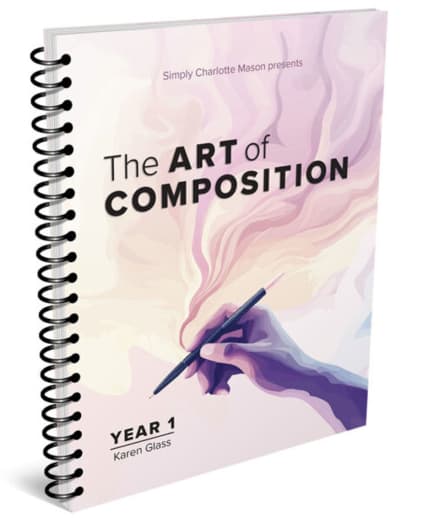

The Art of Composition Year 1 uses excerpts from other writers (famous, historical, poets, and more) to guide students through the composing process. Your student will examine and engage with these well-written samples. Over the course of 3 modules, you’ll be guiding your student through editing and writing introductions and conclusions. This one text provides composition guidance for both teacher and student. If your student has not yet written essays, no worries. Your student will start by writing narrations for other courses (approximately 4 per week suggested). Then, they’ll select one of these weekly to complete their composition assignment in each weekly lesson. The course is divided into 3 modules, each ending with an exam. Module 1 closely instructs students in editing their own writing while examining sentence structure, fragments, punctuation, and tone. Then, for the Module 1 exam, your student will edit one of their own uncorrected narrations. Module 2 teaches reverse outlining (taking a written selection, outlining it, and then, eventually, building their own narration from that outline). This module’s exam asks students to create a detailed outline from a school assignment. Module 3 guides your student in writing effective introductions, transitions, and conclusions. This module’s exam will ask the student to rewrite one of their own narrations, adding an introduction and conclusion. The end of the book includes a consumable Spelling Journal (where students will record misspelled words from their compositions) and a Grammar Journal (to record grammar points that help them personally with capitalization and punctuation). You’ll also find a Commonplace Book space, where students record and respond to quotations they’ve selected from their readings. Permission is granted to copy for immediate household use. Spiralbound softcover, consumable,180 pages. ~ Ruth
Simply Charlotte Mason Art of Composition Year 1
Product Overview
- Three units, each with a unique skill focus
- A one-text (student and teacher) approach
- Requires regular writing of narrations from other courses
- Emphasizes regular writing analysis and student revisions
Description
Your high school student is already fluent in written narration. Now your student’s writing skills are ready to be honed with The Art of Composition.
Karen Glass invites your high school student to develop skill in the art of excellent writing with The Art of Composition. This Charlotte Mason composition course guides your high school student to find and develop his own writing voice and become a person who communicates well with the written word. Your student will work independently, refining and rewriting written narrations from other school subjects.
Great writing is an art. This four-year course’s once-a-week, 30-minute lessons will guide your student to learn this art of communicating well with the written word. By the end of the course, your student will have a firm grasp of how to write with excellence, and be prepared for writing assignments in college level courses.
In Year 1, your student will explore
- the editing process;
- structure and outlining;
- introductions, conclusions, and transitions.
This consumable student-led workbook guides your student through three modules of 12 lessons each. An exam is included for each module, giving the student a chance to demonstrate the writing skills he has mastered.
Help students bridge seamlessly to traditional high school composition assignments! Simply Charlotte Mason’s The Art of Composition is a teacher- and student-involved, step-by-step course. Over the 4 years of this program, students will transition from writing narrations to writing essays, researching, and completing creative writing assignments, and eventually will be ready for college-prep assignments. As a prerequisite, students should be comfortable writing narrations (or what Charlotte Mason called “oral compositions”). This composition course requires that students write 4-5 narrations weekly, which will be taken from their reading assignments in their other courses (such as history, language arts, etc.). These narrations will serve as the “rough drafts” of their weekly composition assignments.
Each text assigns one weekly 30-minute lesson. However, don’t let this time limit fool you. These weekly lessons aren’t the only tasks in the course—or the only composing. Each lesson provides an excerpt of a skilled author’s work: perhaps a newspaper article or a Reader’s Digest article, a passage of fiction, or even a sample student narration. Weekly, students will select one of their own narrations (from their other courses), practice applying that week’s writing instruction in their narration, and then follow their text as directed. Periodically, the text will give the student an additional Creative Narration assignment that will include thought-provoking questions to answer. Students will also record interesting quotations from their reading and write their responses in their own “Commonplace book” (space provided in the back of the text).
Consistent with the Charlotte Mason method, regular
student/teacher interaction and discussion is expected. Each week’s assignment
guides the student step by step. Teacher directions are often placed first,
followed by the student directions. These sections are clearly identified.
Sometimes, the teacher and student are addressed simultaneously. Each yearlong
course is divided into 3 modules, each with a unique focus. Each module ends
with a written exam. As the teacher, you’ll be grading these exams and writing
assignments based on provided checklists.
Eventually, this curriculum will span 4 full years (36 weeks per level). Each year builds upon the previous. Throughout the 4 years, you’ll see specific skills emphasized within each level; previously taught skills will still be developed. Year 1 skills start with focusing on editing and creating strong sentences. Then students learn “reverse outlining” to study how selected authors have organized their content. Finally, this course ends with writing introductions, conclusions, and transitions. The first unit of Year 2 begins with editing, with a focus on strong word choice. Then, students learn to write essays from outlines and compose three essays. Essay types are primarily narrative and descriptive. The third unit emphasizes writing to an audience and developing a point of view and an individual writing style. Year 3 teaches research writing, including thesis development and how to cite sources. In unit 2, students practice advanced editing skills. The final unit helps students analyze and write creatively, exploring tragedy/comedy, point of view, poetry, and even fan fiction. Year 4 (coming in 2026) reviews concepts taught in the previous 3 levels. Then, students will be guided in persuasive writing, and the course ends with a 12-week senior writing project. After completing these 4 courses, students will be prepared for college-level composition. For details on each level, see individual course descriptions. ~ Ruth
| Product Format: | Paperback Book |
|---|---|
| Grades: | 9-12 |
| Brand: | Simply Charlotte Mason |
| ISBN: | 9781616346997 |
| Length in Inches: | 11.125 |
| Width in Inches: | 9 |
| Height in Inches: | 0.75 |
| Weight in Pounds: | 1.2 |